A festival organizer offers you a three-day spot. Twenty thousand people expected, $1,500 vendor fee, eighteen food trucks on the lineup. Do you take it?
Most Vendors Answer That Question With A Feeling, Not A Number
Here is the direct answer: a food truck event is worth booking when your own sales math says yes, not when the attendance number sounds big or an app hands you a score. Twenty thousand people tells you nothing on its own. How many of them will be near your truck during service hours? How many are there to eat, versus wander an art fair after grabbing lunch somewhere else? And how many other trucks sell something close to your menu? None of that lives in the headline attendance figure, and none of it lives in a generic app created opportunity score either.
In all the time I have been doing this I have watched owners take an event because the number looked good. They drove home wondering where the crowd went. I have also watched sharp operators turn down a “can’t miss” festival because they ran their own numbers first, and the math said no. The difference is never luck. It was whether they evaluated the event or just reacted to it.
That is what this post is for. Not another app under construction, not another list of booking platforms or “review” sites. A real process for deciding, with your own numbers, whether a food truck event is worth your fee.
Key Takeaways
| Attendance figures from organizers are marketing numbers, not sales forecasts, and they are frequently inflated well beyond what the same organizer tells the city on a permit application. A big crowd does not equal a profitable event. Menu overlap, placement, and your truck’s own production speed matter more than the headline number. Every event decision should run through two numbers before you say yes: your breakeven sales figure and your maximum service capacity for the hours you will actually be open. Booking apps and event platforms are useful for finding opportunities. They are not built to tell you if an opportunity fits your specific truck. Vetting an event takes minutes with a calculator. Skipping that step costs you a full weekend of food, fuel, and payroll. |
Why Owners Keep Getting Burned By The Same Mistake
New owners are the most vulnerable here. You are excited. Somebody hands you a flyer with a big round number on it, twenty thousand, fifty thousand. Your brain does the math before you ever open a spreadsheet. Big crowd, big sales, right?
I know owners who spent $150 in propane and $1000’s in food prep, drove four hours to a “can’t miss” street fair, and sold $340 worth of food across an eight-hour shift. The event genuinely had thousands of people walking through. Almost none of them were hungry when they passed the truck. The fair ran from 10 a.m. to 8 p.m. Most foot traffic showed up after dinner to browse craft booths and relax, not to eat as they walked. The attendance was right, the opportunity was not.
Experienced operators fall into a quieter version of the same trap. You had a great year at an event in 2024, so you book it again for 2026 without checking what changed. Maybe the organizer doubled the vendor count. Maybe a food festival now runs the same weekend across town. Or maybe the parking lot that used to hold five hundred cars is under being paved and the event is running shuttles with little instruction. The event’s name stayed the same. Everything else moved. I have experienced all of this.
This is not an argument against events. Events are a real part of a healthy food truck calendar, and plenty of them are worth every dollar of the fee. The problem is deciding with a gut feeling instead of a number, and then acting surprised when the gut feeling was wrong.
What The Numbers Actually Say About Event Attendance
Event attendance figures get stretched. We all THINK that here’s the proof. A 2024 analysis of Chicago permit data found that festival organizers routinely tell the city one number and advertise a much larger one to vendors. Taste of Randolph’s official permit listed 9,000 expected attendees, while the same event’s marketing materials promised food vendors a crowd of 100,000. Windy City Hot Dog Fest’s permit said 1,500 people. Its promotional materials said 40,000. One event operations director put it plainly: the marketing figures come from someone trying to make an event sound bigger. They do not come from anyone measuring who will actually show up.
It is not “lying” any more than you saying your BBQ is “world famous” or that all vendors always report 100% of cash sales. What you have to do is parse the truth and assess odds of success.
You can see the same pattern in a single festival’s first year. Tucson’s inaugural Palo Verde Bloom Festival told food vendors to expect one thousand to five thousand attendees. Several vendors later reported fewer than a dozen sales for the entire day, with one operator estimating total revenue under $100. The organizer later cited weather and competing events, which happens, but none of that changes what the vendors lost that day. BUT vendors could have spent a minute researching those “competing events” to protect their own business.
Booking platforms and apps have real value for finding opportunities, and I recommend a couple to NSFVA members. But talk to owners who actually use them daily and you get a more grounded picture than any app store review. One operator running booking services through the slow season told a food truck trade publication he spends $500 to $1,000 a month on platform fees. He calls it “like rent,” because the busy spots the platform lands him are worth the cost. Another owner in Los Angeles stopped using booking services altogether because, in his words, the return no longer justified the cost. Same tools, same industry, two completely different outcomes. The tools were never the thing making the decision. The owner’s own numbers were.
The tools can surface an event, but only the operator’s own math can tell you if it fits your truck.
The Two-Number Test
Here is the framework I teach every NSFVA member before they book anything: run every event through two numbers before you sign a contract. It takes like two minutes using numbers you should ALREADY know.
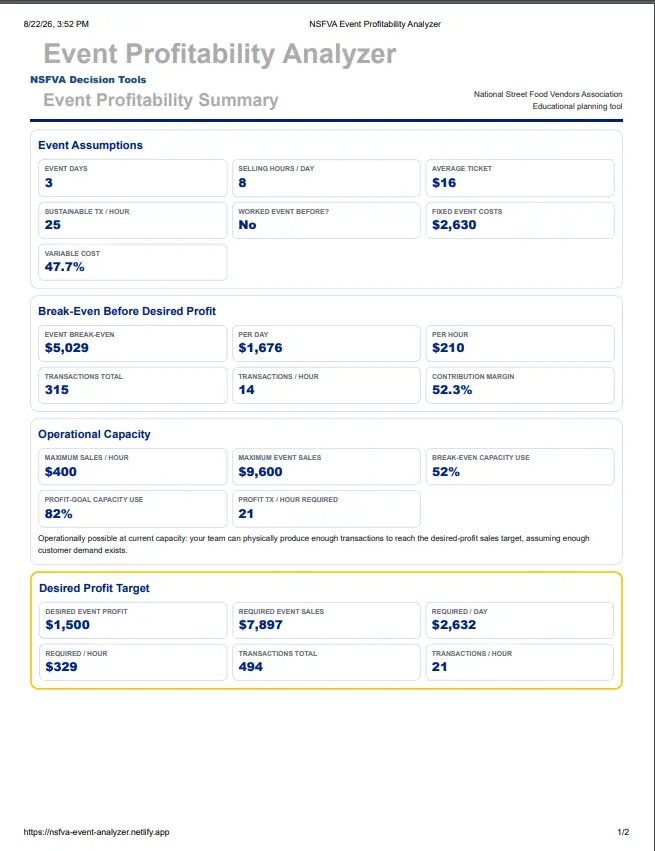
Number one is your breakeven. Add up every real cost tied to the event plus your normal fixed costs. Food and packaging at your true food cost. Hourly labor plus payroll taxes. The vendor fee itself. Travel, fuel, and lodging if you need it. Add your own pay as the owner too, because owner pay is a real cost, not a leftover. That total is your breakeven number, and you need to clear it in sales just to walk away even.
Number two is your capacity. This is the number most owners skip entirely. How many orders can your truck physically turn out during the actual service hours of this event, at your realistic ticket average? A two-person truck running a scratch-cooked menu might max out at 15 transactions an hour. Over a six-hour service window, that is 90 transactions. At a $14 average ticket, your hard capacity ceiling is $1,260, no matter how many thousands of people are on the grounds.
The event is only worth booking when your capacity number sits comfortably above your breakeven number, with room left for a slow day. If breakeven is $1,000 and your ceiling is $1,260, you are one slow hour away from a loss. It doesn’t matter how impressive the attendance figure looked on the flyer. A festival that reports twenty thousand attendees cannot rescue a truck whose own equipment and staffing can only produce twelve hundred dollars. That problem is not the organizers fault no matter how over stated the numbers are.
Putting The Two-Number Test To Work
Let’s run the numbers on the example from the top of this post: three days, $1,500 fee, eighteen food trucks, 20,000 expected attendees.
Start with breakeven. Say your food cost runs 27 percent. Your two crew members earn $18 an hour across the weekend, and you’re driving three hours each way while paying yourself $200 a day as the owner. Add the $1,500 fee, roughly $650 in food and packaging, $950 in labor and payroll tax, $300 in fuel, and $600 in owner pay. That is a $4,000 breakeven before you sell a bite of food.
Now capacity. Service hours are 11 a.m. to 9 p.m. each day, ten hours, but realistically you are running at full speed for maybe six of those. At a solid pace of 20 transactions an hour and a $12 average ticket, that is $240 an hour, or $1,440 a day. Across three days, that’s $4,320.
That truck clears breakeven, but just barely, with a couple hundred dollars of profit over an entire weekend of work. Now factor in eighteen trucks competing for the same crowd, several of them likely selling something close to your menu. That thin margin gets thinner fast. This is the event where the Two-Number Test earns its keep. The attendance figure said “can’t miss.” The math said “thin, and only if everything goes right.” Those are two very different answers, and only one of them is useful for making a decision.
Practical Steps For Vetting Your Next Event
- Calculate your breakeven before you ever open the application. Food cost, labor, the fee, travel, and owner pay, added together into one hard number. Do this once and save it as a template so future events take seconds not hours.
- Calculate your realistic capacity for the actual service hours, not the event’s full open hours. Look at your last three similar events and use your real transactions-per-hour number, not the number you hope for on a perfect day.
- Ask the organizer where their attendance figure comes from. Tickets, last year’s headcount, or a marketing guess are three very different levels of confidence. A straight answer tells you a lot about how the rest of the event will be run.
- Ask for the current vendor count and food category breakdown, not just the total number. Eighteen vendors selling eighteen different cuisines is a different event than eighteen vendors and six of them selling tacos.
- Check the event’s own history if it has one. Search the organizer’s name along with the words “vendors” or “food trucks” and see what past participants said, good and bad.
- Compare capacity to breakeven with a buffer, not a tie. If the two numbers are nearly equal, one slow hour turns your weekend into a loss. Look for real daylight between them before you commit.
- Put your decision in writing before you sign. A short note to yourself with both numbers and the date protects you from talking yourself back into a bad event later, once the excitement creeps back in.
Frequently Asked Questions
Should I trust the attendance numbers an event organizer gives me?
Treat them as a starting point, not a fact. Ask whether the figure comes from ticket sales, past headcounts, or marketing estimates. Then compare it to what the event tells its city or county on permit paperwork, if that information is public.
What if I don’t have enough history to calculate my realistic capacity?
Track your transactions per hour at your next few events, even small ones, and build the number from real data instead of a guess. Three or four data points give you a usable average faster than most owners expect.
Are food truck booking apps worth paying for?
They can be, for finding opportunities you would not otherwise see. But they are not built to tell you whether a specific event fits your specific truck. Treat the listing as a lead, then run your own breakeven and capacity math before you commit.
How much buffer should I look for between breakeven and capacity?
There is no universal number, but many experienced operators aim for capacity to sit at least 25 to 30 percent above breakeven before calling an event a strong yes. Thinner margins can still make sense for brand exposure or a first-year relationship with a promising organizer, as long as you go in with your eyes open.
What should I do if an event’s numbers looked good but the result was bad anyway?
Write down what actually happened: attendance, placement, competing vendors, and weather. That record makes your next Two-Number Test sharper and helps you separate a genuinely bad event from one bad day at a good event.
Run Your Numbers Before You Run Your Truck
That flyer with the big round number on it will always be exciting. Twenty thousand people, fifty thousand people, a “can’t miss” weekend. None of that excitement pays your fuel bill or covers payroll if the math underneath it does not hold up.
You did not get into this business to guess. You got into it to build something that outlasts the excitement of opening day. That means treating every event the way you treat every other business decision: with real numbers, checked before you commit, not after. Run the Two-Number Test on your next event before you sign anything.
Your breakeven and your capacity will tell you the truth an attendance figure never will.
Keep Learning
- What Should a Food Truck Weather Cancellation Policy Say? Another event-day risk worth locking down in writing before you sign a vendor contract.
- Should You Trust an AI Tool You Didn’t Build? The same skepticism that applies to an event’s opportunity score applies to any AI-driven recommendation you didn’t build or verify yourself.
- What Bookkeeping Basics Does Every Food Truck Owner Need? The recordkeeping habits that make your breakeven number fast and accurate instead of a guess.
- Lease, Buy, or Loan? Food Truck Equipment Financing Guide Another decision where the right call comes from running your own numbers instead of trusting the pitch.