The three ways to pay for a flat top, fryer, or trailer build-out and why most owners pick the wrong one under pressure
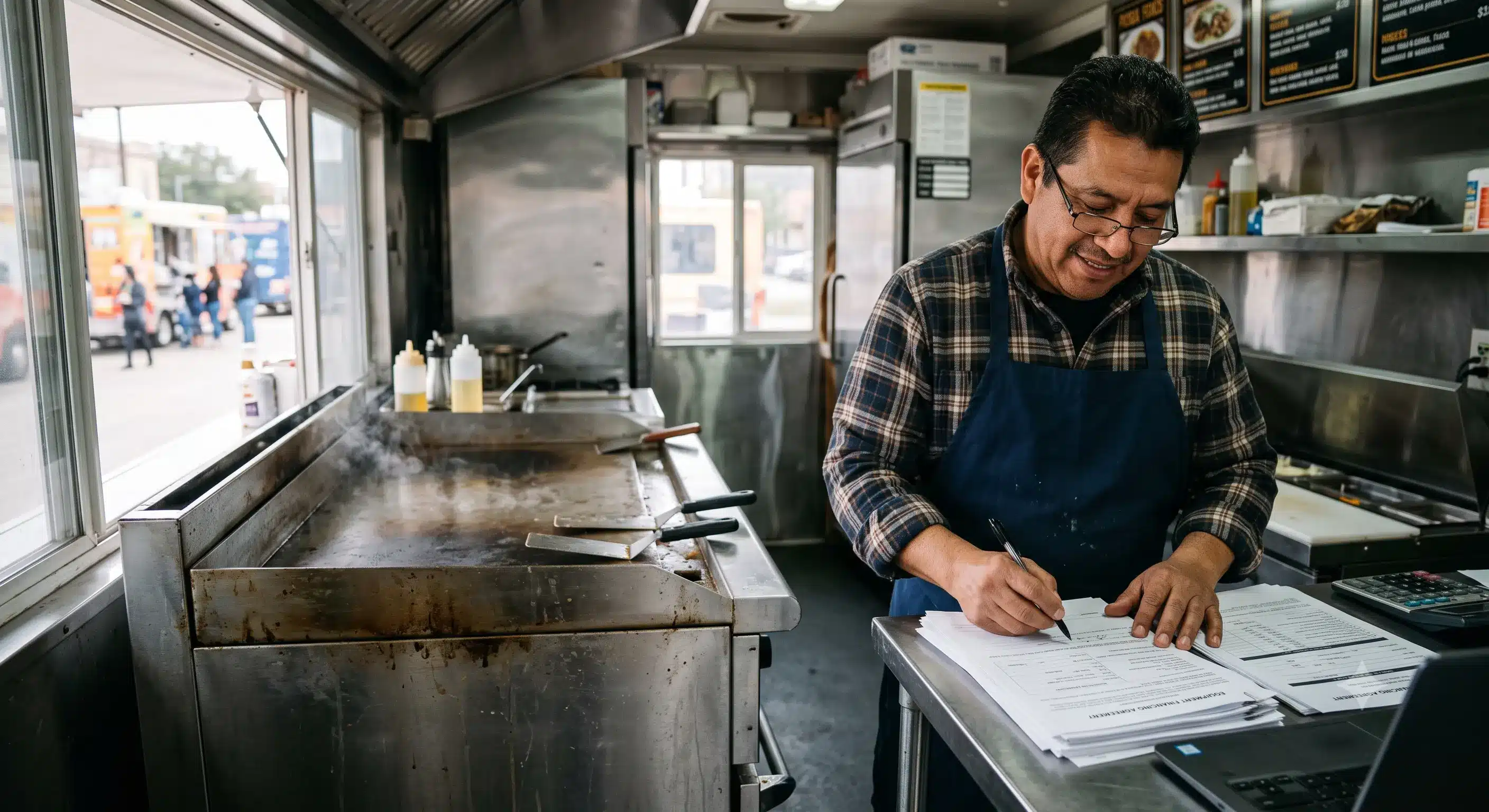
I got a call from a guy whose flat top died on a Friday night, mid-rush. He panicked, signed the first food truck equipment financing lease the salesman put in front of him. He also didn’t look at the number again until the first payment hit. That payment was eating almost nine percent of his weekly sales. Not nine percent of profit, nine percent of gross revenue, gone, before he bought a single onion.
That’s not a financing decision. That’s a financing mistake. I see it over and over, when equipment fails, you’re not thinking clearly. You’re thinking about tonight’s service.
So here’s the direct answer: there is no single “best” way to finance food truck equipment. Paying cash, taking a loan, and leasing are three different tools. Each with a different cost and a different effect on your capacity to operate. The right choice depends on how long you’ll actually use the equipment. How much cash cushion you have left after the purchase and whether the payment is small enough for your breakeven to absorb it as a planned cost.
The rest of this article walks through all three options. What they actually cost in today’s market, and the math you need to run before you sign anything.
Key Takeaways
- Paying cash saves you interest, but it can drain the operating cushion you need to survive a slow month or a second equipment failure.
- Equipment loans build equity and, for well-qualified borrowers, currently run roughly 6% to 15% APR through banks and SBA-backed lenders.
- Leasing makes sense for equipment that ages out fast, like POS hardware — not for a flat top you’ll run for a decade.
- Whatever you choose, the payment is a planned cost. It belongs in your contribution-margin breakeven math, right next to food cost and labor cost.
- Get at least two quotes, compare APR (not the monthly payment), and talk to your accountant before you sign.
Why Do Food Truck Owners Get Equipment Financing Wrong?
Financing equipment isn’t one decision. It’s three, and most owners only ever consider one of them: whichever option the salesman mentions first.
Most owners pick based on the smallest number they see that week. The lowest down payment, lowest monthly payment instead of the total cost and what that payment does to their breakeven. I’ve watched this play out at events, in coaching calls, and in the FTT Facebook group more times than I can count. An owner is proud of a low monthly payment, and three months later they’re telling me they can’t figure out why they’re not making money even though sales are decent.
That’s the cook mindset showing up in a business decision. A cook thinks, “Can I afford this payment right now?” An operator thinks, “What does this payment do to my profitibility for the next three to five years, and does the equipment earn back more than it costs me?” Those are two completely different questions, and they usually get two completely different answers. If you’ve been running your truck for a while and still find yourself surprised by a payment every month, that’s not a math problem. It’s a planning gap, and it’s fixable.
What Do Equipment Financing Options Actually Cost Right Now?
Let’s break down the three real options.
Option one: pay cash. No interest, no payment, you own it outright day one. That sounds like the obvious winner, except now that cash isn’t in your account for the slow month in February, or the fryer that also happens to go down two weeks later, or payroll you still owe when a Tuesday event gets rained out. Paying cash for a six or eight thousand dollar piece of equipment can feel responsible and still be the wrong move if it drains your operating cushion below what you need to survive a bad month. Cash is a capacity too.
It has the capacity to absorb a surprise.
Option two: an equipment loan. (loans are NOT automatically a bad thing as too many folks think) You borrow against the equipment, the equipment is your collateral, and you own it once it’s paid off. Average equipment financing rates in 2026 run roughly 6% to 15% APR for qualified borrowers using traditional bank or SBA-backed financing, with terms typically running two to seven years depending on the lender and the equipment. If your credit or your time in business isn’t there yet, alternative and online lenders will still say yes, but that convenience and speed is priced into higher rates, often 14% to 35% APR. That’s the trade off: banks and SBA backed lenders are cheaper and slower, alternative lenders are faster and more expensive. Either way, a loan builds equity. That matters for your balance sheet, and it matters if you ever sell the truck.
Option three: leasing. Lower upfront cost, sometimes no down payment, and you’re not tying up capital. But you’re renting the use of the equipment, not building equity in it, and over the life of the lease you’ll typically pay more than you would financing the same piece with a loan. Leasing makes sense in one specific situation: equipment that changes fast or that you genuinely expect to upgrade in a few years. Think POS hardware, not a flat top. A flat top griddle you’ll run for a decade if you take care of it. A five-year-old POS terminal is obsolete. We updated POS systems at every chain I worked frequently. Match the financing structure to how long the equipment will actually be useful to you. That’s the real test, not which option has the lower monthly number.
One more piece worth knowing: current tax rules let many businesses write off qualifying equipment in the year it’s placed in service instead of depreciating it over several years, through what’s called a Section 179 deduction. For 2026, that deduction applies to purchases up to $2,560,000, with the benefit phasing out above roughly $4,090,000 in total equipment spending for the year. Most food truck owners will never get close to that ceiling, but it means a fryer or flat top you finance this year could reduce your tax bill this year too, not five years from now. Talk to your accountant about whether and how much of your purchase qualifies. Rates, terms, and tax treatment change, and they’re specific to your credit, your state, and your situation. Don’t take a number from an article, a podcast, or an AI tool as gospel for your specific deal.
The Reframe: Your Payment Is a Planned Cost, Not a Hope
Here’s the piece nobody walks through: whatever option you pick, that payment is a planned cost, same as your food cost and your labor cost. It goes into your breakeven math, not off to the side as some vague future obligation.
If a new fryer costs you three hundred dollars a month, you don’t just hope you’ll cover it. You calculate how many additional guests you need to cover that three hundred dollars, every single month, before it touches your profit or your own pay. If you can’t answer “how many extra plates does this fryer need to sell every month to pay for itself,” you don’t actually know if you can afford it. You just know you can afford the payment this week.
This is the same think I teach on food cost and labor cost: a number only means something once you know what it costs you to keep the lights on and the truck rolling. Equipment financing is no different. It’s a fixed cost with a name and a due date, and it belongs in the same spreadsheet as everything else that has to get covered before you pay yourself.
How Should You Actually Run the Numbers Before You Sign?
This is where the theory turns into a decision you can defend. When I coach owners through an equipment purchase, we don’t start with the monthly payment. We start with the breakeven point. You just changed it.
Breakeven is what it takes to pay all the fixed costs AND the variable costs it takes to produce that level of sales. Your pay is in this number, too. Once you know that number per guest, a financing decision stops being a guess. A new $300-a-month payment against a $15 average guest spend means you need 20 MORE guests each and every month just to break even on the equipment. Is that realistic for your truck, your locations, and your current marketing? If yes, the equipment earns its keep. If you’re not sure, that’s an answer too, you’re not ready to sign yet.
I’ve sat across from owners who financed a second fryer because “it’ll help us keep up,” without ever running that math. Six months later they’re carrying a payment with no clear line back to the sales it was supposed to generate. The equipment wasn’t the problem. Skipping the math was.
What Steps Should You Take Before Financing Equipment?
- Pull your last three months of sales and calculate your actual average spend per guest. If you don’t already track this, start here before you do anything else.
- Take the monthly payment you’re being quoted and divide it by that guest spend number. That tells you exactly how many more guests you need per month that this piece of equipment has to help serve just to break even on itself, not to make profit, just to not lose you money.
- Get at least two financing quotes before you sign anything. One from your bank or an SBA-backed lender, one from an equipment specific lender. Compare the APR, not the monthly payment, because a lower payment stretched over a longer term can cost you more total dollars.
- Talk to your accountant before you sign. Equipment purchases can sometimes be written off faster than you’d expect under current tax rules, and that changes the real cost of buying versus leasing. I’m not a tax professional and I’m not your accountant. Verify the actual numbers with your own lender and your own accountant before you commit to anything.
- Check your cash cushion after the purchase, not before. If paying cash or making a large down payment leaves you without enough to cover a slow month or a second breakdown, that’s a signal to finance more conservatively even if you technically “can afford” the outright purchase.
- Match the term to the equipment’s real useful life. Don’t lease something you’ll run for ten years, and don’t take a seven-year loan on something you’ll want to replace in three.
- Write the payment into your monthly breakeven, permanently, before the equipment arrives. Not as a mental note. In the same spreadsheet from this MasterClass.
Frequently Asked Questions
Is it better to lease or buy food truck equipment? It depends on the equipment’s useful life. Buying or financing with a loan makes sense for equipment you’ll run for many years, like a flat top or fryer, because leasing typically costs more over time. Leasing fits equipment that changes fast, like POS hardware, where you’ll want to upgrade in a few years anyway.
What credit score do I need for an equipment loan? Lenders weigh credit score alongside time in business, revenue, and collateral. Stronger profiles unlock lower rates from banks and SBA-backed lenders. If your credit or time in business isn’t there yet, alternative lenders will often still approve you, but typically at a meaningfully higher rate.
How do I know if I can afford a new piece of equipment? Divide the monthly payment by your average guest spend. That tells you how many new guests you need each month just to cover the payment. If you can’t hit that number reliably, you can’t afford it yet, even if the payment looks small.
Should I pay cash for equipment if I have the money? Not automatically. Paying cash saves interest, but it also removes that cash from your cushion for slow months or a second breakdown. Weigh the interest cost against the risk of running with less operating capital before deciding.
Does financing equipment help at tax time? Often, yes. Many qualifying equipment purchases can be deducted in the year they’re placed in service rather than depreciated over several years, which can lower your tax bill sooner. Rules and limits change, so confirm your specific situation with your accountant before you buy.
The Bottom Line
Equipment is going to fail. That’s not an if, that’s a when. The owners who get hurt aren’t the ones who need to finance a piece of equipment — that’s normal. It’s the ones who sign under pressure, on the salesman’s timeline, without running the number back through their own breakeven.
Slow down, run the math, and make the equipment earn its keep instead of just hoping it does.