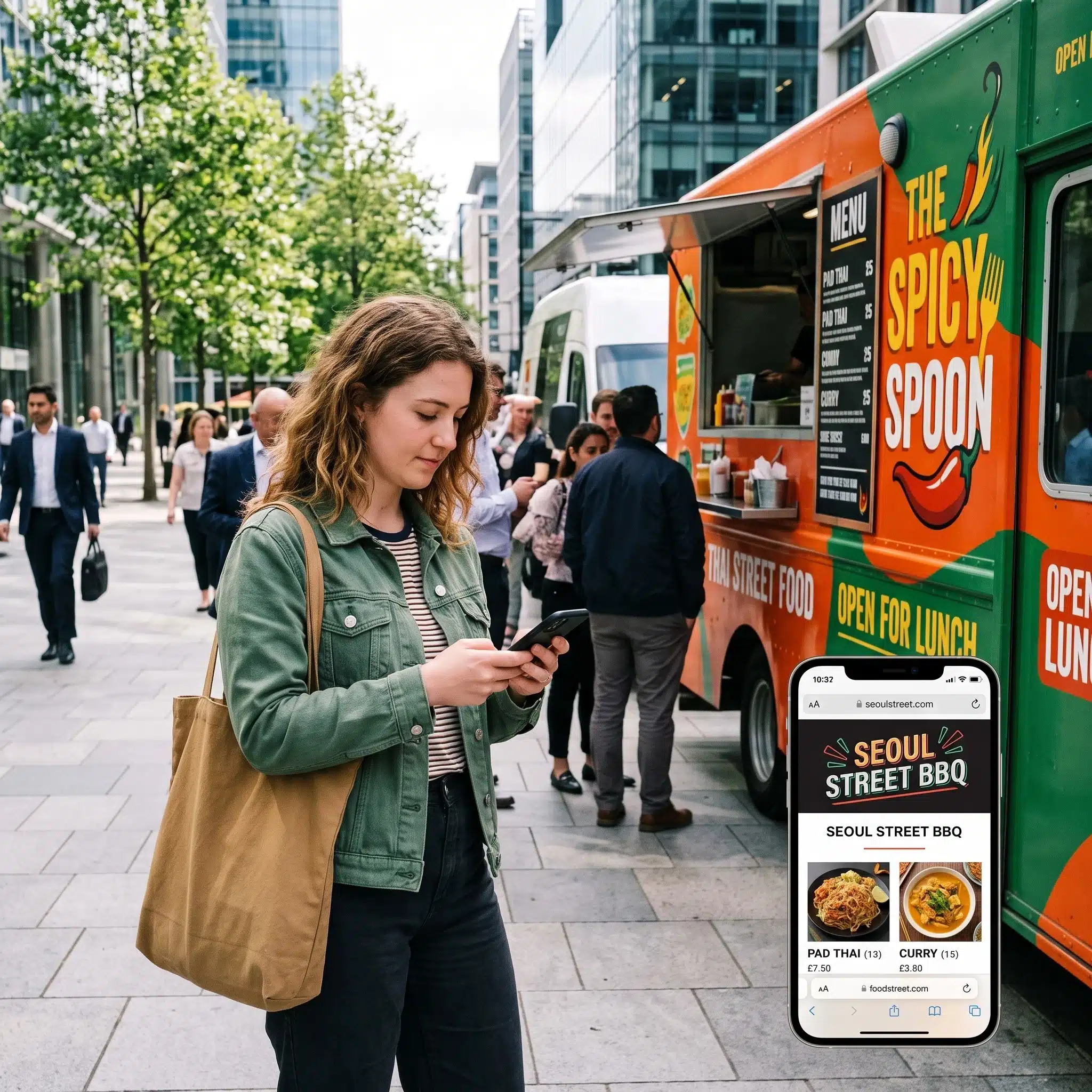
Most lost sales never show up in your line count. They happen on a phone three blocks away, when someone can’t figure out where you are or what you serve.
Why Would a Hungry Customer Skip Your Food Truck?
Imagine a Tuesday lunch. You’re parked at the office park you’ve worked for years. Your food is dialed in, the window is open, and the line is shorter than it should be.
Three buildings over, somebody types your truck’s name into Google. The listing still shows last spring’s Saturday market hours. Your Facebook page says you’re at a brewery that closed in August. Your menu photo shows a $9 plate that now costs $13. So they shrug, open a delivery app, and order a sandwich from a chain.
You never saw that person. You’ll never know they existed. But you still lost the sale.
That’s the short answer to the question in the title. Yes, your food truck online presence is almost certainly costing you customers before they ever reach the window. The problem isn’t your food or your prices. It’s friction: missing, stale, or conflicting information that makes it easier to choose someone else.
A recent QSR Magazine article by Aman Devgan, president of the online ordering company Menufy, called this the “invisible walkout.” Restaurants deal with it every day. Food trucks deal with a tougher version, because our address changes constantly.
Your online information is part of your service. If a guest can’t answer four basic questions in 30 seconds or less on their cell phone, you’ve lost them.
Key Takeaways
- Menufy’s 2026 consumer survey found 59% of people have skipped ordering from a restaurant because they couldn’t find basic information online.
- Food trucks face a bigger version of this problem because location and hours change all the time.
- Customers want fresh reviews, and 74% look for reviews written in the last three months.
- The Four Question Test: where are you, when are you open, what do you sell, and how much does it cost.
- Keeping your online information current is an operating task, like restocking the truck, not a marketing hobby.
Why Is Online Presence Harder for a Food Truck Than a Restaurant?
Way back went I started in this industry marketing meant parking in the same spot every day until people learned your schedule. Regulars found you because you were predictable.
That still works. What changed is that new customers check their phone first, and they check it before they go anywhere.
Keeping a food truck online presence accurate is difficult. A restaurant might update store hours four times a year. A food truck owner might change locations five times in one week. Every move creates a new chance for your Google listing, Facebook page, Instagram bio, website, and food truck finder apps to disagree with each other. When they disagree, the customer doesn’t call to ask. They just eat somewhere they trust to be right.
The truck posts its weekly schedule on Monday. Wednesday’s event gets rained out. The owner posts a quick Instagram story and forgets Facebook. Google still shows the truck as open. Meanwhile, the owner sits at home frustrated about slow sales and blames the economy.
Many owners treat online updates as something to handle after the shift. After a 14-hour day of prep, service, breakdown, and cleaning, nobody updates four platforms. So the correct information decays one missed post at a time.
You didn’t buy a truck to become a social media manager. But skipping this work doesn’t save you time. It costs you guests you never get to meet.
What Does the Research Say About Customers Who Can’t Find You Online?
The QSR article draws on survey data from Menufy. Menufy’s 2026 consumer survey was conducted by Dynata in April 2026 with 1,000 U.S. adults. Fair warning: Menufy sells online ordering software, so it has a stake in this message. The findings still deserve your attention, because they line up with independent research and with what I’ve seen in real life.
59% have walked away over missing information. Menufy found that 59% of consumers have decided not to order from a restaurant because they couldn’t find basic information online. Among Gen Z, that number climbs to 71%. These people aren’t rejecting your food. They just couldn’t confirm what you serve, when you’re open, or how to order.
Google is the front door. The same survey found 34% of consumers start with a Google search when deciding where to eat. Word of mouth came second at 27%. Even a recommendation from a friend usually leads to a search. A messy listing can undo the best word of mouth recommendation you’ll ever get. Menufy also found that 74% of consumers say a restaurant’s online presence influences whether they order, rising to 80% among millennials.
Reviews carry trust. Menufy reported that 35% of consumers named positive online reviews as the most important trust factor when trying a new restaurant. Reviews ranked ahead of personal recommendations, a professional website, and social media.
Independent research backs this up. The BrightLocal Local Consumer Review Survey 2026 surveyed 1,002 U.S. adults in February 2026. It found that 74% of consumers look for reviews written in the last three months, and 32% want reviews from the last two weeks. BrightLocal also found that 47% of consumers won’t use a business with fewer than 20 reviews.
Have you been open six months with only eight Google reviews? Then a big share of potential guests already crossed you off.
AI is reading your listings too. BrightLocal reported that 45% of consumers now use AI tools like ChatGPT for local business recommendations, up from 6% the year before. Those tools pull from the same listings, reviews, and websites your customers see. Stale information goes in, and the AI repeats it with total confidence. AI can be useful, but it must be verified. Your customers won’t verify it. They’ll just go where the AI sent them. (If you’re weighing AI in your own marketing, read my take on AI-generated food photos for food trucks.)
Replies matter. According to BrightLocal, 80% of consumers say they’re more likely to use a business that responds to all of its reviews. Generic, copy-and-paste replies turn off half of them, though.
Put it together and the picture is clear. As I laid out in where the food truck industry stands in 2026, this business keeps getting more digital whether owners like it or not. The customer decides before they ever smell your grill.
What Is the Four Question Test for Food Truck Guests?
Menufy frames the customer’s needs as three things: what you serve, when you’re open, and how to order. That works for restaurants. For food trucks, we must add one more element. WHERE?
Every potential guest needs clear answers to these, in 30 seconds, on their cell phone:
- Where are you? Today. Right now. Not last week, and not “around town.”
- When are you open? Real start and end times, plus a quick post if you sell out. (But don’t make it a habit)
- What do you sell? A current menu they can read without zooming or searching.
- How much will it cost? Real prices, and whether you take cards.
Notice what’s missing. A strong food truck online presence doesn’t require a fancy website, paid ads, or a marketing agency. You already know every one of those answers every morning. The only question is whether your guests can find them.
For a truck, “Where are you?” changes daily, and it’s the answer most likely to be wrong. A food truck has to treat this information like the propane gauge. You check it every day before you roll out.
I teach owners to run four to five core items. A tight menu moves faster at the window, and it’s far easier to keep current online. Try keeping a 30-item menu with shifting prices accurate across five platforms. It ain’t gonna happen.
How Do You Build a Food Truck Online Presence That Stays Accurate?
Start by picking one source of truth for your online presence. For most trucks, that’s a simple schedule page on your website or your Google Business Profile. Every other platform points back to it. When plans change, you update the source first and then the others, in the same order every time.
Set up your Google Business Profile correctly. Local search firm Whitespark notes that Google’s guidelines don’t directly address food trucks. The common workaround is a service area profile that uses the address on your business documents, with that address hidden from the public. You lose the map pin, so you make up for it with Google posts and a link to your schedule. Parking at the same spot at the same times every week may open other options. Check Google’s current guidelines before you set anything up. Don’t treat my word, or an AI chatbot’s answer, because Google changes its rules.
Make review requests part of the service script. Reviews won’t arrive on their own at the pace customers now expect. Train your crew to ask at the right moment: when the customer picks up their food and smiles. A small QR code sign at the pickup shelf that links straight to your Google review page turns it into a two-tap job. If you’re building a crew that sticks around, make this part of how you train your food truck employees from day one.
Reply like a human. Answer every review, good or bad, in your own words. Mention the dish they ordered. Thank them by name if they left one. A canned “Thanks for your feedback!” tells the reader nobody’s home.
Think capacity before you add online ordering. Menufy’s data shows people like ordering direct, and that can help a truck at office lunches or private events. But pre-orders stack on top of your walk-up line. Can your cooking space, your fryer, and your two-person crew handle both? If not, online ordering creates a slower window and angrier guests. Turn it on only when you know the truck can produce that volume.
Collecting customer phone numbers or emails through an ordering or loyalty system brings its own risks, too. Before you start, read whether your food truck should collect customer data at all, and check how secure your loyalty program really is.
What Steps Should Food Truck Owners Take This Week?
- Search yourself on your phone. Stand across the street and search your business name like a stranger would. Time how long it takes to answer the Four Questions. Longer than 30 seconds means you found a leak.
- List every place your truck appears online. Include Google, Facebook, Instagram, your website, Yelp, Apple Maps, and any food truck finder app. Write down what each one says about your hours, menu, and prices. Then circle every conflict.
- Pick one source of truth. Choose the platform you’ll update first, every single time. All other listings link back to it, and nothing gets updated before it.
- Assign the job to one person. “Somebody should update Facebook” means nobody will. Name one person and give them a set time, like right before the generator starts each morning.
- Build a weekly 15-minute check. Every Monday, confirm your schedule, menu, prices, and special hours on every platform. Add it to your opening checklist next to propane and water.
- Set a review goal. Fewer than 20 Google reviews? Make 20 your first target. Put the QR code at the pickup window and track new reviews each week.
- Post cancellations everywhere, immediately. A weather cancellation posted on one platform is worse than no post, because it creates a conflict. Update your source of truth and every other listing before you leave the lot.
Frequently Asked Questions
Can a food truck have a Google Business Profile without a permanent address?
Yes. The common approach is a service area profile that uses the address on your business documents, hidden from the public. You won’t get a map pin, so use Google posts and a link to your schedule to show where you’ll be. Google’s guidelines change, so confirm the current rules before you set up your profile.
How many online reviews does a food truck need?
Aim for at least 20 Google reviews as your first milestone. BrightLocal’s 2026 survey found that 47% of consumers won’t use a business with fewer than 20 reviews. After that, focus on a steady flow of recent reviews, since 74% of consumers look for reviews written in the last three months.
Isn’t social media enough to market a food truck?
No. Social media helps regulars follow your schedule, but many new customers start with a Google search. Menufy’s 2026 survey found that 34% of consumers search Google first when choosing where to eat. If your Google listing disagrees with your Facebook page, you create doubt, and doubt costs the sale.
Should my food truck offer online ordering?
Only if your truck has the capacity to handle it. Online orders stack on top of your walk-up line and compete for the same grill, fryer, and crew. Start with predictable, high-volume stops like office lunches. Test it during slower shifts before you turn it on everywhere, and shut it off when the window backs up.
What is the Four Question Test?
The Four Question Test is a quick check of your food truck online presence. A customer should be able to find where your truck is, when you’re open, what you sell, and how much costs in 30 seconds on a cell phone. If they can’t, you’re losing sales you’ll never even know.
Your Window Opens Before You Slide It Open
Go back to that Tuesday lunch I asked you to imagine. The food was right. Your truck was clean. Your crew was ready. Still, the customer three buildings over ordered a chain sandwich, because your truck made the decision harder than it needed to be. That is called friction.
You can’t fix that with better brisket. You fix it with a system.
Treat your online presence the way you treat propane, water, and your food safety log. Check it before you roll out. Update it the moment something changes. Hand it to one person who owns it.
This isn’t about becoming an influencer. It’s about removing every reason a hungry person has to choose somebody else. The owners who win here aren’t always the ones with the best food. They’re the ones who are easiest to find, easiest to trust, and easiest to say yes to.
Your window opens long before you slide it open.
Keep Learning
- The State of the Food Truck Industry in 2026: Opportunity Is Real, but So Are the Numbers. Where the industry stands, including how fast it’s going digital.
- Should Your Food Truck Collect Customer Data? What to gather, what to skip, and the risks of holding customer information.
- Is Your Food Truck Loyalty Program Actually Secure? How to protect the customer relationships your marketing builds.
- Should Food Trucks Use AI-Generated Photos to Market Their Food? Why honest photos build the trust your listings depend on.
- How Do You Know If a Food Truck Event Is Actually Worth Booking? Run the numbers before you add another stop to your schedule.
Bill Moore is the Founder and Executive Director of the National Street Food Vendors Association (NSFVA), a trade association dedicated to advocacy, education, and unifying street food vendors nationwide. He has worked in food service since 1977, and his first street food vending was in 1981. Bill hosts the “10-Minute Food Truck Training” podcast, leads NSFVA’s weekly Mini Class and group coaching sessions, and is the author of Food Truck 101: Beginner to Winner and, with Melisa Moore, Food Truck 201: Get Off the Truck!