McDonald’s built a 515-page file on one customer and still lost him. Here is what that story means for a business with one window and no marketing department.
The 515-Page Receipt
Last month a WIRED reporter named Reece Rogers asked McDonald’s for a copy of everything the company had on him. He got back 515 pages.
QSR Magazine summarized what was inside: every Monopoly code he had ever scanned, a prediction that he would visit 2.16 times over the next six weeks, an average order of $13.49, and a “customer attrition likelihood” score of zero. Zero. The model said this man was never leaving.
He read the file, asked McDonald’s to delete it, and quit eating there.
Think about that. One of the largest restaurant chains on earth, running a data operation most Fortune 500 firms would envy, built a profile detailed enough to name his most likely next order. And it still could not see that showing him the file would chases him away.
So should your food truck collect customer data? Yes. Gather it, keep it, and use it, because food truck customer data is the cheapest marketing asset you will ever own. Collect it like a vendor, though, not like a corporation. That means taking only what you will actually act on, being honest about why you want it, and understanding the legal weight attached to a phone number.
Most trucks have the opposite problem from McDonald’s. They are not drowning in data. They are throwing away years of it every time they close out the POS and never look back again.
Key Takeaways
- Repeat guests carry your revenue, and your POS should already tracking them whether you read the reports or not.
- Collect only the data that changes a decision you can act on this week. Everything else is clutter and liability.
- A phone number is not a free marketing channel. Federal rules on commercial texting apply to a one-truck operation exactly as they apply to a chain.
- Your structural advantage over McDonald’s is recognition at the window, not computing power.
- Data that fills your line past your capacity is a problem, not a win.
Why Do Most Food Trucks Waste the Customer Data They Already Have?
Walk up to almost any truck in this country and ask the owner one question: how many of the people who bought from you last month had bought from you before?
Nine out of ten cannot answer. Not because they are lazy, but because nobody ever told them the data mattered. They are running on the oldest food truck system there is, which is show up, sell out, go home, repeat.
The pattern has not changed much from when I started. A truck works a festival, moves 400 tickets in six hours, packs up exhausted and proud, and walks away without a single name. Six months later that same owner is on the phone with me asking why weekday sales are flat. He a customer base of 400 people and didn’t collect anything other than money.
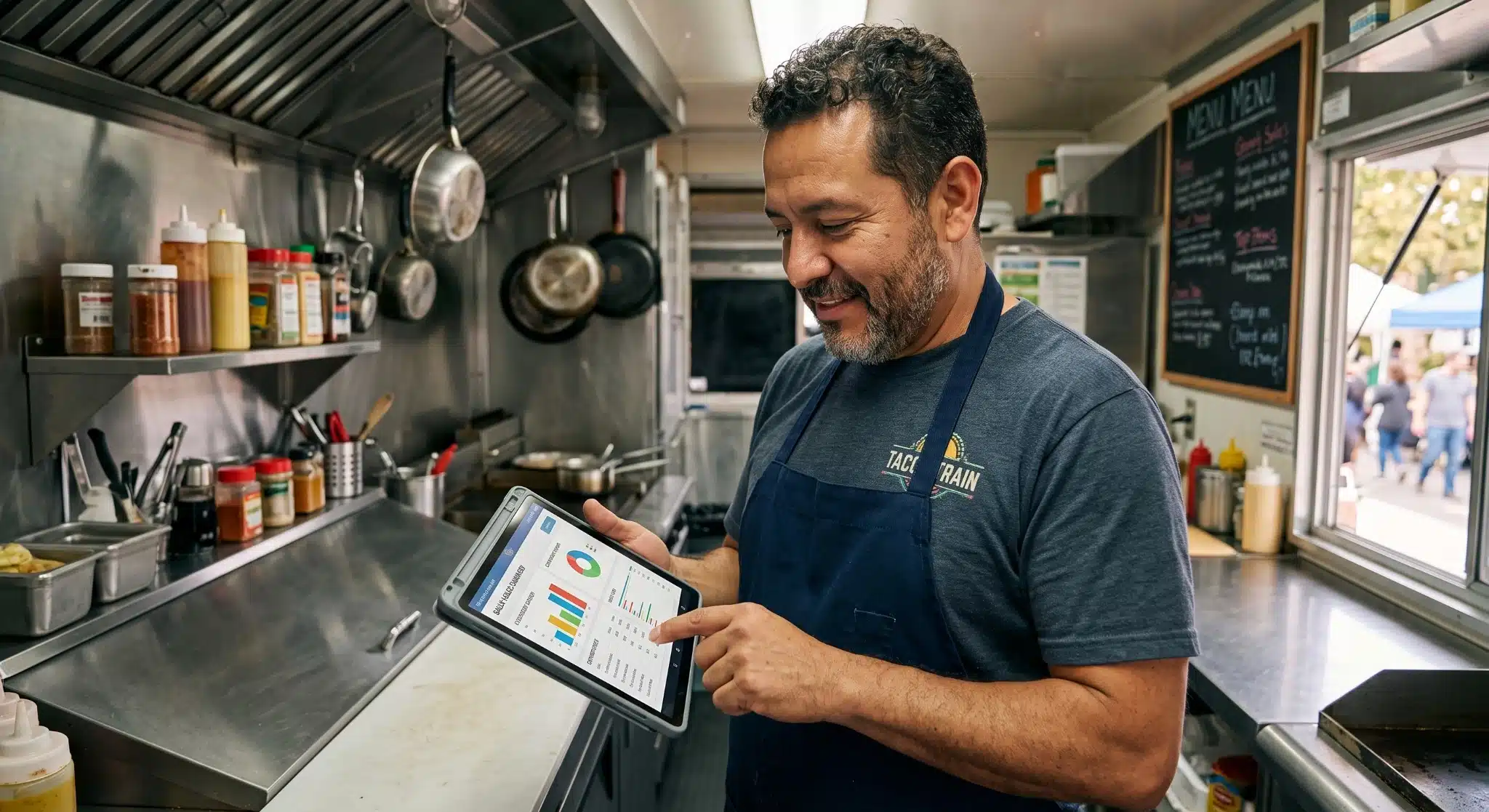
Modern POS keeps records: repeat visits, average ticket, time of day, what sold and what died. Most owners never open those reports. They check the daily total, feel good or feel sick, and close the app.
Then there is the fishbowl of business cards nobody ever typed up. The catering inquiries buried in a Facebook inbox. The 300 people who followed the page after one good event and never heard from the truck again.
None of that is a technology problem. It is a habit problem, and it is expensive.
What Does the Research Actually Say About Repeat Guests?
Olo analyzed more than 100 million guest records and found that roughly 60 percent of restaurant revenue comes from repeat guests. Six out of every ten dollars. Not from the crowd that discovered you at the fall festival, but from people who already knew your name and came back on purpose.
Now put that next to what McDonald’s is doing. Ray Gallagher, who runs the guest engagement product line at Olo and spent 15 years in restaurants before that, made the point plainly in QSR: the 515-page file is really just a receipt for years of purchases. Both sides traded. The customer got points and prizes, and the company got a forecast.
Privacy experts told WIRED that this depth of tracking is normal for large American loyalty programs. That is worth understanding, because it means the tools are no longer exotic. What used to require a team of analysts now ships inside a $79 per month POS add-on.
Two more numbers belong in this conversation.
First, the legal one. Federal rules require written consent before a business sends commercial text messages to a mobile phone. Violations under the Telephone Consumer Protection Act carry statutory damages starting at $500 per message, and up to $1,500 per message if the violation is judged willful. There is no small-business exemption. A truck that blasts 600 numbers scraped off catering forms is exposed the same way a franchise group would be.
Second, the one that surprises people in the other direction. California’s privacy law only reaches for-profit businesses that clear one of three thresholds. The first is gross revenue above $25 million, adjusted for inflation. The second is buying, selling, or sharing the personal information of 100,000 or more California consumers a year. Third is earning at least half your revenue from selling personal data. Most other state privacy laws use similar consumer-count thresholds. Your truck almost certainly falls under all of them.
So the picture is lopsided in a way most owners get backwards. The privacy statutes that made headlines probably do not apply to you. The texting rules absolutely do.
And on our side of the industry, NSFVA’s 2026 state of the industry research found that about 74 percent of customers discover food trucks through social media. Discovery is not the bottleneck. Coming back is.
The Reframe: Your Window Is the Algorithm
McDonald’s is spending an enormous amount of money to simulate something your truck does for free. Every predictive model, every RFM segment, every attrition score exists to answer one question that a corporation physically cannot answer any other way: who is this person, and what do they want?
I tough a session at the Food Truck Owners Expo called “The Guest Loyalty Loop: Engage, Delight, Retain.” The whole loop runs on recognition. A guest steps up, somebody on your truck says “hey, the usual, extra jalapeños?” and that guest has just been given something 515 pages of analytics is trying to manufacture. McDonald’s needs a model because the counter person will never know that guest. You do not have that limitation, and treating your window like a checkout lane throws away the only structural advantage you have.
So use data to serve recognition, not to replace it. Before you collect anything, run it through a two-question test.
One: what decision does this change?
Two: can I act on it by Friday?
If a field fails either question, do not collect it. Birthdays fail unless you actually have a birthday offer built. Home addresses fail for almost every truck alive. Repeat visit counts pass. Favorite item passes. The email address of somebody who booked catering passes with room to spare.
That test is the whole difference between a working list and a 515-page liability.
What Should a Food Truck Actually Do With Customer Data?
Job one: know your regulars. Not in a spreadsheet, in your head and in your crew’s heads. Every truck has 20 to 50 people who account for a disproportionate share of weekday sales. Name them. Know their order. Train your window staff to greet them differently than a first-timer. This costs nothing and it is the single highest-return move on this list.
Job two: own a list you can reach. Social media is rented ground. An algorithm change can cut your reach in half overnight and nobody will send you a warning. Email is the one channel you own outright. Start there, build slowly, and add SMS later only if you set the consent up properly.
Job three: turn sales history into event selection. This one gets skipped and it is worth the most money. Bill selection is a numbers game, and your POS holds the scoreboard. Pull last season’s events and calculate revenue per hour of gate time, not gross sales. Include the permit, the fuel, the labor, and the prep day. Some of the events you love will come out ugly. Good. Now you can price the next one correctly instead of guessing.
What You Already Know
I had an owner in a coaching call last year who was convinced his best event was a two-day music festival. He loved the crowd. We pulled the numbers and it ranked fifth out of nine, behind a boring Tuesday brewery stop he had almost dropped. He did not need artificial intelligence to figure that out. He needed to open a report he already had.
One caution before you get excited about list building. A promotion that drives 200 people to your window in 40 minutes is not a success if your truck has the capacity to serve 80. You will hand out 120 bad experiences and a stack of one-star reviews. Match the size of your outreach to the throughput of your equipment, your prep, and your crew. Capacity comes first, always.
Start This Week
1. Open your POS customer report today. Not next month. Log in, find the customer or loyalty section, and look at how many guests have more than one visit. Write the number down. That single figure will tell you more about your business health than your gross sales will.
2. List your top ten regulars by name and order. Do it from memory first, then check it against the POS. Post it inside the truck where your crew can see it. Recognition is a system, not a personality trait.
3. Pick one owned channel and start collecting. Email is the right first move for most trucks. Put a simple sign-up at the window with a clear reason attached: location schedule, or first notice on catering dates. Skip the vague “join our list” language.
Then
4. Fix your opt-in before you ever send a text. If you plan to text, the consent has to be in writing, it has to name your business, it has to say what kind of messages people will get, and it cannot be a condition of buying food. Keep the records. Four years is the standard window for TCPA claims, so keep them that long.
5. Attach names to events, not just totals. Starting at your next booking, capture something. A sign-up sheet for the schedule list, a QR code on the menu board, anything. An event that produced 300 sales and zero contacts produced 300 strangers.
6. Verify every claim a loyalty vendor makes. The AI-powered guest platform pitches are landing hard in our industry right now. Some of those tools are genuinely useful. Ask three questions. Who owns the customer list. How do you handle text consent. Can I export my data. Never take a sales rep’s word, or an AI chatbot’s word either. Especially on anything touching legal, tax, health department, or financial territory. Verify with a human who is accountable.
7. Write a two-sentence data promise and post it. Something like: we keep your email to send our schedule and catering openings, we do not sell it, and you can leave any time. Trust is cheap to build at this scale and expensive to rebuild.
Frequently Asked Questions
Do I need a loyalty app for my food truck?
No. Most trucks are better served by an email list and a crew trained to recognize regulars. Apps add monthly cost, require downloads customers rarely complete, and often hold your data hostage. Consider one only after you are consistently using the customer reports your POS already generates for free.
Is it legal to text customers who gave me their number at the window?
Not automatically. Federal rules require prior express written consent before you can send commercial texts. Handing over a cell number for an order does not count. You need a clear written opt-in that names your business and states what messages they will receive. Penalties start at $500 per message.
Does the California privacy law apply to my food truck?
The California statute reaches for-profit businesses with gross revenue over $25 million, or those handling data on 100,000 or more California consumers annually, or those earning half their revenue from selling data. Most state privacy laws use similar thresholds. The texting rules apply to everyone.
What customer data should a food truck collect?
Start with three things: an email address, repeat visit count, and favorite item. Catering contact details should be added separately. Those leads are worth the most per record. Skip birthdays, addresses, and demographics unless you have a specific offer for them. Unused data is clutter and risk.
Can I buy a list of local customers to market to?
Do not. Purchased lists carry no valid consent, which makes them a serious liability under federal texting rules and a fast way to get your email domain blacklisted. Build slowly from people who walked up to your window.
What McDonald’s Could Not Buy
The company had every transaction. It had the offers, the points, the Monopoly prizes, and the time stamps. Behavioral segments were in there too, with names like “On the Go Lunch in a Rush.” The model calculated that Reece Rogers would spend $29.15 over six weeks. It gave him a zero percent chance of walking away.
Then he walked away.
All that data described the man perfectly and understood him not at all. Nobody at McDonald’s ever knew him. Nobody could, because at that scale nobody is standing at a window looking a customer in the face.
You are. Every service, every day. That is not a small business disadvantage you need to overcome with better software. That is the thing McDonald’s is spending millions of dollars trying to fake.
So collect the data. Read the reports. Build the list, get the consent right, and price your events off real numbers instead of a good feeling about a crowd. Do all of it. Just remember what the data is for.
McDonald’s needed 515 pages to guess what one man might order. You just need to remember his name.
Keep Learning
- The State of the Food Truck Industry in 2026: Opportunity Is Real, but So Are the Numbers. Where the industry actually stands on operator counts, average sales, and how customers find trucks.
- Should Your Food Truck Charge a Credit Card Processing Fee? Think Twice. What a small point-of-sale decision costs you in repeat business over a year.
- Food Truck Owners Expo: Vegas Version A recap of the sessions on guest loyalty, order turnaround time, and multi-truck growth.
Bill Moore is the Founder and Executive Director of the National Street Food Vendors Association (NSFVA), a trade association dedicated to advocacy, education, and unifying street food vendors nationwide. He has worked in food service since 1977, and his first street food vending was in 1981. Bill hosts the “10-Minute Food Truck Training” podcast, leads NSFVA’s weekly Mini Class and group coaching sessions, and is the author of Food Truck 101: Beginner to Winner and, with Melisa Moore, Food Truck 201: Get Off the Truck!