
A new restaurant industry survey confirms what most truck owners already suspect. Training gets skipped first and paid for later, and on a two person crew the bill comes due fast.
Why Does Food Truck Employee Training Get Skipped First?
I hired a kid in 1981 who could make sandwiches perfectly and with some speed. Three weeks in, I lost him to a McDonald’s on our same block. They offered him fifty cents more an hour. Plus, actually showed him how to close out a register instead of making him guess. I didn’t lose him over money. I lost him because I never trained him past day one, and he found somewhere that would.
If you want food truck employees who actually stick around, you train them past the first shift. You cross-train them onto a second station inside the first month. You must treat training as a scheduling decision instead of a nice-to-have you’ll get to when things slow down. A survey from workforce learning platform Schoox found that 66% of frontline restaurant workers under 34 say their employer isn’t training them well enough to do the job. 79% blame lack of time, not lack of willingness. Food truck employee training fails for the same reason restaurant training fails. Everybody is too busy running the window to teach the person standing next to them.
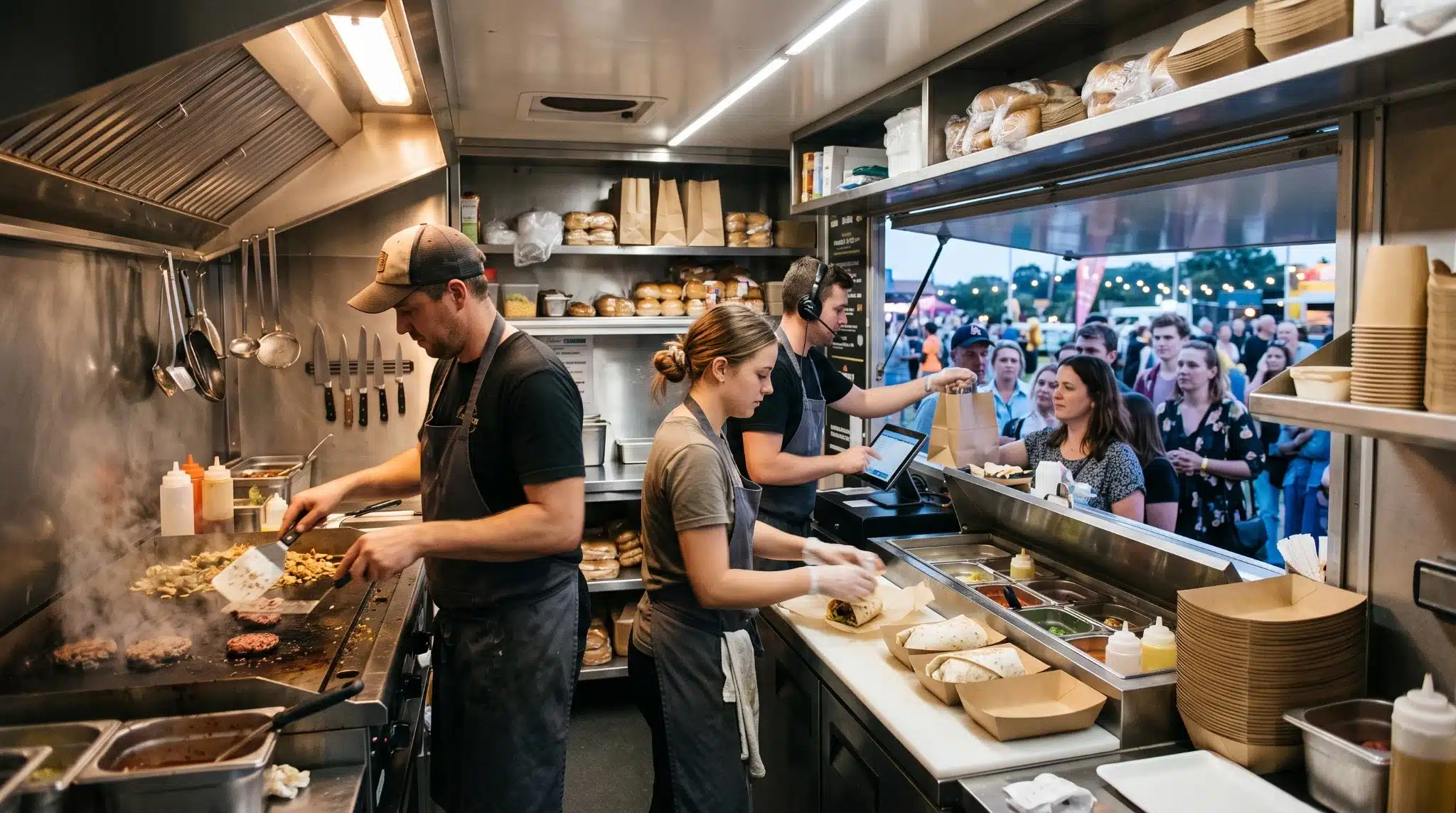
The difference is that a restaurant with twenty employees can absorb a bad hire and work around them. A crew of two or three cannot. Lose one untrained person mid-lunch rush and you don’t have a staffing problem. You have a reputation damaging slow service or a closed window.
Employee training isn’t about a binder you haven’t made yet or no one reads if you did make one. It’s about building a small crew that can cover for each other. On a truck, teamwork is the whole business plan.
| KEY TAKEAWAYS 66% of frontline restaurant workers under 34 say their employer doesn’t train them well enough to do the job, and lack of time is the top reason cited, not lack of manager effort. Cornell University research puts the cost of replacing one hourly restaurant employee at roughly $5,864, a number that lands harder on a truck running a three-person crew than a restaurant running twenty. Poor onboarding contributes to early departures inside the first 45 days, which on a truck can mean losing someone before they’ve paid back what you spent training them. The fix isn’t more training time. It’s training built around capacity: everyone learns a second station, not just their own, inside the first 30 days. A written, one-page station map beats a forty-page manual nobody opens during a lunch rush. |
The Real Reason Training Falls Apart on a Small Crew
Let’s name it plainly. Most food truck owners don’t have a training problem because they don’t care. They have a training problem because they are the cook, the cashier, the dishwasher, and the person answering the phone about Saturday’s private event. Training the new hire competes with every other thing screaming for your attention, and training loses. Training doesn’t come with a deadline attached the way a broken fryer does.
A new hire shows up. Then shadows for a shift or two. Finally gets thrown on the line during a Friday rush because you’re short-handed. Then is forced to figure out the rest by making mistakes in front of guests. That’s not training. I bet you have done it before that way.
The Schoox survey backs up what we see on the ground. Employers aren’t lazy about training, they’re squeezed. Tight staffing, busy shifts, and owners juggling ten jobs at once push training to the back of the truck. A food truck just feels it faster because there’s no office to hide in and no extra body to cover while you teach.
Here’s the part that should bother you. When training gets skipped, the newest person on your truck ends up making decisions about portion size. Or allergen questions. Or how to handle a complaint. All without ever being shown the right answer. That’s a business liability standing at your service window.
What Does the Research Say About Restaurant and Food Truck Training?
The numbers on this are not close. A 2026 survey from Schoox found that 66% of workers aged 18 to 34 say their employer isn’t giving them the training they need to do their job well. Nearly eight in ten of pointed to lack of time and low prioritization. Not a shortage of available programs, as the real barrier.
That same survey found 42% said training and development would make them stay with their employer at least another year. That’s not a soft perk. That’s a retention clue food truck owners just don’t know. They assume training is something big chains do with tablets and modules. Not something a two-person operation can afford to build.
Here’s what skipping it actually costs. Cornell University’s Center for Hospitality Research puts the average cost of replacing one hourly restaurant employee at roughly $5,864. Count recruiting, onboarding, lost productivity, and the mistakes a green employee makes while learning on the fly. Multiple industry sources report that poor onboarding drives early departures inside an employee’s first 45 days on the job. A real chunk of the people who quit early are quitting because nobody set them up to succeed in the first place. Not because the job itself was wrong for them.
If you run three people and one of them quits, you didn’t lose 3% of your labor force. You lost a third of it, during a season you can’t just pause. The broader food truck industry is already absorbing real staffing and cost pressure heading into this year. Restaurant industry turnover overall runs north of 70% annually. A small truck feels that pressure with no slack in the system. Which is exactly why training can’t be something you will get “around to”.
None of this means you need a corporate learning platform. It means the gap between “we’re too busy to train” and “we can’t afford this turnover” is the same gap.
The Cross Training Rule (Teamwork): Training for Capacity, Not Just Tasks
The standard advice says train for the task, a single station: teach the register, teach the grill, teach the fryer. That’s fine as far as it goes. But task training solves the wrong problem for a truck.
Cross Training and Teamwork builds for capacity instead of chasing efficiency. On a truck, the real risk isn’t that someone does their one job slowly. It’s that the only person who knows how to run the window is the same person who’s out sick. Task training gets someone competent at their spot. Cross training gets your crew covering for each other, which is the only insurance policy a small truck actually has.
Every person on your crew learns a second station, cold, inside their first 30 days. Not “familiar with it.” Able to run it solo during a rush.
How Do You Actually Train a Food Truck Crew That Stays?
The owners who train for capacity build a crew that survives a no-call, no-show. The owners who train for tasks only find out how thin their operation is quickly.
We don’t start with a training manual. We start with a station map or position chart. A simple one-page breakdown of every job on the truck: grill, window, prep, register, close-out. Then we ask one question about every new hire: which second station will this person own by day 30? That question forces you to actually plan training instead of hoping it happens by osmosis. There’s a ninth grade science word you thought you’d never use as an adult!
This is where the shadow-and-solo approach earns its keep. It works even better on a small crew than a big one because there’s nowhere to hide. A new hire shadows an experienced crew member for their first one or two shifts, no exceptions. Even if you’re short-handed that day. Then they run their primary station solo with someone experienced nearby, not across the truck. Close enough to catch a mistake before it reaches a paying guest. Only after that do they start learning station two. No matter whether that’s the point-of-sale system up front or a second prep role in back.
Digital tools have caught up to this problem in a way they hadn’t a few years ago. Menu-based quiz apps built specifically for food trucks now exist. Allowing a new hire learn ingredients, allergens, and pricing on their phone before their first shift instead of during it. I’ll say the same thing here I say about any AI tool you didn’t build yourself. Verify what it produces before you trust it with a food safety or allergen claim. A quiz app that gets a dairy-free answer wrong is worse than no app at all.
None of this requires a training budget. It requires a decision that training happens on the clock. On a schedule and with a second person’s name attached to every new hire’s first two weeks. That’s the whole system.
7 Steps to Build Food Truck Employee Training That Works
- Build a one-page station map before you post the job. List every role on your truck: grill, window, prep, register, close-out, and note who currently owns each one. If a station only has one name next to it, that’s your next hire’s second-station assignment. It was decided before they ever apply.
- Shadow for the first one to two shifts, no exceptions. Even on a day you’re short-handed, resist the urge to throw a brand-new hire straight onto the line solo. The lunch rush they mess up in front of guests costs you more in reputation than the training cost.
- Assign a second station inside 30 days. This is the Cross Training (Teamwork) Rule in practice. Pick the station, put a date on the calendar, and treat that date like a health inspection. It happens whether or not the week got busy.
- Debrief for five minutes after every shift for the first two weeks. Ask what confused them, what they’d want to know next time, and what almost went wrong. New hires won’t volunteer this unless you ask directly. The mistakes you catch in a debrief are the ones you never see repeated on a Saturday rush.
- Put your food safety and allergen answers in writing. Don’t make a new hire guess what to tell a guest with a peanut allergy. A written, one-page answer sheet posted where they can see it removes the guesswork that turns into a liability.
- Train for the rush, not the calm. A slow Tuesday afternoon teaches someone nothing about what your truck actually feels like at 12:15 on a Friday. Schedule at least one training shift during real volume, with an experienced person right next to them.
- Recognize the second-station milestone out loud. When someone hits day 30 and can run their second station solo, say so, in front of the crew. The Schoox data is clear that people stay longer when they can see themselves growing. A truck can offer that just as well as a two-hundred-unit chain can.
Frequently Asked Questions
How long should food truck employee training take?
Plan for at least two full weeks before a new hire runs a station alone during a rush. 30 days before they’re competent at a second station. Rushing this to save a few days of labor cost almost always costs more later in mistakes, remakes, and turnover.
Do I need a written training manual for a two or three person crew?
You need a one-page station map and a written food safety and allergen answer sheet, not a forty-page binder. On a small crew, a document nobody has time to read is worse than no document. It gives you false confidence that training happened.
How much does bad training actually cost a food truck?
Research puts the cost of replacing one employee at roughly $5,864 once you count recruiting, onboarding, and lost productivity. On a truck losing and replacing one person hits your labor budget and your capacity at the same time.
Should I use an AI tool to help train my food truck crew?
AI-built quiz tools can help a new hire learn your menu before their first shift. Verify every food safety and allergen answer yourself before trusting it in front of a customer. Never let an AI tool be the final word on a health or safety claim.
What’s the biggest difference between training a food truck crew and a restaurant crew?
A restaurant can absorb one undertrained employee without the whole operation feeling it. A food truck usually can’t. Because losing one person out of three means losing a third of your labor force on any given shift.
Train the Path, Not Just the Position
That kid I lost in 1981 taught me something it took me years to actually apply. He didn’t leave because the job was wrong for him. He left because nobody showed him a path past day one, and somebody else did. I’ve watched hundreds of owners since then make the exact same mistake I did. Just faster and with more at stake.
You don’t need a corporate training department to fix this. You need a station map. Then a second-station date on the calendar, and five minutes after every shift to ask what almost went wrong. That’s the whole system, and it costs you time you’re already spending, just spent on purpose instead of by accident.
Your crew isn’t going to stay because you paid them fifty cents more an hour. They’re going to stay because you showed them a path.
Build that path, one station at a time. You’ll spend less of your year hiring and more of it running a business when you’re not just standing at the window.
Keep Learning
Should You Trust an AI Tool You Didn’t Build? The verification habit every truck owner needs before handing any task, including training, to an AI tool.
Sponsor Spotlight: EasyEats Point of Sale Built By a Small Business, For Small Businesses. A look at the kind of point-of-sale system new hires need to learn during onboarding.
The State of the Food Truck Industry in 2026: Opportunity Is Real, but So Are the Numbers. The labor and staffing pressure behind why training matters more this year, not less.
What Bookkeeping Basics Does Every Food Truck Owner Need? The same operator mindset this article applies to training also applies to your numbers.