A food truck owner’s guide to checking what a skill, GPT, or prompt is actually designed to do before you put it in your own AI account.
A few weeks ago somebody handed me an AI tool built by a man who calls himself an AI expert. It was a customer service tool for food businesses, built around two names everybody respects, the book Raving Fans and Chick-fil-A. It read great. Confident, polished, professional. And it was wrong in ways that would have cost me if I had trusted it in front of my members.
So let me answer the question in the title right up front, because you are busy and you came here for the answer. No, you should not trust an AI tool you did not build until you have checked what it was actually made to do. Not because AI is bad. AI is one of the most useful things to hit our industry in years. You should not trust it blindly and for the same reason you would not hand your window to a stranger who walked up and said he knows how to run a truck. Confident is not the same thing as correct, and when the tool is wrong, you are the one holding the bag, not the person who built it.
| KEY TAKEAWAYS An AI “skill,” GPT, or prompt someone else built is a set of instructions that quietly runs inside your account and can speak in your name. Confident AI output is not verified AI output. The two courtroom cases below prove people got burned trusting the difference. When an AI tool you installed gives a bad answer, you own the result, not the person who built it. Most bad AI tools are not scams. They are built by people who do not know the subject well enough to know they got it wrong. You can check any tool in a few minutes, even on a topic you do not know cold, if you know what to look for. |
What Is an AI “Skill,” and Why Does It Matter Who Built It?
Let me keep this plain, because the tech crowd loves to make it sound complicated. An AI skill, or a custom GPT, or a shared prompt, is just a set of written instructions that you drop into your AI account. Once it is in there, it changes how the AI behaves. It can write in your voice, answer your customers, build your menus, draft your posts, and coach you on your numbers. That is the appeal, and it is real. A good one saves you hours.
Here is the part nobody selling (or giving away) these tools wants to slow down on. When you install one, you are not just getting a helpful answer one time. You are installing standing instructions that run every time the tool wakes up. You are, in effect, putting a worker on your truck who talks to your people in your name, and you did it without an interview, without checking references, and often without reading the job description. If that worker is good, wonderful. If that worker is confidently wrong, they are confidently wrong all day, every day, and they never break character to tell you.
That is why it matters who built it. The instructions carry the builder’s knowledge, or the builder’s ignorance, straight into your business.
What Happens When You Trust AI Without Checking It?
This is not a hypothetical. People with more lawyers and more money than any of us have already learned this lesson in public.
Start with Air Canada. A grieving customer named Jake Moffatt used the airline’s website chatbot to ask about bereavement fares. The chatbot told him he could book a regular ticket and apply for the discounted bereavement rate within 90 days after travel. He did exactly that. Then he went to collect, and the airline told him the chatbot was wrong, that its real policy did not allow refunds after travel. The chatbot had essentially made up a policy that did not exist.
Here is the part that should stick with every business owner. When Moffatt took it to a tribunal, Air Canada actually argued it should not be held responsible because the chatbot was a separate entity accountable for its own actions. The tribunal shot that down cold. The ruling said it makes no difference whether the bad information comes from a static web page or a chatbot; the company is responsible for everything on its site. Air Canada was ordered to pay the customer damages and fees. The company paid for the machine’s mistake. Not the machine. The company.
Now the lawyers. In a case called Mata v. Avianca, two attorneys used ChatGPT to help write a legal brief. The AI generated a motion full of fake court cases, complete with fabricated quotes and citations for cases that did not exist. The scary part? When the lawyers asked ChatGPT whether the cases were real, it confidently assured them the cases existed and could be found in the major legal databases. They filed it. The judge could not find the cases either, called one of the AI’s legal analyses gibberish, and fined the lawyers $5,000. Their reputations took a hit far bigger than the fine.
Two different fields, same lesson. The AI sounded sure of itself. It was wrong. And the human who trusted it without checking is the one who paid. You run a food truck, not an airline or a law firm, but the machine does not know the difference, and neither does the health inspector, the tax man, or the guest or client your AI just gave bad information to.
The Real Reason Bad AI Tools Fool Good Operators
Here is the thing I want you to understand, because it is the part that protects you. Most bad AI tools are not built by con men trying to trick you. They are built by people (often novices or “influencers” seeking clicks) who do not know the subject well enough to know they got it wrong. That is a different animal, and it is more dangerous, because it does not feel like a scam. It feels like expertise. Confident expertise but wrong.
Go back to that customer service tool I got handed. When I took it apart, here is what I found. It took one idea from the Raving Fans book, which is about quiet consistency, and jammed it together with a different idea from Chick-fil-A, which is about a specific service gesture, and treated them like the same thing. They are not.
I use both Raving Fans and Chick-fil-A in presentations and classes. Most recently at FTO Expo. Then it claimed Chick-fil-A runs a big-dollar customer recovery budget, which is a Ritz-Carlton practice that got stapled onto Chick-fil-A because it sounded impressive. It was not true. Then it called a food truck a different animal from Chick-fil-A, when Chick-fil-A is the highest-volume QSR in the country and a QSR is the closest thing we have to a food truck at scale. No one who actually studied CFA or read Raving Fans would have written those sentences as instructions for AI.
That is the tell. The AI skill builder could not feel the seams between the sources, so he smoothed three different things into one wrong thing and signed it with famous names. Call it what it is. A silent employee who talks a big game, has a great résumé on paper, and does not actually know the job. You would spot that person in about ten minutes on the truck. You have to learn to spot them in your AI account too.
Treat Every AI Tool Like a New Hire You Have Not Interviewed
Every AI skill, GPT, or prompt you install is a silent employee. It works in your name, it never gets tired, and it never breaks character. That last part is exactly why it is risky. A human employee who does not know the answer will usually hesitate, shrug, or ask somebody. A silent employee just answers, smoothly, whether it knows or not.
A tool built by someone else is a silent employee working in your name.
You already know how to protect your business from a bad hire. Interview them. Check what they actually know. Watch them work a shift before you trust them alone at the window. Don’t hand the keys to your truck to somebody because they showed up in a nice shirt and used the right buzzwords. An AI tool deserves the exact same treatment, and the good news is that checking one takes less time than a real interview, because everything the tool will do is written down in front of you before you ever install it.
I just went through this myself. After I threw out that broken tool, I built my own from scratch, sourced correctly, and before I trusted it with a single member I ran several real tests through it and read every line it produced. That is the standard. Build it or vet it, then test it, then trust it. In that order, every time.
How Do You Check an AI Tool Before You Trust It?
You do not need to be a tech person to do this. You need to read like a suspicious operator. Here is the walk-through.
1. Read what it is built to do before you install it. Every skill or GPT has its instructions written out in plain text. Open them and actually read them. If you cannot see the instructions, that by itself is a reason to walk away. You would not hire someone who refused to tell you what they planned to do on your truck.
2. Check whether the claims trace to something real. When the tool states a fact, ask if it is something you can verify or just something that sounds impressive. A tool that name-drops big brands and famous books but gets the details wrong is worse than useless. It is confidently wrong, which is the most expensive kind.
3. Watch for hidden sales pitches. The broken tool I reviewed had a chunk of sales copy buried in it, pushing a $197-a-month membership, with a built-in instruction telling the AI not to remove the pitch. A tool that is quietly selling something on every use is not working for you. It is working for the person who built it. That inclusion alone is a conflict of interest. If the skills works properly why would you need a $197 subscription?
4. Ask if the AI builder actually knows your world. Food trucks are their own business. Generic small-business advice bolted onto a food truck point of reference usually falls apart the second a real operator reads it. If the tool does not understand capacity, food cost, permits, and speed of service the way you live them, it does not understand your business.
5. Never trust it on the high-stakes stuff without a second source. Permits, taxes, health department rules, food safety, contracts, financial decisions. AI can point you in a direction, but you verify anything in these areas with your health department, your accountant, or your attorney. The machine will give you a confident answer either way. The confidence is free. Being wrong is not.
6. Test it before it touches a customer. Run a real question through it and read the whole answer like you are grading it. If it drifts, softens, or makes something up on a test you control, it will do the same in front of a paying guest, where you cannot take it back.
7. When in doubt, hand it to someone who knows. If you cannot judge the content yourself, find someone who can before you rely on it. That is not weakness. That is how smart operators run their whole business.
Frequently Asked Questions
What exactly is an AI “skill” or custom GPT?
It is a set of written instructions you add to your AI account that changes how the AI behaves. Once installed, it runs automatically whenever its topic comes up, writing, answering, or advising in your name. Think of it as standing instructions, not a one-time answer, which is why it deserves a real look first.
Can I trust AI for permit, tax, or food safety questions?
Use it to get oriented, never as your final word. AI can explain a concept or point you toward the right question, but permit rules, tax law, and food safety codes vary by location and change often. Always confirm anything in these areas with your health department, accountant, or attorney before you act.
Isn’t it fine to use an AI tool if it’s free?
Free does not mean correct, and it does not mean neutral. Some of the worst tools are free on purpose, built to lead you toward a paid product or to promote the builder. Judge a tool by whether its instructions are accurate and whether it works for you or for whoever made it, not by its price.
How do I know if the builder actually understands food trucks?
Read the tool’s instructions and look for real operational knowledge, capacity, food cost, permits, speed of service, event pricing. Generic business language dressed up with a food truck word or two is a warning sign. A tool built by someone who knows mobile food will sound like an operator, not a brochure.
What’s the worst that can happen if I skip this?
You install a confident tool that gives you or your customers wrong information, and you own the result. As Air Canada and those sanctioned lawyers learned, “the AI said so” is not a defense. A bad tool can cost you money, a health violation, or the customer trust you spent years building. Imagine your AI chatbot being asked about allergens and it doesn’t know. It will likely say your food is allergen free.
The Bottom Line for Your Truck
AI is going to be part of how you run your food truck, and that is a good thing. It can save you time and make you a sharper operator. But a tool built by someone else is a silent employee working in your name, and you would never put a stranger on your window without checking them first. So do not do it in your AI account either.
Read what it was built to do. Check that the claims are real. Watch for the hidden pitch. Test it before it touches a customer. Verify anything that could hurt you if it is wrong. Do that, and AI becomes one of the best workers you ever hired. Skip it, and you have handed your reputation to someone you never even interviewed.
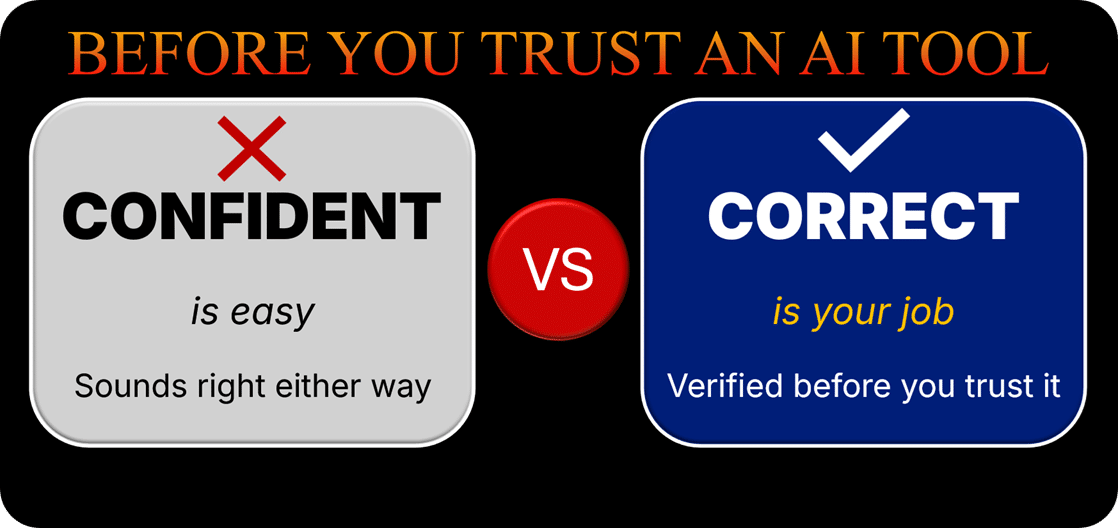
Confident is easy. Correct is your job. Check the tool before you trust the truck to it.
Keep Learning
Internal links, to be confirmed and swapped for real NSFVA article URLs before publishing.
- AI Food Truck Advice: Why Confident Answers Can Still Be Wrong — AI Sounds Confident. That Does Not Mean It Is Correct.
- When Cheap Food Trailers Become Expensive Mistakes — the same read-it-first discipline, applied to the biggest check you will write.
- Stop Pricing Your Food Truck Menu Based on Other Vendors’ Prices — how to know the true costs before setting your prices.
About the Author
Bill Moore is the Founder and Executive Director of the National Street Food Vendors Association (NSFVA), a trade association dedicated to advocacy, education, and unifying street food vendors nationwide. He has worked in food service since 1977, and his first street food vending was in 1981. Bill hosts the “10-Minute Food Truck Training” podcast, leads NSFVA’s weekly Mini Class and group coaching sessions, and is the author of Food Truck 101: Beginner to Winner and, with Melisa Moore, Food Truck 201: Get Off the Truck!