“How much are you guys charging for cheeseburgers?” That question shows up in food truck groups all the time.
At first glance, it seems reasonable. You are trying to figure out the market. You want to avoid overcharging. You do not want to scare guests away. You also do not want to leave money on the table.
But here is the problem.
When you ask a national group of food truck owners what they charge for a cheeseburger, you are not really getting pricing guidance. You are getting a collection of random answers from people operating in different cities, with different costs, different equipment, different rent, different labor, different sales volume, different guest bases, and very different levels of profitability. If they are profitable AT ALL.
So why would you build your menu price around their number?
A National Average Is Not a Pricing Strategy
A food truck in rural Alabama, a truck in downtown Austin, a truck at a brewery in Denver, and a truck working events in Southern California are not operating the same business. They may all sell burgers, but their numbers are not the same.
One owner may be paying $2,000 a month in commissary fees. Another may pay $500. One may have employees at $18 an hour. Another may be owner-operated with unpaid family help. One may be buying premium beef, bakery buns, and name-brand cheese. Another may be using cheaper products and smaller portions. Hopefully you see the differences. If not stop now and join our Association then take the full Master Class series. https://www.nsfva.org/join
So when one person says, “I charge $9,” and another says, “I charge $15,” those numbers do not mean anything all by themselves.
The better question is, “What does it cost me to make, sell, and support this item while still paying myself and producing profit?”
The Hidden Fallacy: Assuming Other Owners Know Their Numbers
Here is where the pricing trap really starts. Many food truck owners do not know their true food cost. They may know what they paid for a case of beef or a sleeve of buns, but they have not broken the item down by portion.
They may not know the cost of:
- The beef patty
- Cheese
- Bun
- Sauce
- Pickles, onions, lettuce, or toppings
- Seasoning
- Paper tray or box
- Napkins
- Condiment cups
- Credit card processing
- Waste
- Shrinkage
- Comps
- Employee labor
- Generator fuel
- Commissary expenses
- Insurance
- Event fees
That means the person telling you, “I sell mine for $10 and do great,” may not actually be doing great. They may not even not it. They may be confusing cash flow with profit.
They may be selling a lot of burgers and still not making enough money to pay themselves properly, maintain equipment, handle taxes, or survive a slow month.
Your Price Must Start With Your Recipe Cost
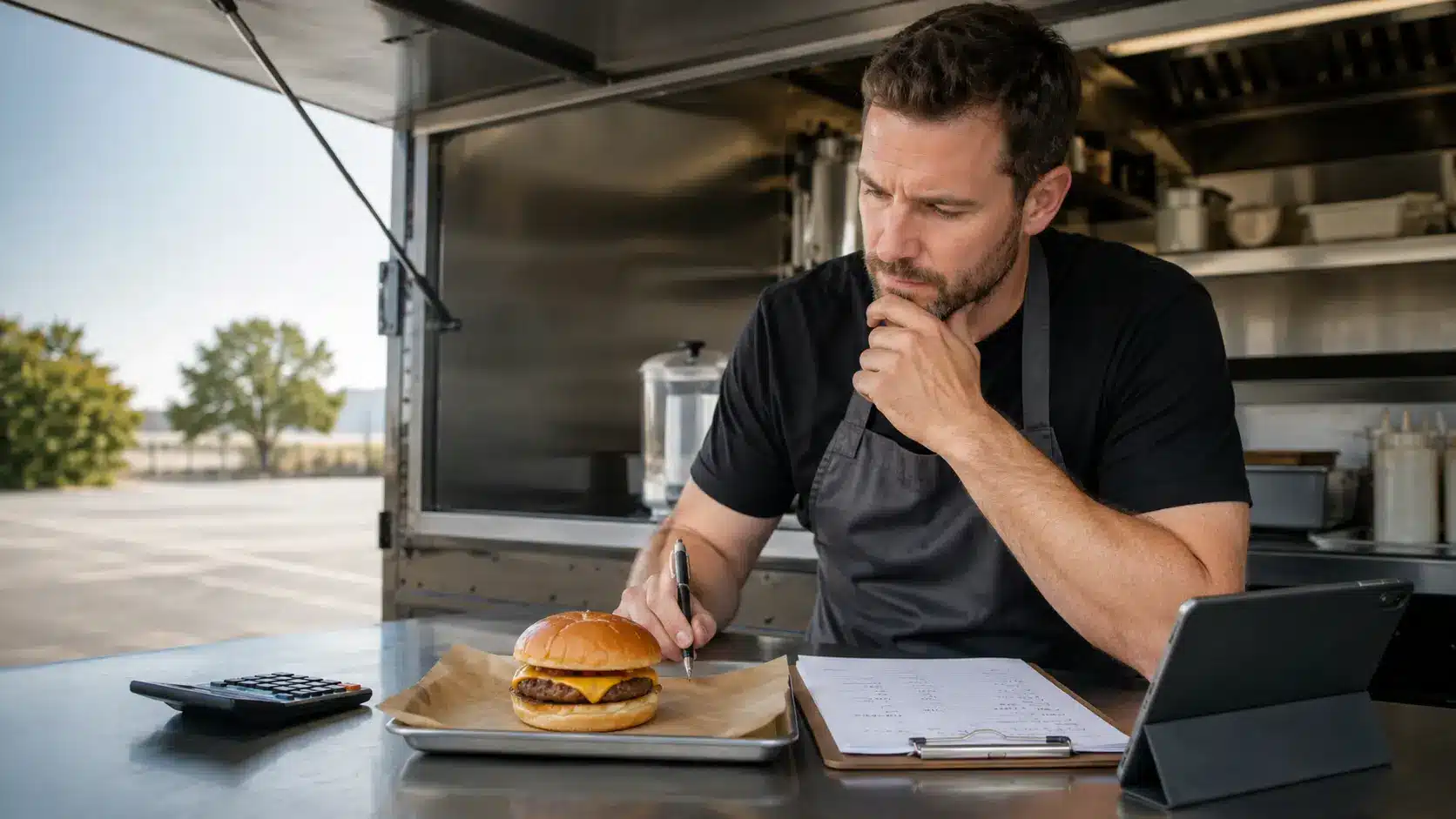
Before you ask what anyone else charges, you need to know what your cheeseburger costs you.
Let’s say your burger includes:
- Beef
- Cheese
- Bun
- Sauce
- Pickles
- Onion
- Paper container
- Napkins
You need a real recipe cost for that item.
Not a guess. Not “about two bucks.” Not “I think it’s around three dollars.” You need the actual portion cost.
If your total ingredient and packaging cost is $3.50, and you want to stay around a 28% food cost, the math looks like this:
$3.50 ÷ 0.28 = $12.50
That means a $3.50 cost item needs to sell for about $12.50 just to hit a 28% food cost target.
If you price that same burger at $9 because someone online said that is what they charge, your food cost jumps to almost 39%. That is a completely different business model depending on VOLUME (very high volume) to survive. Are you a master marketer? If not 39% is a slow walk to business failure. At least you’ll have company.
Cheap Pricing Can Make You Busy and Broke
One of the most dangerous things in food trucking is being busy but not profitable. A low price may create a line. It may make guests happy. It may even make the truck look successful from the outside.
But sales volume is not the same as profit.
If every burger is underpriced by $2 or $3, a good sales day hides a bad business model. Sell 200 burgers and underprice each one by $2, and you just gave away $400. Do that often enough and you will feel it.
You will feel it when the generator needs repair.
You will feel it when insurance renews.
You will feel it when sales tax is due.
You will feel it when you realize you worked hard all weekend and still cannot pay yourself.
Market Research Still Matters, But It Comes Second
As in LOCAL market and this does not mean you should ignore your market.
You do need to know what customers in your area are used to paying. You do need to understand the difference between a brewery crowd, a lunch stop, a festival, a corporate catering event, and a late-night entertainment district.
But market research should help you position your product within the local economy. It does not replace math.
There is a big difference between asking, “What are others charging?” and asking, “Can my market support the price I need to charge?”
That second question is much more useful.
If your numbers say the burger needs to be $13, but your local market only supports $9, the answer is not to blindly charge $9.
The answer would be to adjust the item.
You may need to change portion size, improve perceived value, create a combo, change your sourcing, reduce waste, simplify toppings, or choose a different menu item.
Pricing Is Not Just About the Burger
A cheeseburger does not exist by itself.
It has to support the business around it.
Every menu item has to contribute toward fixed expenses like:
- Truck or trailer payments
- Insurance
- Licenses and permits
- Commissary fees
- Accounting
- Software
- Repairs
- Marketing
- Generator maintenance
- Owner pay
If your menu prices only cover food cost and little else, you are not really pricing your business. You are pricing your groceries.
That is why “What are you charging?” is such a dangerous shortcut.
The real question is, “What does this item need to contribute to keep my business healthy?”
The Right Way to Price a Smashburger
Start with your own numbers.
First, calculate the true recipe cost, including packaging.
Second, decide on a realistic food cost target. For many fast-service food trucks, a target around 25% to 30% food cost is common, depending on the concept, product type, and business model. We recommend 25% because most food trucks don’t run what they think anyway.
Third, calculate the needed selling price.
Fourth, compare that price to your local market.
Fifth, adjust the item, portion, positioning, or sales strategy if the market does not support the number.
That is menu pricing.
Not guessing.
Not copying.
Not polling strangers.
A Better Question to Ask
Instead of asking:
“How much are you guys charging?”
Ask:
“My burger costs me $3.50 in ingredients and packaging. I want to target a 28% food cost. That puts my selling price around $12.50. For those selling a similar item, does that price make sense in your market, and how are you positioning it?”
That question gives people something real to respond to.
Now you are not asking them to price your menu.
You are asking them to help you think through positioning, value, and market fit.
That is a much better conversation.
Final Thought
The danger of pricing from a national survey is that it feels like research, but it may just be a collection of guesses.
Some of those owners may be profitable. Some may not. Some may be charging too little. Some may be charging too much. Some may not know either way.
Your menu price has to be built from your food cost, your overhead, your labor model, your market, your capacity, and your profit goals.
So the next time someone asks, “How much are you guys charging for smashburgers?” remember this:
Other people’s prices are information.
Your numbers are the foundation.
Start there.