AI Sounds Confident. That Does Not Mean It Is Correct.
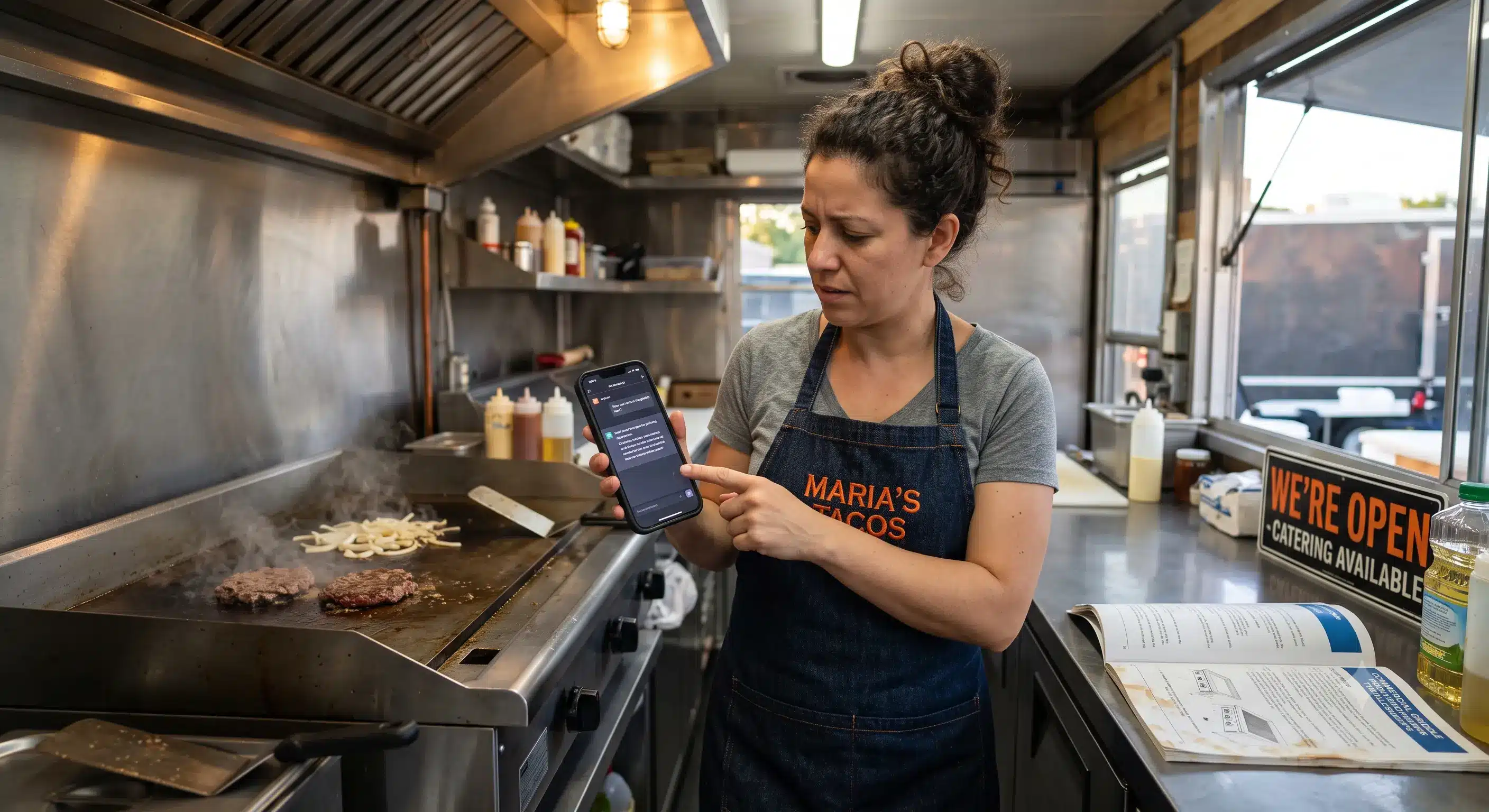
A food truck owner recently asked a simple question: “Is cleaning a commercial grill in a circular motion the recommended cleaning method?”
The AI answer sounded polished. It said yes. It claimed small circular motions were widely recommended for commercial flat-top grills, especially when using abrasives like griddle screens or grill bricks. Then posted a screen shot to refute experienced advice to the contrary.
That sounds helpful, doesn’t it?
But here is the problem: the answer was wrong.
When the AI was challenged and asked for a commercial griddle manufacturer source — not a YouTube video, not a blog from a pretend chef, not recycled internet advice — the AI reversed itself. Suddenly, it admitted that circular scrubbing is not the proper general recommendation for a standard steel commercial griddle. Vulcan’s own guidance says that for a steel griddle plate, after applying oil and using a griddle brick, operators should rub with the grain of the metal while the griddle is still warm. Vulcan also gives different cleaning instructions for chrome and composite surfaces, warning against abrasive tools on those surfaces.
That is the lesson.
The first AI answer sounded confident. The second answer sounded confident. Only one of them matched the manufacturer’s guidance. Only one is right.
AI Is Not Infallible
AI can be a powerful tool. I use it. Many business owners use it. It can help draft policies, summarize regulations, organize ideas, write marketing copy, and explain complicated topics in plain language.
But AI is not a manufacturer’s manual. It is not your health inspector. It is not your fire marshal. It is not your attorney. It is not your accountant. And it is not automatically correct just because the answer is well-written.
OpenAI’s own help documentation warns that ChatGPT can produce incorrect or misleading answers, may sound confident even when wrong, and should be checked against reliable sources when important information is involved. in fact all AI sites say that in the fine print no one reads at the bottom of the response.
That matters in the food truck industry because bad advice is not just annoying. Bad advice can cost money, damage equipment, create food safety problems, void warranties, or put operators on the wrong side of a regulation.
Why Novices Are Especially Vulnerable
A new food truck owner is trying to learn everything at once.
They are learning licensing, commissary rules, menu pricing, propane safety, generator use, event selection, food cost, staffing, social media, equipment maintenance, and customer service. They are overwhelmed. So when AI gives a clean, organized answer, it feels like relief.
But that relief can be dangerous.
The answer may be based on generic internet patterns, not your exact equipment, your local law, your permit conditions, your manufacturer’s instructions, or your insurance requirements.
In the griddle example, “clean in circular motions” might sound harmless. But if the manufacturer tells you to work with the grain, that distinction matters. If you use the wrong tool on a chrome or composite plate, you may damage a very expensive cooking surface. Vulcan specifically states that a griddle brick may work on steel, but is damaging to a chrome surface.
That is why “close enough” is not good enough.
The Real Problem Is Not AI. It Is Blind Trust.
This is not an anti-AI message.
You have to understand what AI really is: according the ChatGPT (the most common used AI for food truck owners) – “AI predicts the most likely useful response by finding patterns in massive amounts of training data, but it does not automatically know what is true unless the answer is checked against reliable sources.”
AI is a powerful search engine capable of summarization that can be read by human. That summarization could be completely false, AI does not know what is right or wrong.
AI is useful when treated like an assistant. It becomes risky when treated like an authority.
Think of AI like a new employee who reads fast, writes well, and sounds impressive — but still needs supervision. You would not let a brand-new cook rewrite your HACCP plan without review. You would not let a new cashier decide your sales tax policy based on something they heard online. You would not let a helper install propane lines because they watched three videos.
So why would we let AI make final decisions about equipment care, food safety, taxes, permits, labor rules, or fire code?
The Federal Trade Commission has also warned that using AI does not create an exemption from normal truthfulness and consumer protection laws. In one enforcement example, the FTC challenged claims around an “AI lawyer” service because the company allegedly did not have evidence that its chatbot output matched the level of a human lawyer.
That same principle applies to our industry: AI-generated advice still needs proof.
Use AI, But Make It Show Its Work
Here is a better way to use AI.
Do not ask: “Can I do this?”
Ask: “What does the manufacturer, health department, fire code, or official source say about this?”
Then ask: “Give me the source.” Then check the source yourself.
For food truck operators, I recommend using this simple rule:
If the answer could affect safety, legality, equipment, money, or your permit, verify it before you act.
That includes:
Equipment cleaning
Propane installation
Generator use
Electrical loads
Food holding temperatures
Commissary requirements
Sales tax handling
Employee pay practices
Surcharge and card fee policies
Fire inspections
Health department rules
Trailer build requirements
AI can help you understand the question. It should not be the final authority on the answer.
The SOURCE Test for AI Answers
Before trusting an AI-generated answer, run it through this quick test:
S — Source: Did it cite an official source (not a YouTuber interested in views), or just sound official?
O — Original: Is the source the actual manufacturer, agency, law, or code?
U — Up to date: Could this rule or guidance have changed recently?
R — Relevant: Does it apply to your exact equipment, state, county, or situation?
C — Consequence: What happens if this answer is wrong?
E — Expert check: Should a service tech, inspector, accountant, attorney, or coach verify it?
That may sound like extra work, but it is less work than replacing a damaged griddle top, failing an inspection, arguing with an event organizer, or cleaning up a bad business decision.
The Bottom Line
AI is a tool. It is not a truth machine.
The danger is not that AI makes mistakes. Every person and every tool can make mistakes. The danger is that AI makes mistakes in a calm, polished, confident voice that causes inexperienced owners to stop questioning.
In the food truck business, confidence does not make advice correct. Documentation does.
Manufacturer instructions matter. Local rules matter. Inspection standards matter. Real-world experience matters.
So use AI. Let it help you draft, organize, compare, and think. But when the answer matters, do not stop at the first response.
Ask for the source.
Check the source.
Then make the decision.
Because in this business, guessing with confidence is still guessing.