A drive-thru study of 2,145 visits shows why fast only wins when the order is right and the person at the window is friendly.
Imagine your truck at 12:15 on a Friday. Eight people stand in line. The first guest ordered four minutes ago and is still at the window. The ticket in your hand lists the wrong sauce, and you have about two seconds to decide what to fix first.
Speed? Accuracy? Or the look on your face while you deal with both?
Here is the short answer. Food truck speed of service matters a great deal, because guests rank it first. But speed only pays when the order is right and the employee at the window is friendly. Drop either and a fast ticket cannot save you.
The newest drive-thru data puts numbers on that. Intouch Insight and QSR Magazine ran 2,145 mystery shops across 13 national chains in June and July 2026. You can see the full study on the Intouch Insight Drive-Thru Study page.
A drive-thru is a window with a line in front of it. Just like your truck. The setups differ in ways I will cover, but the guest asks the same three questions at both. How long did it take, did I get what I ordered, and how did they treat me? That becomes review fodder if you mess one up.
Key Takeaways
- Guests named speed the most important part of a visit (38.4%), then order accuracy (28.4%), then food temperature and freshness (20.6%).
- Slow visits cost you referrals. Shoppers on visits over 10 minutes would recommend the brand 60.4% of the time, against 81.7% on visits of 3 to 5 minutes.
- Friendliness moved nearly every number. Satisfaction hit 98.6% on friendly visits and fell to 26.8% when service was not friendly.
- Expectation matters as much as the clock. Only 12.8% of shoppers who felt a visit ran slower than expected were very likely to recommend.
- Customization was the biggest single cause of wrong orders, so a tight menu and a read-back protect speed and accuracy together.
Why Do Food Truck Owners Get Speed of Service Wrong?
Most owners make one of three mistakes. They chase speed until accuracy slips, they chase being “nice” until the line grows past what anyone will wait through or they think “cook to order” excuses being slow. All feel like good service from inside the truck. None of the looks like good service from the line.
This pattern shows up with new owners and veterans alike. A truck has hard limits: cooking space, prep space, storage, and the number of hands at the window. Push a crew past those limits and something gives. Usually it is the order speed, then the attitude, then the repeat guest.
That is why I teach capacity instead of efficiency. Capacity is how many orders your truck can produce in an hour while staying accurate and polite. Speed of service is what the guest feels when your volume lands above or below that number.
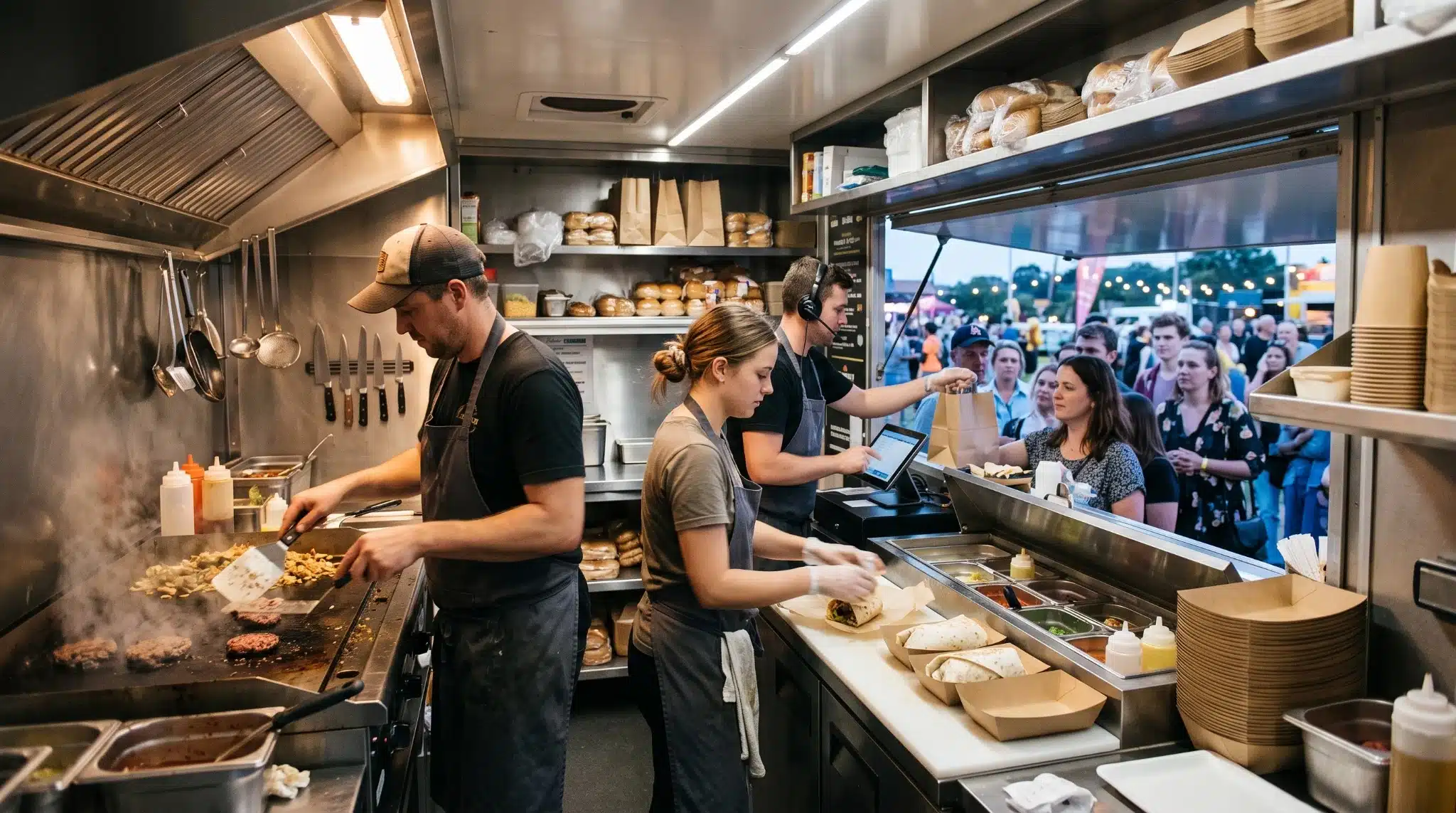
Walk-up guests also judge differently than drivers. They stand there. They count heads, watch your hands, and decide whether to stay. A driver already committed a lane based on a promise of fast, but a walk-up guest can easily jump the line. Most owners never notice.
This is also why event choice matters so much. If you book a crowd your capacity cannot serve, no amount of hustle fixes the line. My post on how to know if a food truck event is worth booking walks through that decision.
What Does Drive-Thru Data Say About Speed, Accuracy, and Friendliness?
The 26th Annual Drive-Thru Study covers 165 mystery shops per brand at chains including McDonald’s, Chick-fil-A, Taco Bell, Starbucks, and Dutch Bros. Those chains have trained crews and big equipment budgets. Your truck does not. I treat these numbers as direction, not as targets. With that said, six things stand out.
Speed is still the first thing guests judge. According to Intouch Insight’s release, the average visit took 5:24 in 2026. That is 11.1 seconds faster than 2025 and the fastest since 2018. When shoppers picked the most important factor, 38.4% chose speed. Let me say that again, speed was the most important factor to over one third of the people in your line. Can you you afford to lose them?
Long waits hurt recommendations before they hurt satisfaction. Here is how the numbers moved by visit length:
| Total time | Visits | Satisfied | Would recommend |
| Under 3 min | 570 | 95.4% | 80.2% |
| 3 to 5 min | 683 | 94.7% | 81.7% |
| 5 to 7 min | 387 | 94.6% | 78.3% |
| 7 to 10 min | 293 | 94.2% | 75.4% |
| Over 10 min | 212 | 84.9% | 60.4% |
Satisfaction barely moved until the 10-minute mark. Recommendations slid at every step. A guest can feel satisfied and still not send a friend. Also notice that half of all visits finished in under 4:25, while the average was 5:24. A few very long visits pull the average up, and the slowest 10% started at 9:56. Your worst tickets shape your reputation more than your average does.
Expectation drives the verdict. Shoppers who said the visit was quicker than expected averaged 3:54, and 65.3% were very likely to recommend. Those who said it was as expected averaged 5:09, with 43.3% very likely to recommend. The slower-than-expected group averaged 9:57, and only 12.8% were very likely to recommend. The clock matters, but so does what the guest believed was coming.
Fast alone did not win. Tim Hortons had the shortest average visit at 4:20. Chick-fil-A had the longest at 7:06, yet 98% of its shoppers were satisfied and 90% rated the service friendly. Dunkin’ averaged 4:49, with 90% satisfaction and 73% friendly. The study does not prove friendliness caused those scores. The pattern is still hard to ignore.
Friendliness traveled with everything else. The gap between friendly and unfriendly visits ran well beyond satisfaction:
| Measure | Service friendly | Service not friendly |
| Overall satisfaction | 98.6% | 26.8% |
| Order accuracy | 91.3% | 73.2% |
| Average total time | 5:16 | 5:41 |
| Would recommend | 86.5% | 19.6% |
| Good or excellent value | 58.6% | 21.4% |
One caution: only 56 visits fell in the not-friendly group, so treat the exact figures with care. The direction is clear anyway.
Accuracy leaks at the customization step. Shoppers filled 89.3% of orders correctly, which means 10.7% had something wrong. Among the 229 inaccurate orders, 43% involved customization that was not provided correctly. Another 13% involved a packaged condiment request, and 13% involved the wrong main item.
Why Is Speed of Service a Capacity Number, Not a Hustle Number?
Here is where I land on all of this. Most advice on speed tells owners to hustle: move faster, cook faster, talk faster. Hustle has a ceiling. Past it, the data shows what you pay.
Speed is a currency that gets set before you open the window. Your menu, your layout, your prep, and your crew count decide it. The window is where you spend it. Accuracy and manners are what you protect while you spend it.
That leaves a third standard, and it costs nothing. Expectation. The slower-than-expected group lost most of its enthusiasm, and those visits ran 9:57 on average, so the clock and the expectation moved together. You cannot erase every long ticket. You can control what the line believes about the wait.
Food truck speed of service is really three jobs. Build the capacity before service. Protect accuracy and friendliness during service. Set honest expectations at the line.
How Do You Build Fast, Accurate, Friendly Service at a Walk-Up Window?
Start with the number of stations. In the study, one-station lanes averaged 3:18 total, two-station lanes averaged 5:31, and three-station lanes averaged 6:27. Those are different chains with different menus, so do not read them as a clean comparison. The logic still carries over. Every extra handoff adds time and another chance to get something wrong.
As a food truck you operate like a two station lane, ordering and payment combined with pickup later. Keep it that way, and keep the touches few.
Next, make your voice the order confirmation board. About 85% of drive-thru visits included some form of order confirmation board, and read-backs reached 77.7% of visits that had no board. Your truck has no board. Repear the order back every time.
Then tighten the menu. I teach two to four core items for a reason: fewer items mean fewer modifiers, and modifiers are where orders break. If a guest wants a change, make sure it lands on the ticket in the same place every time.
Finally, add speed where it costs you nothing. Suggestive selling in the study fell to 51.6% of visits from 57.5% the year before. The most common ask by far was to make it a combo. A cold drink or a prepped side fits that pattern, because it adds revenue without adding cook time. My post on how food truck drinks make you money and the one on whether snacks belong on your menu cover the math.
What Can You Do This Week to Improve Food Truck Speed of Service?
- Time your own window. During one busy service, use a phone stopwatch. Start when a guest begins ordering and stop when the food reaches their hands. Time 20 orders, then write down the median and the slowest few.
- Read every order back. Say the full order, modifiers included, before you take payment. It takes seconds and catches the errors that cause remakes or bad reviews.
- Shrink your customization list. Decide which changes you allow and print them. Put each change so the cook sees it first.
- Tell the line the truth. If your real wait is eight minutes, then say eight. Most people won’t time you. If you say fifteen thinking you are making them happy when you deliver at eight minutes, they may just think the time was a REAL fifteen minutes because you said so. Guests who expect the wait judge it kinder than guests who guessed shorter because you never set up the expectation.
- Make friendliness a written standard. Greet within seconds, look up from the screen, and say thank you. At the three brands in the voice AI comparison, employees said thank you on 75.4% of visits. That is about one visit in four with no thanks at all.
- Add one fast upsell. Pick a drink or a prepped side. Ask in one sentence at the order. Skip anything that adds cook time during the rush.
- Train the crew for the window, not just the grill. Your person at the window sets the tone for the whole line. My posts on training employees who stick around and why people are the product cover how.
Frequently Asked Questions
What is a good speed of service for a food truck?
There is no universal number, because your menu and crew change it. For reference, the average drive-thru visit in 2026 took 5:24, and half finished in under 4:25. Time 20 orders at your own window, then set a target you can hit while staying accurate and friendly.
Should I rush orders to move the line faster?
Rushing trades accuracy and friendliness for speed, and the data suggests that trade loses. Wrong orders and unfriendly service tracked with much lower satisfaction. Build speed through your menu, layout, and prep instead. Then protect accuracy and manners when volume peaks.
Does speed matter more than food quality?
Guests named speed first, accuracy second, and temperature and freshness third. Taste scored 97% across the study, so quality is the baseline guests expect. Slow, wrong, or cold food can still sink great flavor. Treat quality as the entry fee and speed of service as what separates you.
How do I measure speed of service on a food truck?
Use a phone stopwatch. Start when the guest begins ordering and stop when the food reaches their hands. Record 20 orders during a busy rush, then note the median and the slowest few. Averages hide the long waits guests remember, so watch your slowest tickets closely.
Is drive-thru data relevant to a walk-up window?
Partly. Chains have bigger crews, more equipment, and different menus, so copy the direction and not the numbers. The guest’s questions match at both: how long, was it right, and was the staff friendly. Use the study as a guide to what you should measure at your own window.
Circling Back
Go back to that Friday at 12:15. Eight people in line, a wrong sauce on the ticket, and a guest still standing at the window.
You now know what to fix first. Not speed alone, and not friendliness alone. You fix the order, say the right words to the guest, and tell the line how long it will really take. Then you train the staff or change procedures so next Friday looks different.
The drive-thru study shows chains with huge budgets still miss on accuracy about one order in ten. You do not need their budget. You need your numbers, your capacity, and a crew that knows the window is where the business happens.
Fast gets them to the window. Right and friendly get them back.
Keep Learning
- How Do You Train Food Truck Employees Who Actually Stick Around?: Training that builds a crew you can trust at the window.
- Are Food Truck Snacks Worth Adding to Your Menu?: When a prepped extra helps and when it clogs the line.
- How Do You Know If a Food Truck Event Is Actually Worth Booking?: Match your capacity to the crowd before you commit.
- People Are the Product: Why the person at your window is the most important part of your menu.
- How Do Food Truck Drinks Actually Make You Money?: A fast add-on that fits the window.
Sources
- Intouch Insight, 26th Annual Drive-Thru Study (2026), conducted with QSR Magazine. Figures cited from the study report.
- Intouch Insight press release, October 1, 2026
Bill Moore is the Founder and Executive Director of the National Street Food Vendors Association (NSFVA), a trade association dedicated to advocacy, education, and unifying street food vendors nationwide. He has worked in food service since 1977, and his first street food vending was in 1981. Bill hosts the “10-Minute Food Truck Training” podcast, leads NSFVA’s weekly Mini Class and group coaching sessions, and is the author of Food Truck 101: Beginner to Winner and, with Melisa Moore, Food Truck 201: Get Off the Truck!