Your vehicle, your kitchen, and the people around both each need their own protection. Here is how to cover all three without buying more than you need.
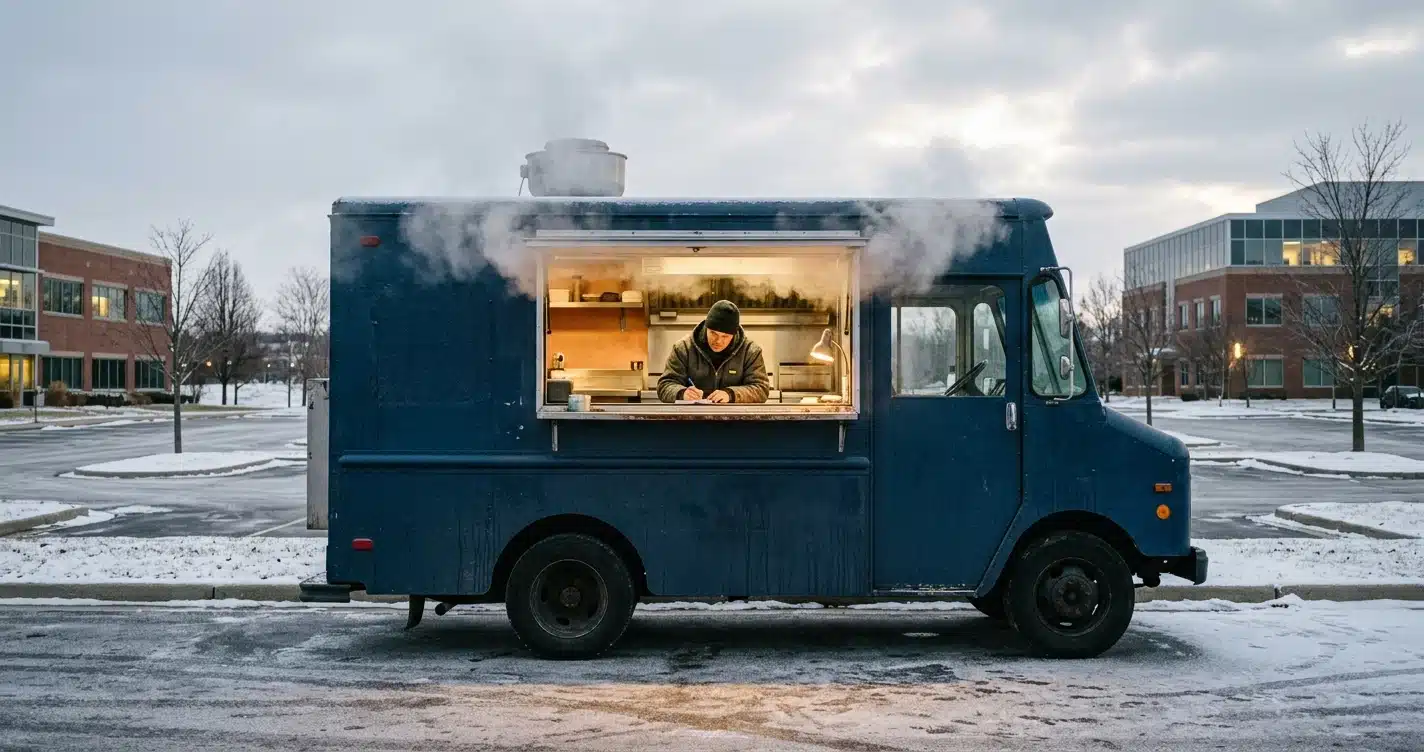
Your personal auto policy will not pay when your food truck backs into a parked car on the way to an event. Most owners learn that after the claim, not before.
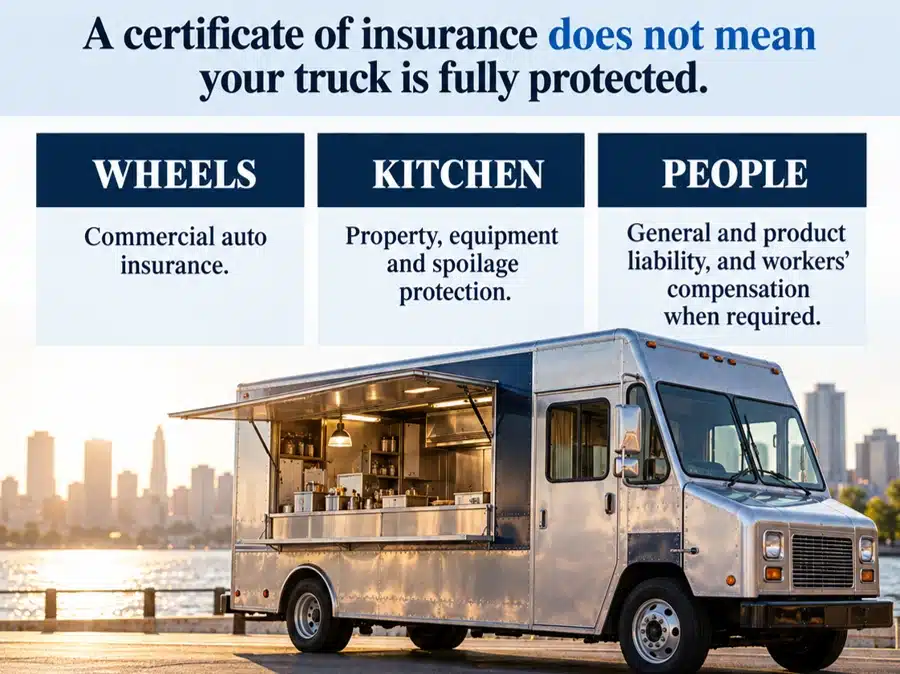
So what food truck insurance coverage do you actually need? Three layers. Commercial auto covers the vehicle. Commercial property covers the kitchen build-out and the equipment inside it. Liability coverage protects you from claims by customers, crew, and anyone who gets sick from your food. Add workers’ compensation when you hire paid help, and ask for spoilage and equipment breakdown coverage by name, because standard policies often skip both.
What does that cost? One national broker, Pro Insurance Group, puts a full-time single truck at roughly $3,600 to $8,400 a year. A part-time pop-up with liability only runs closer to $800 to $1,500. A high-volume truck with deep-fry or open-flame cooking can run $8,000 to $15,000 or more. Those are estimates. Your real quote depends on how you cook, where you park, and your claims history.
Insurance is the topic owners put off longest. They will debate a menu price for an hour, then buy the cheapest policy in ten minutes and hope for the best. That is not a plan. Insurance is a real cost of running a mobile food business, and it belongs in your event pricing, not in a desk drawer.
Key Takeaways
- A food truck needs three layers of protection: wheels (commercial auto), kitchen (property and unattached equipment), and people (liability and workers’ compensation).
- Personal auto insurance does not cover a vehicle you use to run a business, so commercial auto is not optional.
- Standard property coverage often skips spoilage and equipment breakdown, so ask for both by name.
- Event organizers set your minimum limits, often $1 to $2 million per occurrence, and many require additional insured status. Some events are seeking $5 million.
- Insurance is a fixed cost whether you sell out or sit empty, so divide it across your operating days and price your events to cover it.
Why Do So Many Food Truck Owners End Up Underinsured?
Here is how it goes. An owner books their first event. The organizer asks for a certificate of insurance (COI). The owner calls the first agent on Google. Then asks for the cheapest policy that produces a certificate, and gets one the same day. Problem solved, or so they think.
The certificate satisfies the organizer. It does not always protect the owner they way they think it does.
Think about a truck covered by a liability-only policy built for a part-time pop-up. The owner grows into a full weekly schedule and never updates anything. A grease fire guts the kitchen. Liability coverage pays for damage the owner causes to other people. It does not rebuild the owner’s own truck, fryer, and refrigeration. The business ends the same day as the fire.
Three things cause most of the gaps.
Food trucks are three insurance exposures in one. You drive a vehicle, run a restaurant kitchen, and operate a people-facing retail operation. Each carries a different risk, and each needs a different policy. An agent who mostly writes personal or office and retail accounts can miss that.
The paperwork is full of terms nobody explains. Additional insured. Products-completed operations. Replacement cost. Inland marine. One industry guide warns that insurers unfamiliar with mobile food often fail to mention additional insured certificates or what they cost. You cannot price a policy you do not fully understand.
Policies go stale. You add a trailer, a second fryer, a bigger generator, or your first employee. The policy stays the same. Coverage that fit last year’s truck will not fit this year’s business.
How Much Does Food Truck Insurance Coverage Cost?
Start with the numbers. Pro Insurance Group’s 2026 cost guide, updated this month (October 2026), breaks typical monthly costs out by coverage type:
| Coverage | Typical monthly cost |
| Commercial auto | $150 to $450 |
| General liability | $50 to $150 |
| Commercial property (build-out, cooking equipment, generator) | $100 to $200 |
| Business owners policy (liability and property bundled) | Around $85 |
The same guide says a bundled business owners policy usually costs 10 to 15 percent less than buying liability and property separately. It also flags cooking method as a major price driver. Deep-fry and open-flame cooking raise fire risk more than cold prep does.
Other sources land in different places. A QSR Magazine piece on food truck risks cites commercial auto at $1,200 to $3,000 a year and a business owners policy at $500 to $1,000 a year for a $2 million limit. Treat any single number as a rough guide. Your location, equipment value, driving radius, and loss history move the price more than any article can explain.
What Do Event Organizers Actually Require?
Your coverage limits are often set for you by the people who book you.
The University of Denver’s event insurance page asks food trucks for general liability of at least $1 million per occurrence and $2 million aggregate, with the university named as an additional insured, plus $1 million in auto liability. Whatcom County, Washington, asks food trucks catering in its parks for $1 million in general liability and $1 million in business auto. It also wants the county named as an additional insured, coverage that applies first, and a waiver of subrogation. The paperwork is due 30 days before the event. Phoenix College asks for a certificate showing $1 million each in general liability and auto at least three weeks ahead.
Notice the pattern. Limits of $1 million are common. Additional insured status is common. Lead time matters. If you call your agent two days before an event, you may miss it.
Organizers are not being difficult. They are protecting themselves from a risk you bring onto their property. Do not blame the organizer for the requirement. Understand the cost, then price it into what you charge or what you accept. If you are weighing whether a booking pays, my post on how to know if a food truck event is actually worth booking walks through that math.
How Real Is the Fire Risk?
Real enough to plan for. The National Fire Protection Association has reported that about 68 percent of food truck fires involve propane, from either a leak or a tank failure. A Koorsen fire protection write-up of the NFPA data explains why: a truck is an enclosed space, and propane is heavier than air. Older trucks and converted vehicles may lack hood suppression systems entirely.
Insurers know this. It is why your cooking method moves your premium. It is also why I keep pushing owners to read Propane Safety Isn’t Optional. A clean safety record lowers your odds of a claim. Insurance only pays after the loss.
Why Think in Wheels, Kitchen, and People?
Here is the simplest way I know to sort food truck insurance coverage. Ask three questions.
Wheels: Can it legally and safely drive to the event? That is commercial auto.
Kitchen: Can it cook, hold food cold, and make power once it gets there? That is property, equipment, and the spoilage question.
People: Can anyone get hurt, sick, or sued? That is general liability, products coverage, and workers’ compensation.
Every policy you buy should answer one of those three questions. If a quote does not clearly cover a layer, you have found a gap.
Now the second shift in thinking. Insurance is not an expense item you shop on price alone. It is the cost of staying in business after a bad day. A truck that cannot operate has zero capacity. Zero capacity means zero sales while rent, loan payments, and payroll keep coming. The right coverage shortens that stretch. The wrong coverage leaves you paying for a truck that does not run.
Treat your annual premium like any other fixed cost. A $6,000 policy spread over 120 operating days is $50 a day. Add that $50 to the cost side of every event decision. If an event cannot clear its true costs, including insurance, it simply is not a good event.
What Food Truck Insurance Coverage Belongs in Each Layer?
Wheels: Commercial Auto
A personal auto policy is built for personal driving. Commercial auto insurance for food businesses is the policy for a vehicle you use to sell food or haul it to events. File a claim on the wrong policy and the insurer will deny it. Your own truck, your own savings, and the other driver’s medical bills all land on you, personally. Your LLC will be of little use here.
A solid commercial auto policy includes liability for damage and injuries you cause. Add physical damage coverage (comprehensive and collision) so the truck itself is protected.
Towing a trailer? Read this part twice. According to The Zebra’s food truck insurance guide, the commercial auto policy on your tow vehicle may cover the trailer for liability only. You typically need an additional endorsement for comprehensive and collision on the trailer itself. Otherwise a trailer damaged while parked will be your problem. If you are shopping for a trailer, my post on when cheap food trailers become expensive mistakes covers why the purchase price is only the start.
Also ask about hired and non-owned auto. Say a crew member drives their own car to pick up ice or supplies. If something goes wrong, your business may face the claim. That exposure needs the right endorsement.
Kitchen: Property, Equipment, and Spoilage
Commercial property coverage protects the build-out, cooking equipment, generator, and point-of-sale hardware against covered losses such as fire and theft. Many owners buy it inside a business owners policy, which bundles liability and property.
Three questions matter here.
Does it follow the truck? Your property coverage may be location-based. A truck that travels needs protection for contents in transit. Ask whether the policy includes inland marine coverage or a similar floater, which covers business property while it moves between locations.
Replacement cost or actual cash value? Replacement cost pays to buy a new fryer. Actual cash value pays what the used fryer was worth after depreciation. Replacement cost costs more, and it can be the difference between reopening and not. Ask which one your quote uses.
Does it cover breakdown and spoilage? Standard property coverage protects against perils like fire or theft. A failed compressor or generator is a mechanical breakdown. Pro Insurance Group notes that equipment breakdown, or spoilage, coverage is usually a low-cost add-on, and that one bad weekend of spoiled inventory can cost $1,000 to $3,000 out of pocket. Ask your agent to show you the endorsement in writing. Maintenance still matters, and my post on whether your food truck needs its own maintenance schedule is a good place to start.
While you are at it, ask whether you can add business income coverage. It addresses lost income when a covered loss shuts you down.
People: Liability and Workers’ Compensation
General liability is the foundation. It pays when a customer slips at your window, or when you damage a venue’s property. For a food business, the piece that matters most is products and completed operations coverage. That is where a foodborne illness claim lands. Do not assume a general policy includes it. Confirm it.
Next, check your limits against the events you want. Many organizers want $1 million per occurrence. Some want $2 million aggregate. Most want additional insured status, which extends your protection to the venue or organizer. Ask your agent whether the policy adds additional insureds one event at a time or through a blanket endorsement. One industry guide estimated a blanket endorsement at roughly $500 a year, though your price will vary by carrier.
Consider an umbrella policy, also called excess liability. It sits on top of your liability, auto, and workers’ compensation coverage and pays when a serious claim exceeds the underlying limit. One serious injury can blow through $1 million fast.
Then comes your crew. Workers’ compensation rules vary by state, but the trigger can arrive early. Colorado, for example, requires coverage once you have one or more employees working in the state, including part-time workers and family members you pay. Food truck crews work around hot oil, knives, and propane. Check your state’s workers’ compensation agency, and do not guess.
Three more items. If you serve alcohol at events, ask about liquor liability. Take credit cards, ask about cyber coverage for payment data. Serve or make energy drinks ask how that impacts the policy.
This post is education, not insurance or legal advice. Policies and state rules vary. Confirm every detail with a licensed agent in your state.
Practical Steps: How to Buy Food Truck Insurance Coverage Without Guessing
- Inventory what you own. List the truck or trailer, the build-out, every appliance, the generator, and the POS. Add what each costs to replace today, not what you paid. Replacement cost drives your property limits.
- Collect requirements before you shop. Pull the insurance rules from every event, commissary, and venue you want to work. Write down the highest limits and any additional insured or waiver language. That list becomes your shopping list.
- Find an agent who writes mobile food. Ask how many food trucks they insure. Ask whether they place general liability, commercial auto, and property together. A specialist will know the event paperwork without a lesson. This is not something we recommend self service if you are new to the industry.
- Get line-item quotes. Request commercial auto, general liability, and property as separate lines, then ask for the bundled price. Compare the quotes by what they cover, not by the bottom line.
- Read the policy, not the summary. If you use an AI tool to explain a policy, treat the answer as a starting point. Verify every limit, exclusion, and endorsement with your agent in writing. AI can help you build questions. It cannot confirm your coverage.
- Price the premium into your events. Divide the annual premium by your operating days. Add that number to your cost per event so you know your true breakeven.
- Review every renewal and every change. Call your agent when you add a trailer, a fryer, a generator, or an employee. Re-shop at renewal. Coverage that fit last year may not fit now.
Frequently Asked Questions
What insurance does a food truck need?
At minimum, a food truck needs commercial auto for the vehicle, general liability with products coverage for customer injuries and foodborne illness, and commercial property for the kitchen and equipment. Add workers’ compensation when you hire paid help. Ask about equipment breakdown, spoilage, umbrella liability, and any extras your events require.
Is my personal auto insurance enough for a food truck?
No. Personal auto policies are built for private driving and commonly exclude vehicles used for business. Which would include your trailer. If you file a claim on a personal policy for a truck you use to sell food, the insurer will deny it. A food truck needs a commercial auto policy written for how you actually use it.
Does food truck insurance cover spoiled food?
Not automatically. Standard commercial property coverage handles common claims like fire and theft. A refrigeration or generator failure is a mechanical breakdown, so it needs equipment breakdown or spoilage coverage. That add-on is usually inexpensive compared with the cost of losing a weekend of inventory. Ask your agent to confirm it in writing.
What does additional insured mean for a food truck?
An additional insured is a person or business, such as an event organizer or property owner, that receives protection under your liability policy for claims tied to your operation at their event. Organizers commonly require it. Your agent issues a certificate and endorsement naming them. Ask whether your carrier charges per event or offers a blanket endorsement.
Can I just buy the minimum an event requires?
You can, but the minimum protects the organizer, not your business. A $1 million limit can run out fast after a serious injury or illness outbreak. Match your limits to your real risk, consider an umbrella policy, and ask a licensed agent how much coverage fits your cooking method, crowd size, and assets.
Final Word
Go back to that parked car. A food truck backs into it on a Saturday morning, and the owner calls the insurance company with a policy they bought in ten minutes two years ago. In one version of that call, the policy was built for the way the truck really operates. In the other, the owner learns what “exclusions” mean.
You cannot control every accident. You can control what you bought before it happened.
Sort your coverage into wheels, kitchen, and people. Match your limits to the events you want. Get the endorsements in writing. Divide the premium across your operating days and price accordingly. None of it is glamorous, and none of it will put one more customer in line.
But it decides whether one bad day ends your business or just ruins your week.
Keep Learning
- Propane Safety Isn’t Optional: What Every Food Truck Operator Needs to Know: The leading fire risk on a truck and the habits that keep it from becoming a claim.
- How Do You Know If a Food Truck Event Is Actually Worth Booking?: Run the real numbers, including fixed costs like insurance, before you say yes.
- When Cheap Food Trailers Become Expensive Mistakes: Why the sticker price is only the beginning of what a trailer costs you.
- Does Your Food Truck Need Its Own Maintenance Schedule?: Prevent the breakdowns that turn into spoilage and lost sales.
- Lease, Buy, or Loan? Food Truck Equipment Financing Guide: What lenders may require you to insure, and how financing changes your risk.
Bill Moore is the Founder and Executive Director of the National Street Food Vendors Association (NSFVA), a trade association dedicated to advocacy, education, and unifying street food vendors nationwide. He has worked in food service since 1977, and his first street food vending was in 1981. Bill hosts the “10-Minute Food Truck Training” podcast, leads NSFVA’s weekly Mini Class and group coaching sessions, and is the author of Food Truck 101: Beginner to Winner and, with Melisa Moore, Food Truck 201: Get Off the Truck!