Food truck owner time management starts with one uncomfortable question: which of your hours can only you work?
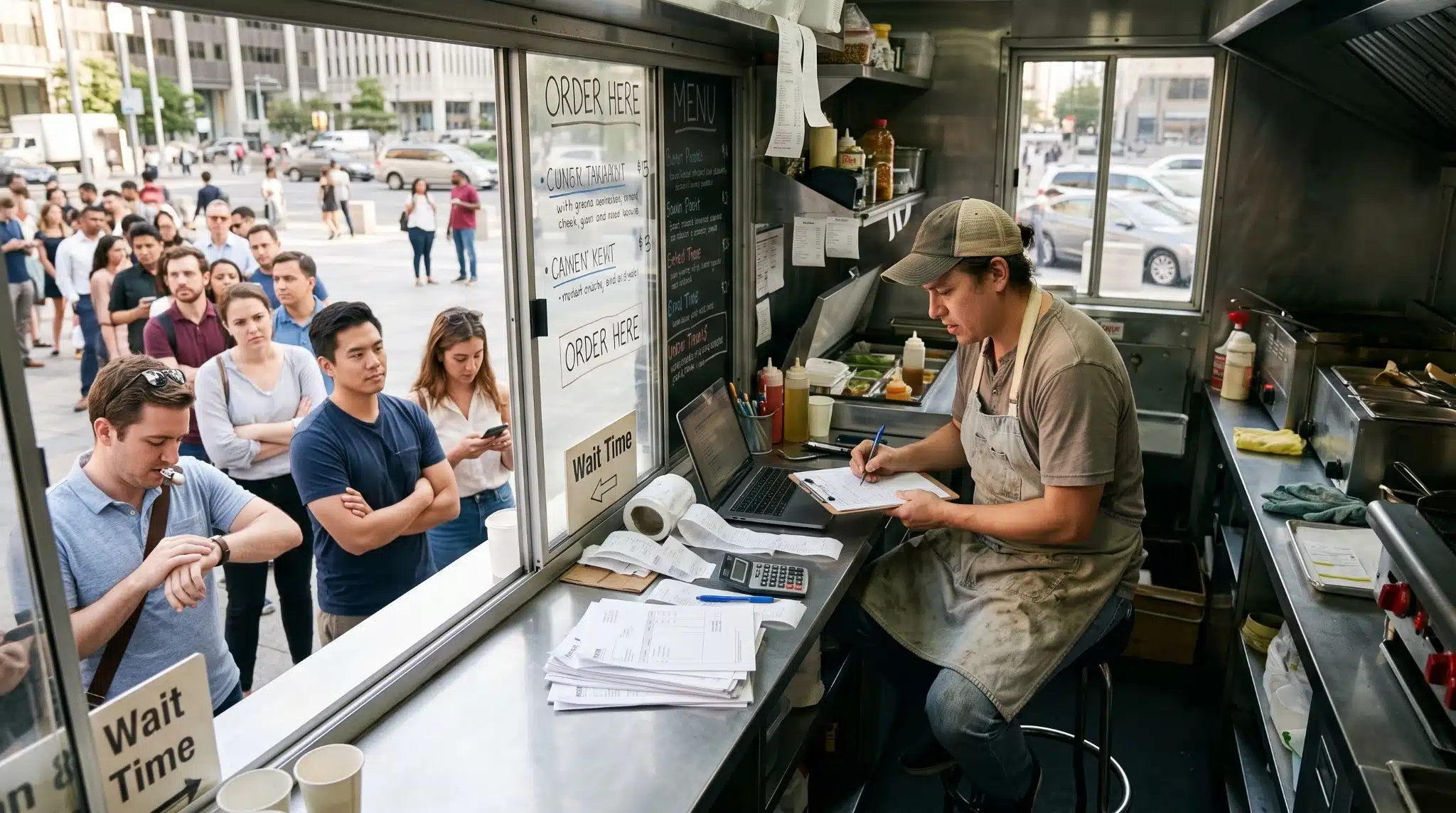
It’s a Sunday night at 11 p.m. Your truck is parked. The weekend event went well. You are at the kitchen table with a laptop, a stack of receipts, next week’s order guide, and an event application due in the morning.
Nobody forced you into that chair. Paperwork has no deadline until it suddenly does, and the only person awake to do it is you.
Spend your best hours on the work only an owner can do: choosing events, setting prices, reading your numbers, and training the people at your window. Move everything that runs on rules instead of judgment to a system, a part-time assistant, or a fixed block on the calendar. That does not mean hiring someone tomorrow. It means knowing which hours are which before you decide what to hand off.
Key Takeaways
- Your most valuable hours go to pricing, event selection, numbers, and people. Data entry, ordering to par, and schedule drafts do not need you.
- One survey of 251 U.S. entrepreneurs found owners spend 36% of a 45.5-hour week on small admin tasks, about 16 hours.
- Sort your week into Truck Hours, Office Hours, and Revenue Growth Hours. Most owners have almost no intentional Revenue Growth Hours.
- Hand off outcomes, not checklists, and write down what the assistant can decide without asking you.
- Desk work comes in waves, so part-time help fits it better than a full-time hire.
Why Does Food Truck Owner Time Management Fall Apart?
Truck work is loud. The prep list is long, the generator needs fuel, and a line is forming at the window. Office work is quiet. It waits until the truck is clean, the crew has gone home, and you finally sit down.
So it slides to later tonight. Then it slides to Sunday. Then it becomes the thing you do instead of sleeping.
A QSR piece, written by Tricia Sciortino, CEO of the virtual staffing company BELAY, describes the same slide for franchise owners. Her point is that an owner who handles the books, inventory counts, and staff schedule saves a salary but relegates the operation’s most valuable player to doing the business’s lowest-return work.
That idea holds on a truck. A franchise owner usually has a general manager who can cover the line. On a truck, the owner often is the line. When you stop to do paperwork, the cooking does not pause, so the paperwork lands in whatever hours are left over.
When I coach owners through their numbers, the conversation starts as a money problem. It usually turns out to be a time problem wearing a money costume. The owner has no hours left to price events well, check food cost, or vet a bad booking. So the business runs on habit, and habits don’t account for change.
What Does the Research Say About How Owners Spend Their Week?
Admin eats more than a third of the week. A 2023 survey commissioned by the virtual assistant company Time etc and run by Censuswide asked 251 U.S. entrepreneurs about their weeks. According to the Time etc survey results, the average workweek was 45.5 hours and 36% of it went to administrative tasks. Multiply those two numbers and you get about 16 hours. The same survey found 31% of owners spend between a quarter and half of their week on small admin.
Many owners keep the work on purpose. In that same survey, 27% said they do not delegate simple tasks because they enjoy them, and 17% said they have no one they trust to hand them to. That second number should sound familiar if you run a one-truck operation. Neither reason is silly. Both cost you hours where you could be growing the business.
Long weeks are normal in this industry. The founder of Mobile Cuisine, writing on his site, says he struggles to recall a full-time food truck owner who works fewer than 70 to 80 hours a week. That is an observation, not a survey. Still, a Wasserstrom piece on established owners describes the same pattern: long days, often seven days a week.
Thin margins leave no room for wasted hours. The QSR article reports that 42% of restaurant operators told the National Restaurant Association their restaurants were not profitable in 2025. When margins are that tight, an owner’s decisions about pricing and bookings carry real weight, and those decisions need hours.
Owners work long weeks, a large slice goes to small repeating tasks, and the work that could change the numbers gets whatever time is left over.
What Is an Owner Hour Actually Worth?
Hands-off advice stops at “delegate the small stuff.” Which skips the question: delegate it to make room for what?
A truck has hard limits: storage, cooking space, prep space, staff, and speed of service. You have a limit too. Your week is a capacity number, and most owners run it at 110% before they ever sit down to think. I sort owner hours into three kinds.
Truck Hours are prep, driving, setup, serving, and cleanup. These pay for today’s sales, and your truck’s capacity caps what they can earn.
Office Hours are bookkeeping entry, ordering to par, drafting schedules, filing invoices, chasing event paperwork, and posting content. These pay nothing directly, but you cannot skip them.
Revenue Growth Hours are deciding which events to book, setting prices, testing the menu, reading your weekly numbers, coaching your crew, and building relationships with organizers. These change what every other hour earns going forward.
Truck Hours pay today. Growth Hours pay next year. Desk Hours cannot be skipped, so they eat the Growth Hours first, because nothing screams when a pricing review does not happen.
Now put a number on it.
Start with owner pay, which belongs in your breakeven math as a fixed cost. Suppose you plan to pay yourself $60,000 a year and you really work 60 hours a week for 50 weeks. That is 3,000 hours, so each hour is worth $20.
If 12 of those weekly hours are office work, that is 600 hours a year. At $20, you spend $12,000 of your own time on tasks a checklist might cover. The honest comparison is not your $20 “rate”. It is what those 600 hours could earn if you used them for Revenue Growth. Vetting and booking one better event a month, or fixing one underpriced menu item, can pay for the help many times over.
That is also the warning. If you free up the hours and spend them scrolling, you just added a cost. Delegation only pays when the hour you get back goes to work that moves your numbers in a positive direction. For more on judging an event before you book it, see my post on how to know if a food truck event is actually worth booking.
What Work Should Leave the Owner’s Desk First?
Start with work that runs on rules instead of judgment. It follows a set process and leaves a paper trail, so you can hand it off and check it.
Usually safe to hand off:
- Entering receipts and invoices, and filing them
- Counting inventory and building the order guide to par
- Drafting the crew schedule from your event calendar
- Tracking permit and license renewal dates on a shared calendar
- Filling out event applications from a standard info sheet
- Scheduling social posts you have already approved
Stays with you:
- Choosing which events to accept and what to charge
- Setting menu prices and reviewing food cost
- Hiring judgment and crew coaching
- Guest recovery when something goes wrong
- Final responsibility for compliance
Notice that compliance is on your list. Mobile vending permits are a normal cost of doing business in many places, and an assistant can track the dates and paperwork. The responsibility stays with you, and the rules vary by jurisdiction. Confirm requirements with your health department.
Bookkeeping needs one more note. You can hand off the data entry, but you MUST review the weekly reconciliation. My post on food truck bookkeeping basics explains why weekly matters and why owner pay belongs in equity as a draw, not in a wage line.
Not sure what belongs in which column? Run a log for 10 working days. Write down every administrative task and mark it either “only I can do this” or “someone could do this with the right instructions.” The QSR article suggests the same exercise. The second column is almost always longer than owners expect.
How Do You Hand Off Work Without Losing Control?
Most owners who try this give up within a month. They pass along the task but keep every decision, so the work boomerangs back for approval at every step. Now you are managing the task instead of doing it, and that feels like more work than before.
Hand over the outcome, not the checklist. “Order to par every Tuesday and keep the count sheet current” tells a assistant what success looks like. A list of checks only tells them what to do next. The first gives them something to own, and it gives you something simple to check.
Put decision rights in writing. Decide what the assistant can do without texting you. Can they reorder to par? Switch to an equal-quality substitute when a supplier is out, up to a dollar limit you set? Raise a price increase with the supplier directly? Every written yes is a decision that leaves your plate for good.
Handing off does not mean losing sight. Visibility comes from what gets reported back, so build three habits.
- A one-page weekly snapshot showing sales by event, food cost percentage, labor percentage, cash position, and open invoices.
- A monthly close on the same date every month, so you always know when the numbers are final.
- A same-day exceptions list for anything that needs you now, such as a supplier price jump, a cancelled event, or a staff problem.
With those in place, your Monday review takes 20 minutes instead of your entire Sunday night.
One more caution. AI tools can sort receipts, draft a schedule, or write an event application, and they get things wrong more often than owners expect. Verify anything touching taxes, payroll, health code, or legal questions with a real professional. My post on whether you should trust an AI tool you didn’t build covers the checks.
Can a Food Truck Afford Help With Office Work?
Most owners weigh the cost of help against zero. That comparison always loses. The honest comparison is against a full-time hire, with payroll taxes, equipment, and the cost of replacing that person, or against what the hours cost at your own hour value.
Back-office work comes in waves: a weekly order, a monthly close, a scheduling crunch midweek. Work that fills a dozen hours a week does not justify a 40-hour hire. A role that needs continuous presence and roughly 20 hours a week or more is the one that warrants a hire. Predictable work on a cycle warrants a fraction of someone’s time.
On a truck, office work is often less than that, which makes part-time help the natural fit. Options include a part-time bookkeeper, a family member working from written outcomes, or a trusted crew lead who gets a paid desk shift each week. My post on training food truck employees who stick around is a good starting point if you are building that crew leader.
Get written quotes before you decide, and do not hire someone to do work you have not written down. If you cannot describe the outcome in one sentence, you are not ready to hand it off. Think job description.
What Can You Do This Week?
- Run the 10-day log. Write down every task you do away from the window and the clock time you spent on it.
- Sort each line. Label it Truck Hours, Office Hours, or Revenue Growth Hours. Total each column.
- Price your hour. Divide planned owner pay by the hours you really work. Treat the result as a floor.
- Pick two tasks to move first. Choose rule-based work with a clear paper trail, such as invoice entry and ordering to par.
- Write one page. Put the outcome, the deadline, and the decisions the helper can make without asking you on a single sheet.
- Set the three reports. Ask for the weekly snapshot, the monthly close date, and the same-day exceptions list from day one.
- Spend the freed hour on purpose. Block it on your calendar as a Growth Hour and use it for event review, pricing, or a crew coaching session.
Frequently Asked Questions
How many hours a week should a food truck owner work?
There is no verified average national number. One industry publisher says full-time owners he meets work 70 to 80 hours a week, but that is an observation, not a survey. Track your own hours for 10 days, then shrink desk hours first rather than the hours that serve guests. I personally kept the work to 50 to 55 hours.
What tasks should a food truck owner delegate first?
Start with work that runs on rules: invoice entry and filing, inventory counts, ordering to par, schedule drafts, permit date tracking, and event application paperwork. Keep pricing, event selection, menu decisions, hiring judgment, guest recovery, and final responsibility for compliance. Those decisions are what owners are for.
Is delegation only for big food businesses?
No. The need is sharper on one truck, because no general manager covers the line while you do paperwork. Delegation can be small: a part-time bookkeeper, a family member working from written outcomes, or a paid desk shift for a trusted crew lead. Size the help to the hours.
Can a food truck really afford to pay for help?
Compare the cost against a full-time hire or against your own hour value, never against zero. Get written quotes for the specific work you want handled. The help only pays back if the freed hours go to higher-earning work, such as event selection and pricing.
How do I figure out what my time is worth?
Divide your planned annual owner pay by the hours you actually work. Count real hours for 10 days and scale up. The result is a floor, not a ceiling, because one good Growth Hour can raise what every other hour earns.
Final word
Go back to that Sunday night at 11 p.m. The laptop is open, the receipts are spread out, and the application is due in the morning.
That scene is not proof that you are committed. It is proof that your week has no room for the work that grows the business, so the work that merely keeps it running took up the room instead.
You can change that without a big budget. Log ten days. Sort the hours. Price your own hour honestly. Move the first two rule-based tasks off your plate, write down what the assistant can decide, and ask for three simple reports. Then spend the hours you get back on the decisions only you can make.
Your hands run the truck. Your decisions run the business. Protect the hours for the second one.
Keep Learning
- What Bookkeeping Basics Does Every Food Truck Owner Need?: Separate accounts, real categories, and the weekly reconciliation you keep even after you hand off the entries.
- How Do You Know If a Food Truck Event Is Actually Worth Booking?: The decision that belongs in your Growth Hours.
- How Do You Train Food Truck Employees Who Actually Stick Around?: Build the crew lead who can take on a desk shift.
- How Important Is Food Truck Speed of Service?: Why capacity, not hustle, sets what your truck can earn.
- Should You Trust an AI Tool You Didn’t Build?: How to verify an AI tool before it touches your numbers.
Sources
- Tricia Sciortino, “How Franchise Owners Hand Off the Back Office Without Adding Headcount,” QSR Magazine, October 19, 2026. The restaurant profitability figure comes from this article’s citation of the National Restaurant Association’s 2026 State of the Restaurant Industry report.
- Time etc and Censuswide, entrepreneur administrative time survey (2023)
- Mobile Cuisine, food truck time management tips
- Wasserstrom, “The Realities of Food Truck Ownership”
Bill Moore is the Founder and Executive Director of the National Street Food Vendors Association (NSFVA), a trade association dedicated to advocacy, education, and unifying street food vendors nationwide. He has worked in food service since 1977, and his first street food vending was in 1981. Bill hosts the “10-Minute Food Truck Training” podcast, leads NSFVA’s weekly Mini Class and group coaching sessions, and is the author of Food Truck 101: Beginner to Winner and, with Melisa Moore, Food Truck 201: Get Off the Truck!