Yes, and if you’re only tracking your kitchen equipment, you’re one belt snap away from losing a weekend.
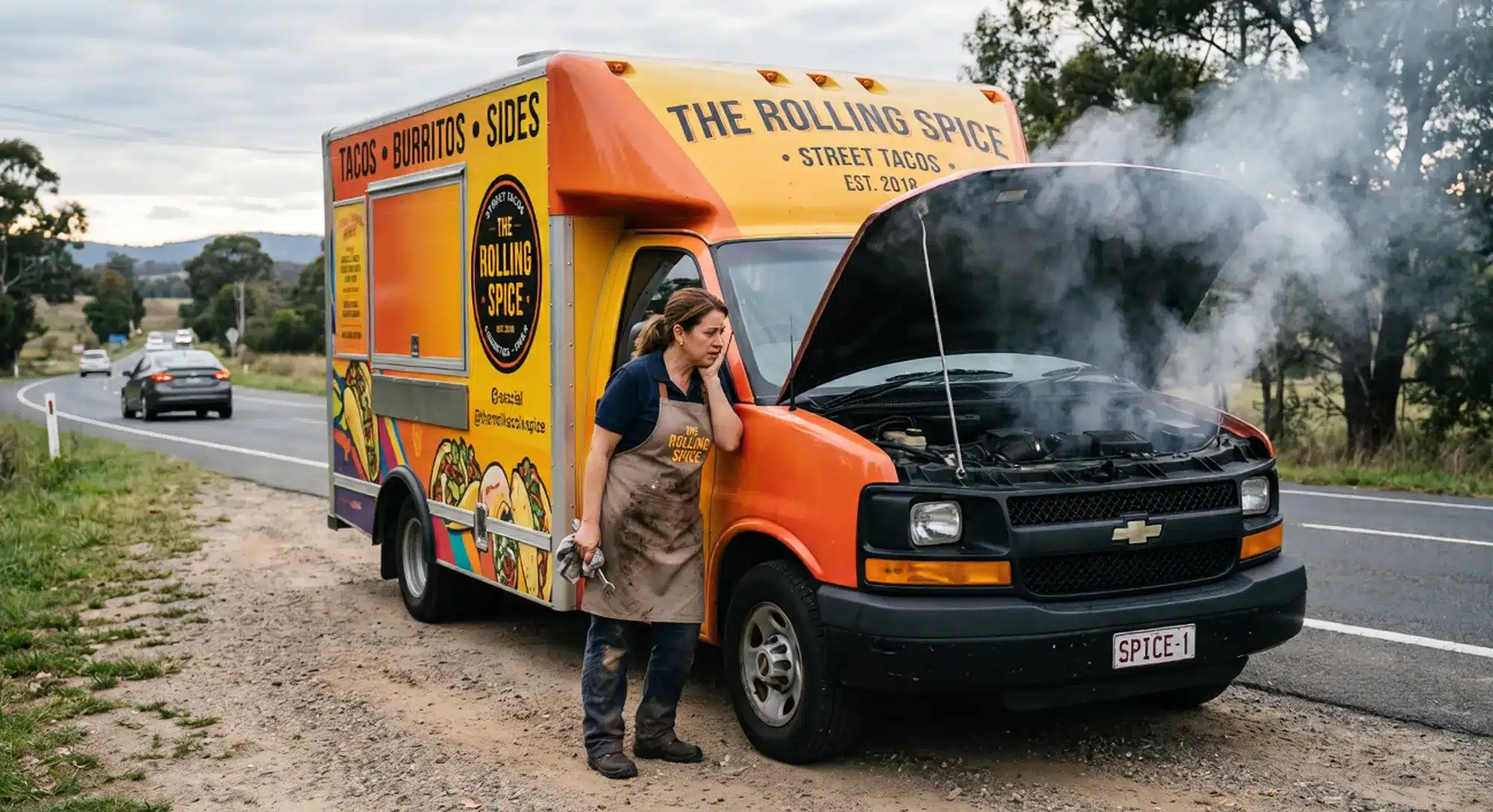
I know an owner who had a perfect kitchen. Fryer schedule taped to the wall, griddle seasoning routine dialed in, prep list laminated and hanging by the door. Then his truck broke down on the interstate on the way to a Saturday event. A belt snapped taking the alternator went with it. The whole weekend was lost and four hundred dollars on a tow bill.
He had a maintenance plan for every piece of equipment that cooks food. however he had zero plan for the engine that gets the food there.
That’s the blind spot almost every food truck owner has. Here’s the direct answer: yes, your food truck needs its own maintenance schedule, completely separate from your kitchen equipment log. Your truck runs a harder duty cycle than a regular commuter vehicle. Repair costs are one of the top expenses in this business. Reacting to a warning light is not a maintenance plan. It’s damage control after the fact. Build a real schedule, and the surprises get smaller and a lot cheaper.
Key Takeaways
- A food truck maintenance schedule is a separate system from your kitchen equipment log. It covers the engine, tires, brakes, fluids, and, if you tow, the trailer and hitch.
- Vehicle repair and maintenance typically eats 5 to 10 percent of a food truck’s revenue, depending on the truck’s age. That puts it right behind food cost and labor cost as a top expense.
- If your rig’s Gross Vehicle Weight Rating tops 10,001 pounds and you’re operating commercially, you may fall under federal DOT annual inspection rules. That’s true whether you feel like a “real trucking company” or not.
- A weekly walkaround, a manufacturer-specific service interval, and an annual deep inspection cover almost every failure mode. Together they stop most breakdowns before they shut down an event day.
- A written maintenance log is not busywork. It’s what a mechanic needs to diagnose fast, and it’s what proves compliance if you’re ever asked.
Your Kitchen Isn’t the Business. Getting There Is Part of It Too.
We talk endlessly on this podcast and in this newsletter about fryers, griddles, and shortening, and we should. That’s food cost, and food cost is where a lot of owners bleed money without noticing. But your truck is a completely separate machine with its own wear pattern. So is your tow vehicle, if you’re pulling a trailer. Most owners never put it on a schedule at all. Something makes a noise, or a light comes on, and then they deal with it.
I’ve coached enough operators to know why this happens. You didn’t get into this business because you love diesel engines. You got into it because you can cook. Maybe you saw a gap in your market. Maybe you just wanted to be your own boss. The truck is the thing that gets you to where the actual business happens. It’s easy to treat it like a company car instead of a piece of commercial equipment. That’s exactly the mistake that costs owners their busiest weekend of the season.
Here’s why this matters more for a food truck than for a regular commuter vehicle. That’s driving to an office and back on a predictable loop. What you are doing is loading a truck or trailer heavy with water, product, and equipment. You’re running it short distances with a lot of stop-and-start. Then you’re parking it and running a generator, or the engine itself, for hours during service. That’s a hard duty cycle. It’s closer to how a delivery fleet treats a vehicle than how your neighbor treats a pickup truck. Treat the vehicle like a surprise expense and it keeps costing you surprise money. Treat it like a planned cost and it gets a lot cheaper, and a lot more predictable.
What the Numbers Say About Vehicle Maintenance Costs
Repair and maintenance is not a rounding error in a food truck budget. The research backs up what those of us who’ve been doing this for decades already know from experience.
The Maintenance Budget by Truck Age
A 2025 food truck maintenance budget analysis from BusinessDojo breaks it down by truck age. Newer trucks under three years old typically run 5 to 7 percent of revenue on vehicle maintenance. Mid-age trucks between three and seven years climb to 7 to 9 percent. Trucks past the seven-year mark often hit 9 to 10 percent or more, as major components start wearing out. For an operation doing $200,000 a year, that’s a real number, not a footnote. That same research puts the recommended annual maintenance budget for a standard food truck at $6,000 to $12,000, covering both the vehicle and the kitchen equipment.
This lines up with what the broader commercial vehicle industry sees. Owner-operators in trucking generally budget around 10 percent of total operating costs toward maintenance, according to Rigbooks. That typically runs 10 to 15 cents per mile. The figure holds up whether you’re running a semi or a heavily loaded box truck making short hops between a commissary and an event site. Your food truck’s duty cycle isn’t identical to an over-the-road rig. But the underlying lesson holds: a vehicle working this hard needs a maintenance line item that’s planned, not reactive.
What Insurance Won’t Cover
Insurance doesn’t rescue you here either. The 2026 FLIP food truck insurance survey put the average equipment claim in 2025 at $2,558. Most standard policies won’t reimburse the income you lose while the truck sits in a shop, unless you’ve specifically added business income or breakdown coverage. That’s a gap a lot of owners don’t discover until they’re already living it.
The DOT Inspection Threshold
Then there’s the regulatory piece. This one catches owners off guard because it sounds like it only applies to “real trucking companies.” Per FMCSA guidance under 49 CFR 396.17, an annual DOT inspection is required for any commercial motor vehicle with a Gross Vehicle Weight Rating of 10,001 pounds or more operating under DOT authority. A lot of fully built-out food trucks, and plenty of tow vehicle and trailer combinations, cross that threshold without the owner ever checking. If you’re not sure where your rig lands, that’s not a guess to make from the driver’s seat.
The Reframe: Two Machines, One Truck
Here’s how I’ve come to explain this to owners I coach. You are not running one machine. You’re running two: a kitchen and a vehicle, bolted together and sharing a single set of keys. They fail differently, and they age differently. They demand completely different maintenance disciplines, but most owners only build a system for one of them.
Your kitchen equipment log tells you when the fryer oil needs changing and when the griddle needs reseasoning. It has nothing useful to say about brake pad wear or alternator life. When an owner tells me “I’ve got maintenance covered,” what they usually mean is “I’ve got the kitchen covered.” That’s half a maintenance plan wearing the label of a whole one. It’s the reason so many breakdowns feel like they came out of nowhere. They didn’t come out of nowhere. They came out of a blind spot.
Building the Schedule: What to Check, How Often, Who’s Responsible
This is the system I walk owners through. It breaks into three pieces.
What Needs Its Own Schedule
This is separate from your kitchen equipment log entirely. You need to track engine oil and filter changes, tire pressure and tread depth, brake condition, and all lights and signals. Add fluid levels across the board: coolant, transmission, power steering. Include belts, hoses, and battery condition too. If you’re towing a trailer, the hitch, safety chains, brake controller, and trailer tires all get their own inspection. A trailer failure at highway speed is a different category of dangerous than a slow leak in a parking lot.
The Intervals
I want to be specific here. A basic inspection covering tires, lights, fluid levels, and brakes should happen weekly, before you head to an event, not after something feels wrong. That’s a fifteen-minute walkaround, and it costs you nothing but the time. An oil change and a deeper look at belts, filters, and brake wear generally falls somewhere in the 10,000 to 15,000 mile range for most vehicles in this kind of service. Your actual interval depends on your specific engine and manufacturer. Check your owner’s manual. Don’t guess. Once a year, budget for a bigger inspection: frame, suspension, exhaust. That’s the kind of once-over a real mechanic does, not something you handle yourself in a parking lot.
Who’s Responsible
You, the owner, do the weekly walkaround. That’s not optional. It’s not something you hand off to whoever’s driving that day without training them on what to actually look for: a soft tire, a crack in a hose, a headlight that’s dim instead of dead. The deeper service work goes to a mechanic who works on your specific engine, not whoever’s cheapest that week. Here’s the piece that separates owners who avoid breakdowns from owners who don’t: write it down. A logbook, a spreadsheet, even a notebook in the glovebox works. Date, mileage, what was done. That log tells you when the next service is actually due instead of you guessing. It’s what a mechanic wants to see when diagnosing a problem fast. If you ever sell the truck, or need to prove you maintain your vehicle, that log is your evidence.
Build Your Schedule This Week
1. Pull your owner’s manual. Find it online if the paper copy is gone. Write down the manufacturer’s actual recommended service intervals for your specific engine and mileage. Don’t use a generic number. Use yours.
2. Start a maintenance log today. Keep it separate from your kitchen equipment log. Put your first entry in right now, with your current mileage and the last service you remember having done.
3. Add the weekly walkaround to your pre-event routine. Use the same clipboard, the same habit you already use to check your propane and fryer oil. This is just a second checklist, not a new system.
4. Check your GVWR before you assume you’re exempt. If you’re not sure whether your rig’s weight rating puts you under federal DOT maintenance and inspection requirements, don’t guess. Check your vehicle’s actual weight rating. Then call your state’s motor vehicle or transportation department, or talk to a commercial insurance agent who handles food trucks.
5. Confirm what your insurance actually covers. Ask directly whether your policy includes business income loss during a breakdown. Most standard commercial auto policies do not. You want to know that before you’re standing next to a dead truck on a Saturday morning.
6. Price out a real inspection, not a guess. Get a quote from a mechanic who works on commercial vehicles in your area for the annual deep inspection. Put that number in your budget now, instead of discovering it later.
7. Do not take an AI tool’s word for the legal or regulatory pieces. Getting your DOT status wrong isn’t just a maintenance question, it’s a legal and safety one. Verify anything a chatbot tells you against your actual paperwork and your state’s requirements before you act on it.
Frequently Asked Questions
Does my food truck really count as a commercial motor vehicle under DOT rules?
It depends on your Gross Vehicle Weight Rating, not on how big your operation feels. Your truck, or your truck-and-trailer combination, may hit a GVWR of 10,001 pounds or more. If it does, and you operate commercially, you likely fall under federal inspection requirements. Check your actual weight rating rather than assuming.
How often should I actually check my food truck’s tires and brakes?
Do a basic visual check, tires, lights, fluids, and brakes, weekly before any event, not after something feels off. That fifteen-minute walkaround catches most problems before they become breakdowns. Deeper brake and component inspection happens at your manufacturer’s recommended service interval.
Does my food truck insurance cover me if the truck breaks down before an event?
Usually not automatically. Most standard commercial auto policies do not cover lost income from a breakdown. You need a specific business income or equipment breakdown rider added. Call your agent and ask directly what your current policy covers.
Is a separate vehicle maintenance log actually necessary, or can I just keep it with my kitchen log?
Keep them separate. Your kitchen log tracks fryer oil and griddle seasoning; your vehicle log tracks mileage-based service and inspection dates. Combining them makes both harder to use. It also increases the odds that vehicle maintenance gets forgotten in the noise of daily kitchen tasks.
What’s the single biggest mistake owners make with vehicle maintenance?
Treating the truck like a personal vehicle instead of commercial equipment. Owners who wait for a warning light or a strange noise before acting are doing damage control, not maintenance. Damage control always costs more in lost events and emergency repair bills than a planned schedule would.
The Truck Gets You There
Your kitchen equipment doesn’t get you to the event. The truck does. Give it the same respect you give your fryer. That means a schedule, a log, and a habit of checking before something breaks instead of after. Do that, and the surprises get a lot smaller and a lot cheaper.
You built a system for the food. Now build one for the machine that carries it.
About the Author
Bill Moore is the Founder and Executive Director of the National Street Food Vendors Association (NSFVA), a trade association dedicated to advocacy, education, and unifying street food vendors nationwide. He has worked in food service since 1977, and his first street food vending was in 1981. Bill hosts the “10-Minute Food Truck Training” podcast, leads NSFVA’s weekly Mini Class and group coaching sessions, and is the author of Food Truck 101: Beginner to Winner and, with Melisa Moore, Food Truck 201: Get Off the Truck!