There’s no standard food trailer rental rate. Pricing one before you handle insurance, repairs, and a real lease is how owners lose months of income.
A guy called into a coaching session a few months back with a problem. He had a second trailer sitting in his lot, paid off, barely used since he upgraded his main rig. A friend of a friend wanted to rent it for the summer. “What’s the going rate on something like that?” he asked me.
Here’s the direct answer: there isn’t one. Not a dependable one, anyway. Two food trailers can look nearly identical parked side by side. They still carry different replacement values, equipment packages, maintenance histories, and permitting headaches depending on where they’ve operated. Asking what someone else charges tells you almost nothing useful about what you should charge. It also tells you nothing at all about whether renting the trailer out is something your insurance company will allow.
Before you ever discuss a food trailer rental rate, you need answers to four bigger questions. Whether your policy covers it. Who pays when something breaks. How you actually calculate a fair number, and what belongs in the written agreement. Skip those and the “easy income” from an idle trailer turns into the most expensive asset you own.
Key Takeaways
- There is no dependable “going rate” for renting a food trailer. Similar-looking units can carry very different replacement value, condition, and repair risk.
- Call your insurance company before you call a renter. Get written confirmation that your policy allows another business to operate the unit, or add the right coverage first.
- Repair responsibility has to be spelled out in a written lease, not assumed. A handshake deal leaves both sides guessing when something breaks.
- Calculate your rental rate from your real ownership costs (depreciation, insurance, a maintenance reserve, admin time, loss-of-use risk, and a return), not from what a friend charges.
- One damaged generator or a bad towing accident can wipe out several months of rental income if your agreement and your insurance weren’t built to absorb it.
Why Do Food Truck Owners Get Burned Renting Out Trailers?
I’ve coached hundreds of owners over the years, and the trailer rental conversation follows a predictable pattern. Someone has a spare unit sitting idle, or they’re between builds, or they picked up a second trailer at auction that turned out to be more than they needed. A renter shows up with cash and enthusiasm. The math looks simple: quote a monthly number, sign something that looks official enough, hand over the keys.
That’s where it goes wrong.
Owners treat a food trailer like a spare bedroom on a short-term rental app. It isn’t. A food trailer is a rolling commercial kitchen with propane lines, electrical systems, refrigeration, and a hitch connection to whatever vehicle is towing it down the highway. When that unit is out of your hands and in someone else’s, you’re not just renting equipment. You’re renting exposure. If the renter causes a grease fire, backs into a light pole, or lets the reefer die in July heat and spoils a week of inventory, the question of who absorbs that cost gets answered by whatever you did or didn’t put in writing, not by what felt fair at the time.
I understand the pull. An idle trailer is dead capital. It depreciates whether it’s working or parked, and a monthly rental check feels like found money. But found money that isn’t insured, isn’t contracted, and isn’t priced against your real costs is a loan you didn’t know you took out against your own business.
What Does the Research Say About Renting Commercial Trailers?
Start with insurance, because this is where most owners assume protection they don’t actually have. Most food trailer general liability policies are written around your own operation, not a third party’s. According to Insureon, a hired and non-owned auto policy is often necessary specifically because <cite index=”1-1″>a business’s own auto insurance typically won’t cover a leased or rented vehicle used for work purposes</cite>. If your renter is towing that trailer with their own truck, your standard commercial auto policy on your tow vehicle isn’t in the picture at all. Their vehicle, their coverage, and if it’s inadequate, you can get pulled into the claim as the equipment owner.
Insurance Canopy’s coverage breakdown makes a related point that surprises a lot of owners: food trailer coverage typically only applies when the trailer is detached from a vehicle and parked, while a separate commercial auto policy is required to cover the trailer while it’s being towed or in an accident</cite>. That split matters enormously in a rental arrangement, because now you have two vehicles, two operators, and two sets of coverage that all need to line up correctly, and none of it lines up automatically just because you both have “insurance.”
On the money side
The equipment rental industry has already solved the pricing problem, and food trailer owners keep reinventing it badly. The standard approach from commercial rental rate calculators isn’t “check what the market charges.” It’s cost-plus pricing: add up your real ownership costs (depreciation, insurance, maintenance, storage, and overhead), divide by your expected rental days, and add a profit margin on top. One industry guide lays out the exact structure operators use, describing rental pricing as a mix of hard numbers and market awareness, starting with the true daily cost of ownership before adding a margin that keeps the business competitive and profitable.
And the downside risk is real money, not a hypothetical. Equipment rental research from Hapn found that the full lifecycle cost of rental equipment, including maintenance, insurance, downtime, and depreciation, typically runs two to three times the original purchase price</cite>. A trailer you paid $28,000 for could genuinely cost you $60,000 or more to own and rent out correctly over its life. If your rental rate doesn’t account for that, you’re subsidizing your renter’s business with your own capital.
The legal side backs this up too. One food truck lease dispute reviewed by an attorney on JustAnswer involved a renter walking away from a two-year contract nine months in, offering to forfeit a $5,000 deposit, only to have the owner refuse and threaten legal action over the remaining contract term. That’s a fight that happens in court, not over a handshake, and it only goes well for the party who had a real contract to point to.
The Real Reframe: You’re Not Renting a Trailer, You’re Renting Risk
Here’s the shift in thinking that changes how you approach this entire conversation: a rental rate is not the price of a piece of equipment. It’s the price of transferring risk from your balance sheet to someone else’s operation for a set period of time, while the liability for how they use it can still boomerang back to you.
Once you see it that way, the four questions in this article stop looking like paperwork and start looking like what they actually are: risk management. Insurance confirms whether the risk is even insurable in the first place. The repair clause decides who eats the cost when the risk becomes real. The rate calculation makes sure you’re being paid for carrying that risk, not just for the use of a piece of metal and stainless steel. And the written agreement is what proves any of it in a dispute.
Most owners price the trailer. You need to price the exposure.
How Do You Actually Handle a Food Trailer Rental the Right Way?
Let’s walk through the four questions in order, because the order matters. Skip step one and nothing after it protects you.
First, call your insurance company before you call a renter.
Don’t assume your current food trailer policy or commercial policy covers another business operating the unit for a season. Tell your agent exactly what’s being proposed: who’s driving it, where it’s going, how long the arrangement runs. Get the answer in writing. The renter should carry their own commercial general liability and product liability coverage, and depending on how the trailer is moved, they may need commercial auto or hired-vehicle coverage as well. You should be listed as an additional insured on their policy, the same way event organizers require you to list them on yours.
Second, put repair responsibility in writing before you hand over keys.
A reasonable starting split looks like this: you handle documented pre-existing defects and major failures from ordinary age or wear, and the renter handles cleaning, routine maintenance, consumables, and any damage from misuse, improper towing, neglect, freezing, fire, overloading, accidents, or ignoring the equipment’s operating instructions. No repair or replacement happens without your written approval, except in a genuine emergency. Vague language here is where relationships and businesses both fall apart.
Third, calculate the rate from your real numbers, not from a guess.
Add up your monthly ownership cost: depreciation from commercial-grade use (which is faster than personal use), the additional insurance the arrangement requires, a maintenance and repair reserve, your administrative time, the loss-of-use risk if the trailer sits in a shop for three weeks, and a reasonable return on your investment. One damaged generator, a refrigeration failure, a towing accident, a hood-system problem, or a bent axle can erase several months of rental income in one event. Your rate has to be built to absorb that, not just to look competitive against what the guy down the road is charging.
Fourth, don’t hand over a trailer without a real agreement.
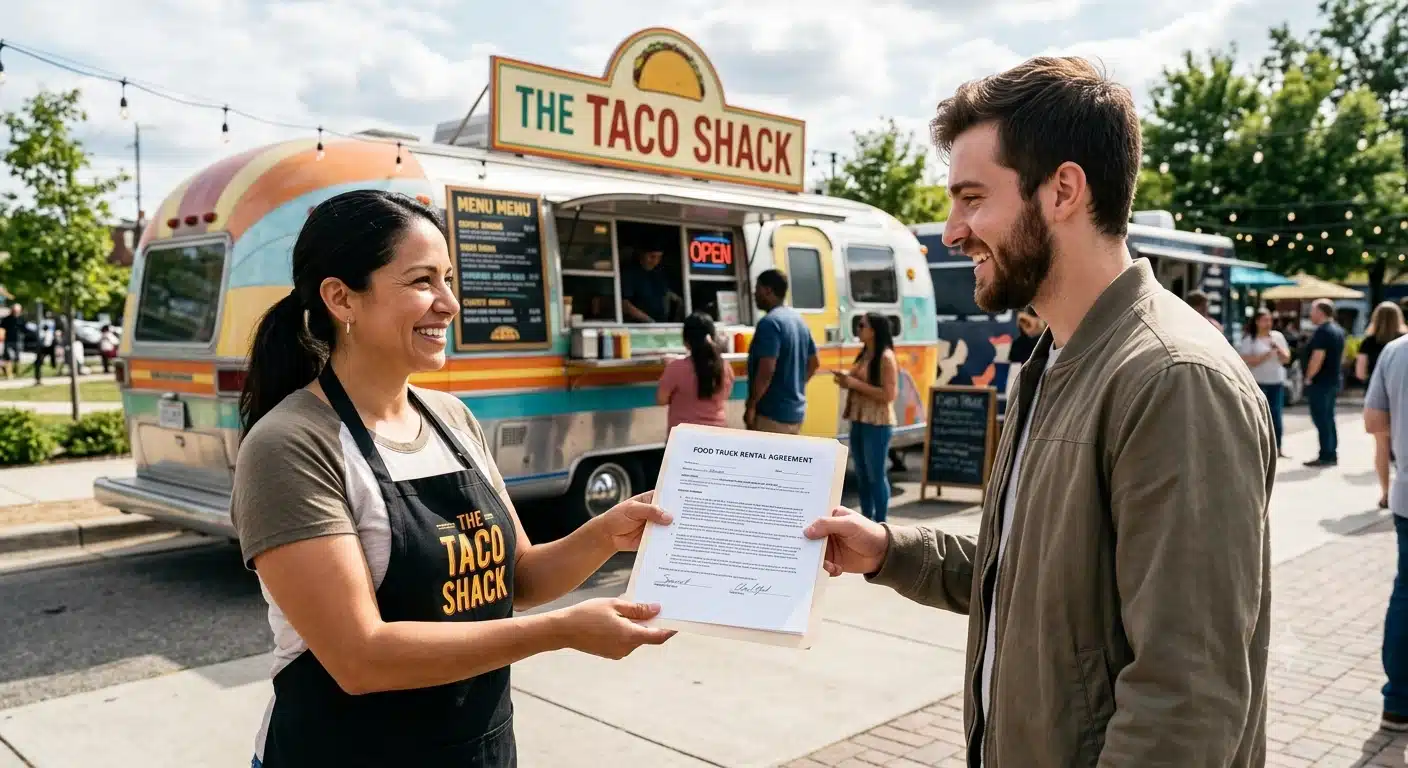
At minimum, this means a professionally prepared commercial lease, a security deposit, proof of insurance before possession, approved drivers and towing vehicles, a detailed equipment inventory, an inspection with photographs documenting condition, limits on location and permitted use, clear responsibility for licenses, permits, and commissary requirements, maintenance and cleaning standards, a breakdown and repair procedure, a prohibition against subleasing, and provisions for late payment, repossession, and abandonment. If the renter is a newly formed or thinly funded business, add a personal guarantee.
Practical Steps Before You Rent Out a Food Trailer
- Call your insurance agent first. Describe the exact arrangement, ask directly whether it’s covered, and get the answer in an email you can reference later.
- Require proof of the renter’s own coverage before they touch the trailer. Commercial general liability and product liability at minimum, with you listed as additional insured.
- Talk to a commercial attorney about the lease structure. A generic online rental form built for renting out a lawnmower is not built for a mobile commercial kitchen.
- Build your true ownership cost model on paper. List depreciation, insurance, a maintenance reserve, admin time, loss-of-use risk, and your target return before you land on a monthly number.
- Write the repair responsibility clause in plain language. Spell out what’s yours, what’s theirs, and what requires your written approval before any work happens.
- Conduct and document a full inspection. Photograph the trailer inside and out, log the equipment inventory, and attach it to the lease before possession changes hands.
- Collect a security deposit sized to actual risk, not to what feels comfortable. A generator or a compressor failure costs real money, and the deposit should reflect that.
Frequently Asked Questions
Will my food trailer insurance automatically cover someone else operating it? Almost never. Most policies are underwritten around your specific operation. Renting the trailer to another business is a material change your insurer needs to approve in writing, and the renter typically needs their own liability and, depending on towing arrangements, commercial auto coverage as well.
What’s a fair way to set a food trailer rental rate? Build it from your real costs: depreciation, insurance, a maintenance reserve, admin time, loss-of-use risk, and a reasonable return. Asking what other owners charge tells you their price, not your cost, and those two numbers are rarely the same.
Who should pay for repairs on a rented food trailer? That belongs in the lease, not left to assumption. A common split has the owner covering pre-existing defects and age-related failures, while the renter covers cleaning, routine maintenance, and damage caused by misuse, neglect, or accidents.
Can I rent out my trailer with a simple handshake deal for a short season? No. A verbal agreement or a generic online rental form leaves both sides exposed the moment something breaks or a dispute starts. A professionally prepared commercial lease protects the arrangement and gives you something enforceable.
What’s the biggest risk of renting a trailer without a proper agreement? An uninsured loss you’re personally on the hook for, or months of lost rental income from a single mechanical failure with no repair clause to fall back on. Both are preventable with the right calls made before you hand over the keys.
The Bottom Line on Renting Out Your Food Trailer
That owner with the idle second trailer eventually did it right. He called his insurance agent first and found out his existing policy excluded the arrangement entirely. He added the right coverage, worked with an attorney on a real lease, and calculated a rate that accounted for what a blown compressor would actually cost him. His monthly number ended up higher than what his friend had originally offered. He took the deal anyway, because now it was a number he could defend instead of a number he hoped would hold up.
Don’t let a handshake, a downloaded template, or someone else’s “going rate” set the terms on a piece of equipment that can put your business at risk the moment it leaves your lot. Make the calls first. Price the risk, not just the trailer.
Keep Learning
- When Cheap Food Trailers Become Expensive Mistakes: The same condition-and-risk variance behind “two trailers can look identical and still carry very different repair risk” gets a full breakdown here.
- Lease, Buy, or Loan? Food Truck Equipment Financing Guide: The ownership-cost math in this article (depreciation, financing, true cost of the asset) is the same math you need before you set a rental rate.
- Bad Advice Is Holding Back the Mobile Food Industry: Why “what’s everyone else charging” is the wrong question to build a business decision on, in pricing and in rentals alike.