A lemonade vendor asks a simple question:
“Do you guys tack on the tax at checkout for your customers, or just pay out taxes from your base lemonade price?”
That should have been an easy discussion about pricing, sales tax setup, and clean recordkeeping. Instead, the answers went sideways.
One person said, “Cash it’s added in. If paying by card, they pay the tax.”
Another said, “Taxes are built into the cash price. If they use a card, I have the machine set up to charge them sales tax. I always tell people I will either pay your sales tax OR your credit card processing fees, not both.”
That may sound clever in a Facebook comment thread. It is not clever. It is the kind of bad advice that keeps the mobile food industry from being taken seriously.
Sales Tax Is Not a Pricing Trick
Sales tax is not a tip jar. Sales tax is not a discount. Sales tax is not something you “pay for the customer” when they use cash and then “make the customer pay” when they use a card.
Sales tax is a legal obligation tied to the taxable sale. The customer’s payment method does not magically change whether the sale is taxable.
If your state, county, or city requires sales tax on that lemonade, taco, burger, coffee, or funnel cake, then the tax has to be handled correctly. Whether the customer hands you a twenty-dollar bill or taps a card, the business still needs to account for the sale, report the taxable amount, and remit the proper tax.
That is the part too many vendors miss. They treat tax like a cost they can absorb when it feels convenient. But tax is not just another expense like napkins or propane. You may be the one filing the return, but that tax belongs in the compliance bucket, not in your margin.
“Tax Included” Can Be Legal. Sloppy Tax Handling Is Not.
There is a difference between properly using tax-included pricing and casually hiding tax inside a cash price. A food truck can decide, in some places, to advertise a clean price such as:
$5 lemonade
Tax included
That can be a smart guest-experience choice. Fairs, festivals, farmers markets, and high-volume service windows often benefit from simple, easy-to-read pricing. Whole-dollar pricing can make the menu cleaner, speed up ordering decisions, and reduce confusion at the window.
But let’s be clear: making change is not the problem. A trained food service operator should be able to handle cash accurately and quickly. I was making change as a teenager by hand in drive-thrus in the 1970s and still hitting speed-of-service expectations. The problem is not coins. The problem is hiding behind “simple pricing” as an excuse to handle sales tax casually.
Simple pricing is fine. Sloppy tax handling is not.
But here is the key: “tax included” still must be handled correctly and legally.
That means the owner needs to know whether tax-included pricing is allowed in their jurisdiction, whether the menu needs to disclose it, how the receipt should show it, and how the taxable sale should be backed out in the POS or accounting system.
That is very different from saying, “I charge one price for cash and then add tax if they use a card.” That sentence is admitting tax fraud and over charging credit card users. How you ask?
If Lemonade is $5.00 tax inclusive that means the retail price is (with a 7% tax rate) $4.67 The tax cheater is admitting charging retail of $5.00 PLUS sales taxes. Effectively forcing the credit card guest to pay $0.33 MORE because that owner is mathematically challenged.
That is not a pricing strategy. That is confusion disguised as confidence. Soon be dressed in prison orange.
The Card Fees Don’t Excuse Dumb Advice
Let’s be honest. Credit card processing fees are a simple expense and one of the LOWEST expenses on your truck. Credit card fees are a cost of doing business. They are not a reason to play games with sales tax.
When a vendor says, “I’ll either pay your sales tax or your credit card fee, but not both,” they are mixing two separate issues. Sales tax is a compliance issue. Credit card processing is a payment cost issue. Combining them into one checkout gimmick creates confusion for the guest, bad records for the owner, and risk for the business.
If an owner wants to offer a cash discount or add a card surcharge, that needs to be done legally, clearly, and correctly. The rules vary by state, by card type, and by processor. Debit cards, prepaid cards, credit cards, cash discounts, service fees, and surcharges are not all treated the same.
This is where a lot of vendors get themselves into trouble. They hear somebody online say, “Just add 3.5% for cards,” and they copy it without understanding the rules.
That is a future problem waiting for a slow Tuesday inspection, a customer complaint, a processor review, or a tax audit.
Bad Advice Spreads Faster Than Good Systems
The mobile food industry has a bad habit. A new owner asks a serious question. Instead of getting a professional answer, they get a pile of shortcuts:
“Just do cash only.”
“Don’t report everything.”
“Build the tax into cash and charge tax on cards.”
“Add a fee and call it something else.”
“Everyone does it.”
“Inspectors don’t care.”
“You’re overthinking it.”
That last one may be the most dangerous.
No, you are not overthinking it when you ask how to collect tax properly. You are not overthinking it when you ask whether your POS is set up correctly. You are not overthinking it when you ask if your pricing is legal, transparent, and profitable.
You are running a business. A food truck is not less of a business because it has wheels. A lemonade trailer is not exempt from business fundamentals because the product looks simple. A tent vendor does not get a pass because the setup is temporary.
Mobile food is food service, retail, tax collection, public health, logistics, event operations, and customer service all rolled into one small footprint. That means bad advice does real damage.
Bad Advice Hurts the Whole Industry
When one vendor cuts corners, they are not just risking their own business. They are hurting the reputation of every serious operator trying to do things correctly.
Think about what happens when an event organizer sees vendors handling tax inconsistently. One vendor charges tax. One vendor says tax is included. One vendor adds tax only on card payments. One vendor adds a mystery fee. One vendor runs cash outside the POS.
From the organizer’s view, the industry looks disorganized. From the customer’s view, the checkout feels suspicious. From the regulator’s view, mobile vendors look like they need more oversight.
Then good vendors wonder why cities add more rules, event organizers demand more paperwork, and lawmakers treat food trucks like a problem instead of a legitimate part of the food economy.
We cannot complain about being treated like amateurs while giving amateur advice in public comment threads.
The Right Way to Think About Pricing
A professional vendor does not start with, “How can I hide the fee?” A professional vendor starts with, “What does this product need to sell for so the business works?”
That means your menu price should be built from real numbers:
Food cost
Packaging
Labor
Credit card fees
Sales tax handling
Event fees
Commissary costs
Fuel
Insurance
Repairs
Waste
Owner pay
Profit
If your lemonade needs to sell for $6 to work, then price it at $6.
If your burger needs to be $14, do not price it at $11 because you are scared of the menu board. You cannot make up a bad price with checkout tricks. A weak menu price does not become profitable because you added a surprise fee at the end.
Guests can handle a fair price.
What they do not like is feeling tricked.
A Better System for Mobile Vendors
Here is a cleaner way to handle it.
First, determine what your state revenue department expects for sales tax collection. Tax inclusive must be handled correctly. If tax is added, make that clear and let the POS calculate it the same way for cash and card. Make sure your receipts and reports still separate the tax correctly.
Second, make cash and card pricing easy to understand. If you offer a cash discount, say so clearly. (I don’t recommend it as it makes you look scammy or like a gas station) If you use a legal credit card surcharge, make sure it is allowed where you operate, disclose properly, calculated correctly, and not applied where it should not be applied.
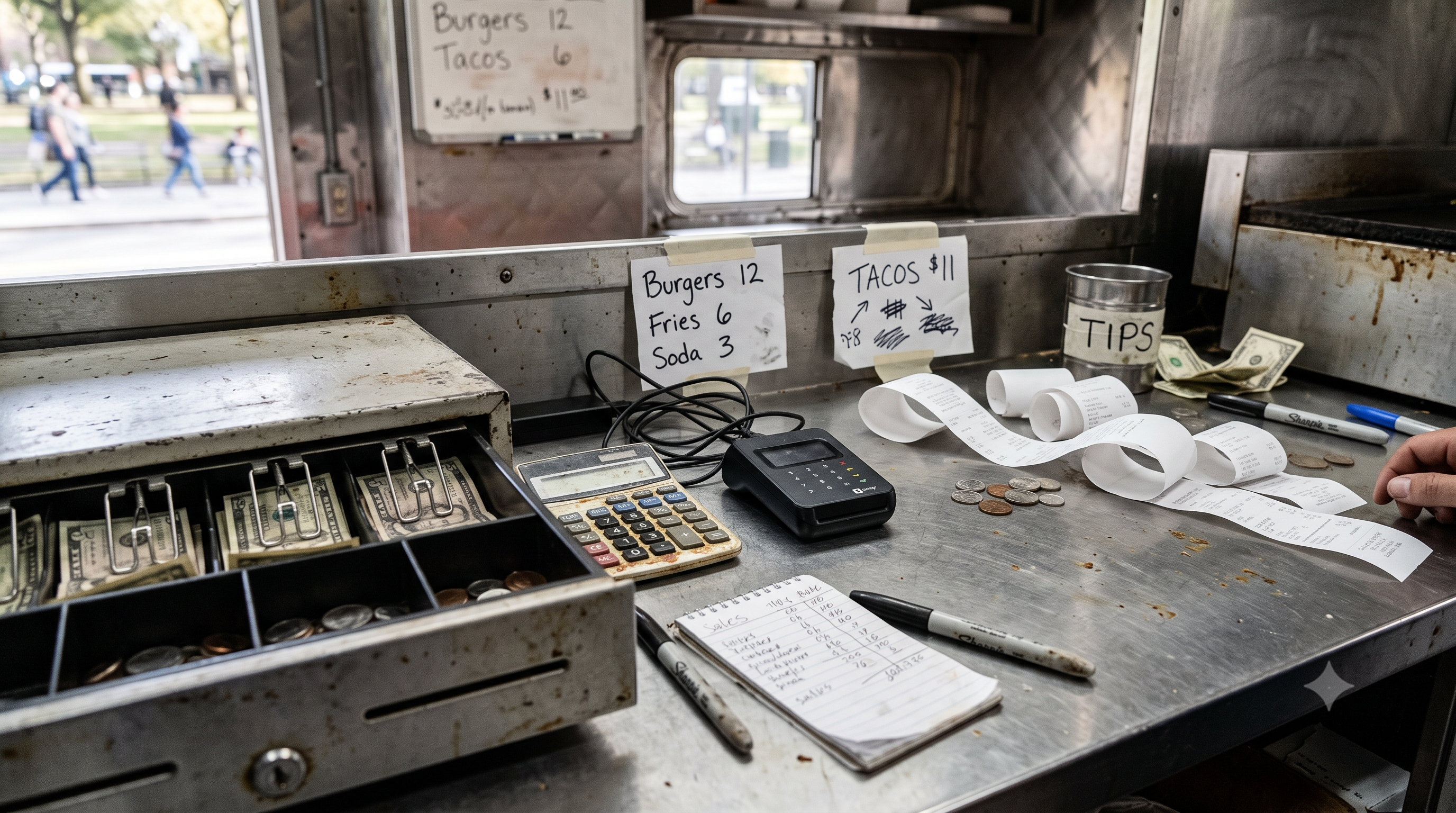
Third, reconcile every day. Your POS should tell you gross sales, taxable sales, non-taxable sales if any, sales tax collected, card payments, cash payments, fees, and deposits. If your system cannot show you that, the problem is not the customer. The problem is your system.
Fourth, stop using Facebook comments as legal guidance. Outside of Food Truck Training, of course. We moderate for legal and best practice advice. But always double check anyone’s advice before implementing.
Ask your CPA. Ask your state revenue department. Read your processor rules. Call your POS company. Talk to vendors who are actually compliant, profitable, and organized.
Do not build your business around the loudest person in the thread. Or the easiest advice.
The Industry Has to Grow Up
The mobile food industry has changed.
Food trucks are not just weekend side hustles. Vendors are doing corporate catering, municipal events, festivals, breweries, private parties, stadium lots, school contracts, and multi-unit expansion. Some are building real brands. Some are creating generational businesses.
But the industry cannot grow if the advice stays stuck in cheat mode. Bad tax advice hurts owners. Illegal fee practices hurt customers. Sloppy records hurt profitability. Cash games hurt credibility.
And every time someone tells a new vendor, “Just do it this way, nobody checks,” they are pulling the industry backward.
Where should a new vendor start?
Start by treating the business like it matters.
Set your prices correctly. Configure your POS correctly. Collect and report tax correctly. Handle card fees legally. Keep clean records. Know your numbers. Stop copying shortcuts from people who may not still be in business next year.
The goal is not just to make today’s line move faster.
The goal is to build a mobile food business that can survive an audit, satisfy a customer, impress an event organizer, and still put money in the owner’s pocket.
That is how this industry earns respect.
Not through tricks.
Through professional systems.