Yes, in most cases. Here is why the law treats your speaker as a public performance, what the research says about music and your crew, and why the wrong playlist can quietly shrink your line.
Most food truck owners never think about a food truck music license until a letter shows up from a company they have never heard of. By then the speaker has been running for two seasons. The playlist came from a personal Spotify account. The owner honestly believed a paid subscription covered it. It does not.
If guests can hear the music, the law treats it as a public performance. You need permission from the people who own the songs. That permission usually comes from a performing rights organization license or from a commercial music service built for businesses. Your personal streaming account does not count, and the small business radio exemption will not save a phone playlist. The safer bet is not to fret over music.
Licensing is only half the conversation, though. What I have seen, repeatedly, is music at the window slowing the crew down. Music can also push guests out of your line, through the songs you pick or the volume you play them at.
So before you press play, you should be able to answer three questions. Is it licensed? Does it slow the window? Does it push anyone out of line?
Key Takeaways
- If a guest can hear it, you are publicly performing it, and that requires a license.
- Personal Spotify, Apple Music, and similar accounts are licensed for personal use only, not for your service window.
- Unlicensed play can bring statutory damages of $750 to $30,000 per song, and up to $150,000 per song when a court finds it willful.
- Studies show music with lyrics hurts verbal memory, and taking orders at the window is a verbal memory job.
- Volume and song choice drive real guests away, so treat your sound like any other part of the guest experience.
Why Does Music on a Food Truck Need a Commercial License?
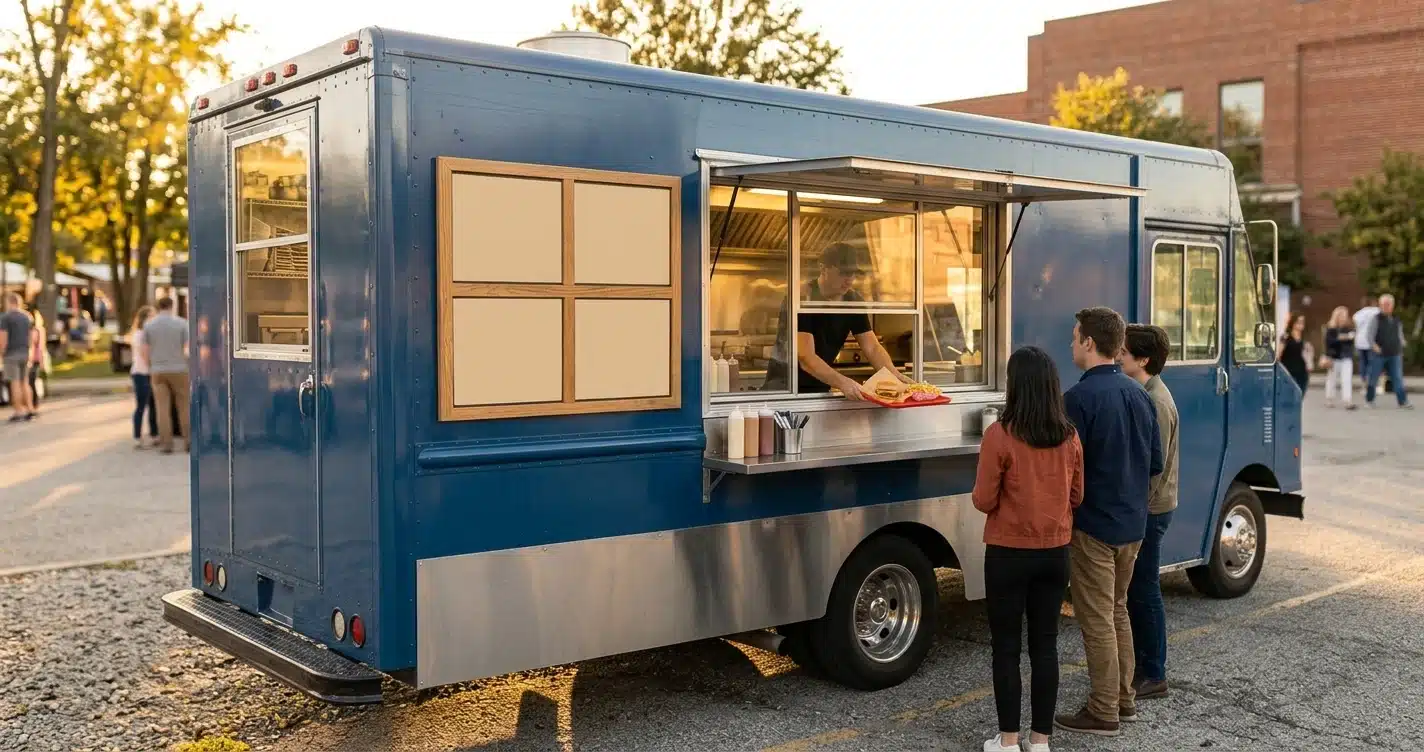
Let’s say you bought a good Bluetooth speaker, hung it under the awning, and hit shuffle. To you it feels like part of the vibe you want for your business.
Now look at it the way the law does. Every song on that playlist was written by somebody. Songwriters and publishers own the right to perform their work in public. A street corner, a festival lawn, and a brewery parking lot are all places open to the public. When your speaker plays a song where your guests can hear it, you are performing that song in public.
That is why performing rights organizations exist. In the United States, four of them handle most commercial licensing: ASCAP, BMI, SESAC, and GMR. Each one represents a different group of songwriters. A license from one does not cover the songs in another catalog. The Washington Hospitality Association tells its members that a business playing a wide range of popular music may need a license from all four.
Then there is the streaming problem. Spotify says it plainly on its own support page: the service is for personal, non-commercial use, and you cannot play it publicly from a business. Most other consumer apps carry similar terms. Paying for Premium buys you ad-free listening at home. It does not buy you the right to perform those songs for paying guests.
The objections are always the same. “It is just background music.” “I am a little truck, not a nightclub.” “Nobody is going to check.” The law doesn’t care and somebody does check. In San Diego, an ASCAP representative contacted the owner of a lot that hosted a weekly food truck night after finding the event on its Facebook page.
Food licenses and vending permits are a normal operating cost in most of the US. Music rights work the same way. If you want it, it is a real cost of doing business, and you plan and price for it like propane or commissary rent.
What Does the Research Say About Music Licensing, Employees, and Guests?
The licensing rules and the price of ignoring them
The penalties are the part that gets an owner’s attention. Under the federal Copyright Act, a court can award statutory damages of $750 to $30,000 for each song infringed. If the infringement is found willful, that ceiling rises to $150,000 per song. Courts can also order the losing side to pay attorney fees.
These are not just numbers on paper. A federal court in Tennessee awarded $40,000 in statutory damages against an establishment called Frisky Frogs over four songs, plus fees and costs. Another court awarded BMI $14,000 against an establishment called Blue Moon. Suits like these follow repeated warning letters that get ignored.
What about the exemption everyone has heard of? The Texas Music Office explains the Fairness in Music Licensing Act clearly. It lets certain small food and drink businesses play radio and television broadcasts without a license. It does not cover CDs, MP3s, or streaming audio. Food service businesses under 3,750 gross square feet, counting outdoor serving space, can qualify if they do not charge to hear the music. Larger ones face limits on speakers and screens. One law firm points out that confusion over the exemption is no defense, even if you meant to comply. Again, the smart move is license what YOU don’t own.
The cost of a proper food truck music license is usually modest. Soundsuit, a business music company, puts the average BMI fee at around $400 a year. Some business music services advertise bundled coverage for all four organizations starting under $30 a month. Those figures come from companies selling the service, so confirm current pricing yourself.
What the research says about music and your crew
Here is where my experience meets science. A 2023 study tested music with lyrics, instrumental music, and silence. Music with lyrics hurt verbal memory, visual memory, and reading comprehension. Instrumental lo-fi music showed no credible effect either way. The kicker? Participants often believed the instrumental music was helping them.
Psychologists call this the irrelevant sound effect. Researcher Nick Perham notes that it does not matter whether the person likes the song. The brain still tries to process the words, and that competes with the task.
A 2011 meta-analysis by Kämpfe and colleagues found background music had a negative influence on reading comprehension and memory tasks.
Memory is needed when your staff takes an order and reading comprehension is needed to read your KDS. My personal experience is employees get slower, sing to the music rather than focus on service. Dance instead of cleaning when slow. Adding insult to injury they often want to change a song they don’t like, turn up ones they do like all on YOUR dime.
What the research says about music and your guests
Noise was the top dining complaint nationally in Zagat’s 2018 survey, cited by 24% of diners. In the UK, the charity Action on Hearing Loss surveyed about 1,200 people. 79% had left a restaurant early because of noise, and 91% said they would not go back to a noisy place. An earlier survey from the same charity found 27% had received the wrong order because of background noise.
Song choice matters too. Research from Cloud Cover Music, a business music company, found about 55% of consumers had left stores because of loud music. Nearly a quarter had left because of profane or explicit songs. The direction matches what restaurant researchers Caldwell and Hibbert found: how much diners liked the music predicted how long they stayed better than tempo did.
The Window Is a Listening Job
Most owners think of the window as a talking job. It is really a listening job.
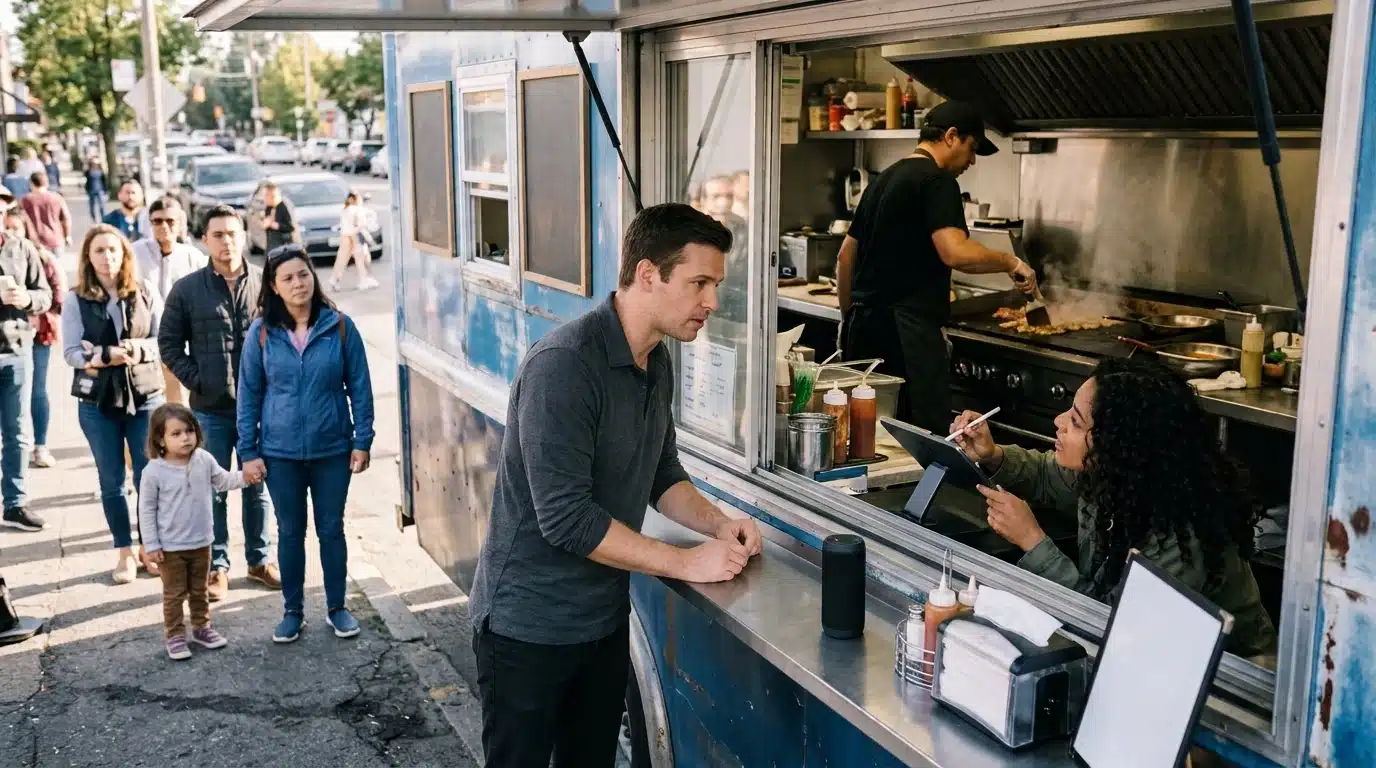
Every order is a short memory test. “Two brisket, one no onion, sub slaw on the second, extra sauce on the side.” Your order taker must hear it, hold it, key it, repeat it back, and perhaps communicate to the cook. Then they do it again 80 more times before the rush ends. That is exactly the kind of verbal task the studies show lyrics damage.
Now add a song everybody on the crew knows by heart. The order taker starts mouthing the chorus. The cook misses a verbal change callout. A ticket gets remade. Each remake eats at your capacity at the exact hour you have the least to spare. Not to mention lost money and bad review potential.
Your business earns its money during service, and that is when your guests expect the full attention of your staff and should not need to shout over music to order a hamburger.
Ask yourself:
- Is it licensed? If you cannot show who granted you the right to play it, the answer is no.
- Does it slow the window? If your crew asks guests to repeat orders, the music is costing you money or encouraging a poor review.
- Does it push anyone out of line? If a parent covers a kid’s ears or a guest lean in to shout, the music is costing you sales.
The turn off the music answer key is NO, YES, YES. Anyone of those answers and the music goes off. Simple as that.
How Do You Handle Music on a Food Truck the Right Way?
You have three honest options, and the first one is free.
Option one: no music during service. This costs nothing. It carries zero legal risk, and it gives your window the best chance of clean, fast orders. A busy line, a sizzling griddle, and a focused crew calling food and communicating with each other.
Option two: a commercial music service. These services are built for businesses and include public performance licensing in the subscription. Before you sign, get it in writing which of the four organizations the plan covers. Coverage varies by provider, and some plans leave one out.
Option three: license directly. You can buy blanket licenses from ASCAP, BMI, SESAC, and GMR yourself. This makes sense if you host live music or run a larger operation. For most single trucks, a business music service is simpler.
Whichever path you choose, treat your food truck music license like any other planned expense. Put it in your budget. Price your menu so it is covered. Do not let it become a surprise you discover later.
For licensing, go to the organizations themselves or an intellectual property attorney.
Then set the rules for your crew. In my experience, music becomes a distraction the moment the crew controls it. Somebody changes the song. Somebody turns it up. One crew member pops in an earbud. Write the standard down and train it like any other station procedure. The same habits that build food truck employees who actually stick around work here: clear expectations, explained once, enforced every shift.
Finally, remember the guest standing in line. Your sound is part of your brand, just like your wrap and your online presence. Explicit lyrics in front of a family or volume that forces people to shout tells a guest you were not thinking about them or don’t care.
Loud music creates a bubble around your truck people will avoid. Just watch crowd movements at a food truck festival.
Practical Steps to Get Your Food Truck Music License and Sound Rules Right
- Find out what is playing right now. Ask your crew where the music comes from. If it runs through anyone’s personal streaming account, you have your answer.
- Stop personal streaming at the window today. Turn it off before your next shift. This one move removes most of your legal exposure immediately.
- Decide whether you need music at all. Work two busy services with no music. Count remakes, repeated orders, and how fast the line moves, then compare. Most likely you don’t “need” it.
- If you keep music, get a real food truck music license. Choose a commercial music service or direct licenses. Get written confirmation of which organizations are covered and keep it in your truck binder with your other permits and licensing.
- Write a service-hours sound rule. Instrumental only, low volume, nothing explicit, and no crew earbuds during service. Music may play during prep and cleanup if your license covers it. Watch productivity CLOSELY.
- Run the window test. Stand where a guest stands and place an order at normal speaking volume. If you have to raise your voice, the music is a distraction.
- Ask event organizers in writing. Some events license the music they present. Ask whether that coverage includes vendor speakers. If you do not get a clear yes, assume it does not, and add the question to how you decide whether a food truck event is worth booking.
Frequently Asked Questions
Can I play Spotify on my food truck if I pay for Premium?
No. Spotify’s terms limit the service to personal, non-commercial use, and its support page says you cannot play it publicly from a business. A Premium plan removes ads for your own listening. It does not include public performance rights. Use a commercial music service built for businesses or license the music directly.
Does the radio exemption cover my food truck?
Only in a narrow way. The Fairness in Music Licensing Act lets small food service businesses play radio and television broadcasts without a license. It does not cover phone playlists, streaming apps, CDs, or MP3s. Before relying on it, confirm your situation with a performing rights organization or an intellectual property attorney, because confusion is not a defense.
How much does a music license for a food truck cost?
Costs vary, but they are usually modest compared to the risk. A single performing rights license often runs a few hundred dollars a year. Business music services that bundle coverage advertise plans starting under $30 a month. Confirm which organizations each plan covers and check current pricing directly, since rates change regularly.
Does music help or hurt food truck employee productivity?
Studies show music with lyrics hurts verbal memory and reading comprehension, which is exactly what order taking requires. Some research shows self-chosen music can lift mood during solo or creative work. Engaging with the public is NOT solo or creative work.
Can loud music really cost me guests?
Yes. Noise was the top dining complaint in Zagat’s 2018 national survey. A UK survey found 79% of people had left a restaurant early because of noise, and 91% would not return. On a food truck, music that forces guests to shout their order slows the line and creates mistakes while defeating loyalty.
Turn It Down and Listen
You did not start a food truck to be a radio station. You started it to serve great food to people who come back. Every part of the truck should support that, including what your guests hear while they wait.
So run the Three Questions before every season and every event, starting with whether your food truck music license is in place. If the music is licensed, protects your window, and keeps people in line, enjoy it. If it fails any one of the three, shut it off. Nobody ever lost a guest because the order taker heard them the first time.
Your guests came for the food. Make sure the only thing they need to listen for is their name. Better yet get a POS with text alerts for orders up.
Keep Learning
- How Important Is Food Truck Speed of Service?. Why every slow ticket costs you money, and how to protect your window during the rush.
- How Do You Train Food Truck Employees Who Actually Stick Around?. A practical approach to setting standards your crew follows on every shift.
- Daily Team Huddle Checklist. NSFVA members can download this checklist and add the service-hours sound rule to every pre-shift huddle.
- Team Training Guide: Delivering 1% Better Guest Experiences. NSFVA members can use this guide to train the guest experience habits that keep people in your line.
| Not a member yet? The huddle checklist and training guide above are two of the tools inside the NSFVA Learning Center, and full access is reserved for members. Vendor Membership includes live mentorship calls with successful mobile food entrepreneurs, the full Learning Center with videos, workbooks, and templates, access to industry experts, and exclusive vendor discounts. It runs $19 a month or $199 a year. See what Vendor Membership includes |
Bill Moore is the Founder and Executive Director of the National Street Food Vendors Association (NSFVA), a trade association dedicated to advocacy, education, and unifying street food vendors nationwide. He has worked in food service since 1977, and his first street food vending was in 1981. Bill hosts the “10-Minute Food Truck Training” podcast, leads NSFVA’s weekly Mini Class and group coaching sessions, and is the author of Food Truck 101: Beginner to Winner and, with Melisa Moore, Food Truck 201: Get Off the Truck!