A bad food cost is not a verdict on you. It’s a message from your numbers, and you can answer it this week.
It’s the end of the month. You had a great run of events, the line never quit, and your sales were the best since you opened. Then you sit down with the invoices and run your food truck food cost. Thirty-eight percent. You check it again. Still thirty-eight. All that work, and the food quietly ate the profit.
Here’s what you do. You stop guessing and start measuring. Cost every menu item with the paper included, compare what each plate should cost to what you actually spent, find the leaks, and fix them in order: portions first, waste second, purchasing third, menu price fourth. Then trim the menu to the items that earn their spot. A food truck food cost that’s too high is not a death sentence. It’s a repair job, and repair jobs have steps.
I’ve watched owners panic over a bad food cost and slash quality until the customers left. I’ve also watched owners treat that same number as a flashlight and use it to find exactly where the money was walking out the window. The number was the same. The response made the difference.
Key Takeaways
- Your food cost on mains should land at 25 to 28 percent with paper included, not the outdated 35 percent many owners still quote.
- Food cost is what a plate should cost on paper; food expense is what you actually spent, and the gap between them is your leak.
- Fix portions and waste before you raise prices, because customers shouldn’t pay for your sloppy scoop.
- A smaller menu of 2 to 4 core items is the fastest way to tighten food cost and protect your speed.
- A bad food cost doesn’t mean you’re bad at business. It means your business is talking, and it’s time to listen.
Why Does a Bad Food Truck Food Cost Feel So Personal?
Food cost hits different than other expenses. A high insurance bill feels like the world’s fault. A high food cost feels like your fault.
You picked the recipes. You set the prices. And you might have scooped every portion. So when the number comes back ugly, it feels like a report card on your cooking and your judgment.
That feeling pushes owners in two bad directions. Some freeze. They know the number is wrong, but they don’t want to look closer because looking closer might confirm their worst fear. So they keep working harder, selling more, and losing a little on every plate. More volume at a bad food cost just means you lose money faster.
Others overcorrect. They buy the cheapest protein on the truck, cut portions until the plate looks lonely, and wonder why the regulars stop coming back. You can’t shrink your way to greatness. You fix food cost with precision, not panic.
And plenty of owners are working from the wrong target in the first place. Somebody told them 30 or 35 percent was normal, so a 34 felt fine. On a food truck, with no dining room, no dish crew, and no “for here” plates, your paper goods are part of your food cost. When you include the paper, your mains belong in the 25 to 28 percent range. The outdated target is one of the reasons I wrote about how bad advice is holding back the mobile food industry.
A bad food cost is one of the most fixable problems in this business. It lives in places you can see, touch, weigh, and count.
What Does the Research Say About Rising Food Costs in 2026?
If your food truck food cost crept up, you’re not alone, and you’re not crazy. The National Restaurant Association’s 2026 State of the Restaurant Industry research found that about 82 percent of operators reported higher food costs in 2025 than the year before. Only 6 percent saw any decline.
The pressure is real at the wholesale level too. Citing Bureau of Labor Statistics data, the Association reported that average food costs now sit more than 35 percent above pre-pandemic levels. The USDA Economic Research Service forecast in September 2026 that wholesale beef prices would rise 9.4 percent this year. If you sell burgers, cheesesteaks, or brisket, you’ve felt every bit of that.
When the Association asked operators how they responded, more than a third said they had increased their tracking of food waste or adjusted portion sizes. The operators who survive cost spikes don’t just raise prices and hope. They go looking for the leaks.
So yes, prices went up. But the research points to the same truth I’ve seen on hundreds of trucks: the part of food cost you control is bigger than the part you don’t.
What Separates the Owner Who Fixes Food Cost From the One Who Fears It?
Every truck has a fresh water tank, and every owner has dealt with a slow leak somewhere in the line. One drip doesn’t look like anything. You hear it, you ignore it, you keep serving. Nobody ever ran out of water because of one drop.
But that drip runs all day. It runs during the rush. It runs during the slow hour. And it keeps running while you’re breaking down. And one afternoon, right in the middle of a line twenty people deep, you reach for the hand sink and nothing comes out.
That’s how a bad food truck food cost happens. Not with one big mistake. With drips.
An extra ounce of fries because the scoop wasn’t level. A heavy hand on the cheese. Chicken that sat too long in the hot box. One more batch of a sauce nobody ordered. A supplier price that went up in March and never made it to your menu board. No single drip broke you. Together, they emptied the tank.
A bad food cost is not a character flaw. It’s a list of drips. And drips get fixed one at a time.
You didn’t lose money because you’re bad at this. You lost money because nobody showed you where to look. Now you know where to look.
You are not the owner who hopes the number improves. You are the owner who measures it, finds it, and fixes it. That’s not a talent. It’s a habit, and habits can be learned by anyone willing to pick up a scale.
Weigh it. Cost it. Price it.
How Do You Fix a Bad Food Truck Food Cost by the Numbers?
Conviction gets you to the truck. Numbers get you paid. So let’s get specific.
Start by separating two numbers most owners blend together. Food cost is what a plate should cost on paper: every ingredient, every sauce cup, every clamshell, every napkin, at today’s prices. Food expense is what you actually spent on food and paper for the week. When the expense runs higher than the cost says it should, the gap is your leak. That gap is waste, over-portioning, spoilage, freebies, and prices you never updated.
For example without doing an inventory. If you spend 35% of sales a week consistently to purchase food and your menu was priced to produce a 25% you have a problem. What you don’t know is where.
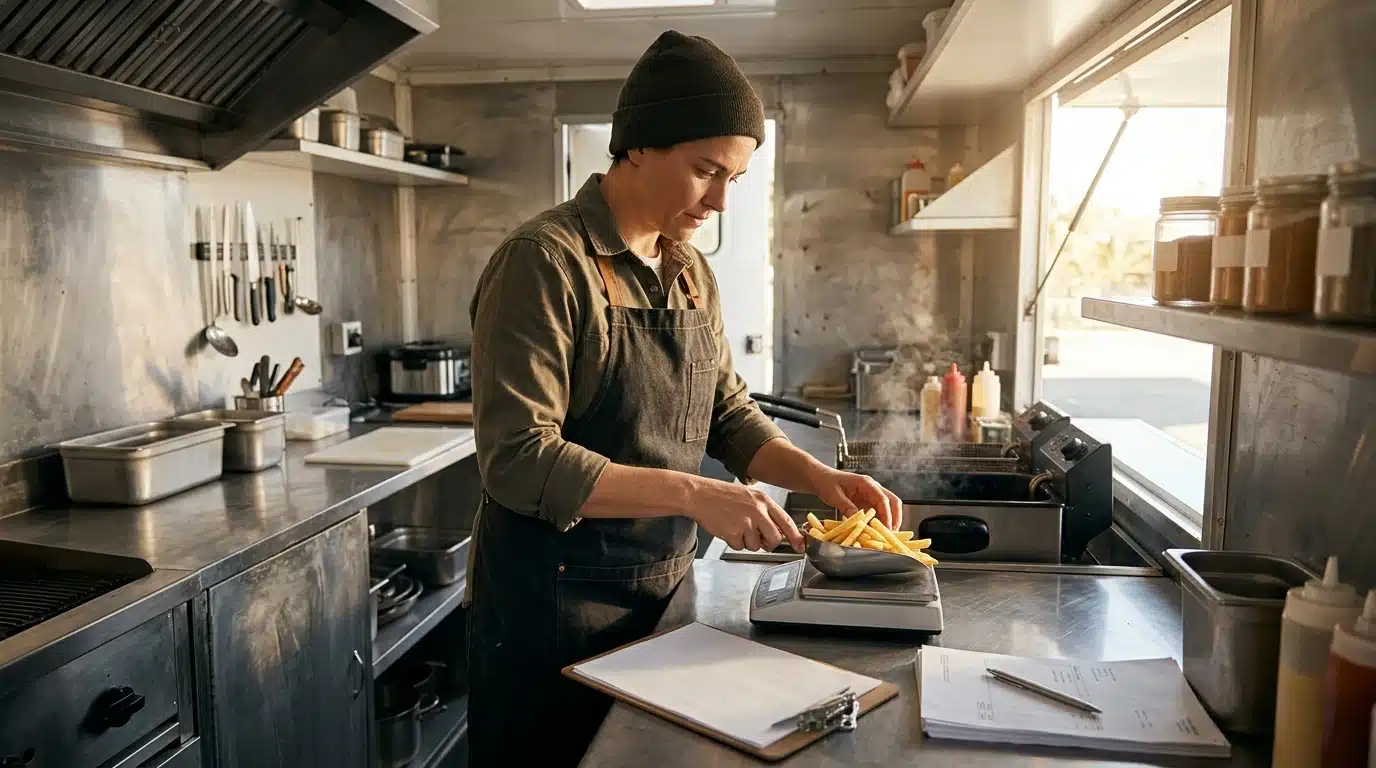
Pull your current invoices, not last year’s. Weigh each ingredient as it actually goes on the plate during service. Add the packaging. Divide the total by the menu price. Now you have a real food cost percentage for every item, and you’ll usually find one or two that are dragging the whole truck down.
Here’s what a repair looks like. Say your burger plate sells for $12.00 and costs $4.20 with paper. That’s 35 percent. Bring the price to $13.50 and you’re at 31.1 percent. Put the fries back on a level scoop and save $0.30 a plate, and you’re at 28.9 percent. Rebid your cheese and save another $0.12, and you land at 28.0 percent, right in the target zone. That plate now leaves you $9.72 instead of $7.80. At 300 plates a week, that’s $576 more every week from one item.
Notice the order. Price was one tool, not the only tool. If you only raise prices, you ask your customers to pay for your waste. Fix the scoop first.
Then look hard at the menu. Every extra item means more inventory sitting in your cooler, more product aging on the shelf, and more chances to throw food away on a slow day. I’ve taught 2 to 4 core items for years because a tight menu protects your food cost and your capacity at the same time. Fewer items also means you buy in bigger, smarter quantities.
Finally, look at your mix. A drink or a high-margin side sold with a plate pulls the whole check’s food cost down. Our breakdown of how food truck drinks actually make you money shows why the cooler can be one of the best friends your food cost has.
What Practical Steps Lower Your Food Truck Food Cost This Week?
- Cost every item with paper included. Use this week’s invoices and weigh what really goes in the box during service. Write the food cost percentage next to every item on a single sheet you can see from the line.
- Set a portion spec for every component. Put the right scoop, ladle, or scale at every station and make the spec non-negotiable. Train it, check it, and correct it on the spot.
- Run a waste log for two weeks. Keep a sheet and a pen by the trash can and write down everything that gets tossed, with a rough weight. The log will show you where your drips are faster than any guess.
- Compare food cost to food expense every week. Take beginning inventory, add purchases, subtract ending inventory, and divide by food sales. If that actual number runs more than a point or two above what your recipe costs predict, go find the leak before next week.
- Reprice the items that still miss the target. Once portions and waste are under control, raise the price on anything still above 28 percent. Price from your own numbers, not from the truck next door, which is why I tell owners to stop pricing their menu off other vendors’ prices.
- Cut the item that drags. If an item can’t hit the target at a price your customers will pay, retire it. One less item means less inventory, less waste, and faster tickets.
- Put food cost on a weekly calendar. Block the same hour every week for numbers. If your books are a shoebox of receipts, start with the bookkeeping basics every food truck owner needs so the weekly check takes minutes, not a weekend.
Frequently Asked Questions
What is a good food cost percentage for a food truck?
For main menu items, a healthy food truck food cost lands between 25 and 28 percent of the menu price, with paper and packaging included. Many owners still use the old 30 to 35 percent restaurant target, but a truck serves everything to go, so packaging belongs inside the food cost, not on top of it.
What is the difference between food cost and food expense?
Food cost is what a menu item should cost on paper, based on current ingredient and packaging prices. Food expense is what you actually spent on food and paper during a period. When food expense runs higher than your food cost predicts, the gap usually comes from waste, over-portioning, spoilage, freebies, or outdated prices.
Should I just raise my prices to fix a high food cost?
Not first. Raising prices without fixing portions and waste asks customers to pay for your leaks. Lock down portion specs, track waste, and rebid key ingredients first. Then raise prices on any item that still misses the target, using your own recipe costs rather than competitor pricing to set the new number.
How often should a food truck owner check food cost?
Weekly. Compare your actual food cost, calculated from inventory and purchases, against what your recipe costs predict. A weekly check catches a supplier price jump or a portion problem within days. Waiting until the end of the month or quarter lets small leaks grow into thousands of dollars of lost profit.
Why does a smaller menu lower food cost?
Fewer menu items means less inventory sitting in the cooler, less product aging out, and fewer ingredients to throw away on slow days. It also lets you buy larger quantities of fewer items at better prices. A tight menu of 2 to 4 core items protects both your food cost and your speed.
Who Will You Be When the Next Invoice Comes?
Go back to that end-of-month moment. The great sales. The ugly number. That sinking feeling that the food ate your profit.
Now you have a cost sheet taped inside the truck. Every station has a scoop that gets used. There’s a waste log by the trash can and an hour on the calendar with your name on it. When the invoice comes, you’re not afraid of it. You’re ready for it.
The prices on those invoices will keep moving. You can’t control beef markets or tariffs. But you can control the scoop, the spec, the menu, and the hour you spend with your numbers every week. That’s more control than most owners ever take.
So pull the invoices. Weigh the plate. Write the number down. Fix the first drip today and the next one tomorrow.
You didn’t start this truck to feed people at a loss. You started it to build something that pays you back for the work.
Your food cost will tell you the truth every week. The owners who win are the ones who listen.
Keep Learning
From the NSFVA Blog
- Stop Pricing Your Food Truck Menu Based on Other Vendors’ Prices: Why your menu prices have to come from your own costs, not the truck down the street.
- What Bookkeeping Basics Does Every Food Truck Owner Need?: The record-keeping foundation that makes a weekly food cost check fast and accurate.
From the NSFVA Library
- Recipe Cost for Menu Pricing (Excel Template): NSFVA members can download this template to cost every item with paper included and set prices from real numbers.
- Actual Food Cost Control (Excel Template): NSFVA members can download this template to compare actual food cost against what your recipes predict, week by week.
Not a member yet?
The Recipe Cost for Menu Pricing and Actual Food Cost Control templates are two of the tools inside the NSFVA library, and full library access is reserved for members. Vendor Membership also includes the full Learning Center with videos, workbooks, and templates, live mentorship calls with successful mobile food entrepreneurs, access to industry experts, and exclusive vendor discounts. Membership is $19 a month or $199 a year. See what Vendor Membership includes.
Bill Moore is the Founder and Executive Director of the National Street Food Vendors Association (NSFVA), a trade association dedicated to advocacy, education, and unifying street food vendors nationwide. He has worked in food service since 1977, and his first street food vending was in 1981. Bill hosts the “10-Minute Food Truck Training” podcast, leads NSFVA’s weekly Mini Class and group coaching sessions, and is the author of Food Truck 101: Beginner to Winner and, with Melisa Moore, Food Truck 201: Get Off the Truck!