The answer is no. Here is what to use instead before you say yes to any booking.
No one forces you to accept an event. Most of the frustration I hear from vendors about crowded lineups starts when they forget that.
How many trucks is too many? Owners want a food truck to attendee ratio they can point to, because a ratio feels like protection. Two thousand guests, six trucks, we should be fine. Right?
It does not work that way. No food truck to attendee ratio can protect you, because trucks do not serve the same number of guests at the same speed. Truck A can handle 30 people an hour. Truck B can handle 200. Put two truck A’s in the same crowd and you get a different event than an event with two truck B’s.
So skip the ratio, that is beginner excuse math and finger pointing. Work out the sales your truck needs to be profitable. Then ask one question: can this event support that number? It is a yes or no question. You do not need to guess at attendance, or at who among those attendees will eat.
Key Takeaways
- No fixed ratio of trucks to guests can work, because one truck may serve 30 guests an hour while another serves 200.
- Organizers often add food vendors because attendees complain about long, slow food lines from prior years.
- Organizers have a right to earn money and a duty to make the event good for attendees.
- Know your profitability number first, then ask whether the event can support it.
- If the answer is no, decline. No one forces you to accept.
Why Do Vendors Blame Organizers When an Event Goes Wrong?
A vendor books an event, preps heavily, and works hard. The truck sells less than expected. By Sunday night the story is set: too many trucks, a greedy organizer, a crowd that never showed up.
A weekend of food, fuel, and payroll is real money. But the blame often lands on the wrong person. An owner can sell out and still lose money by pricing wrong, overstaffing, or ignoring travel costs. I covered that gap between experience and expertise in When Does Food Truck Experience Become Real Expertise?
Busy can also be broke, as I wrote in The State of the Food Truck Industry in 2026. A full line does not prove a profitable day.
The organizer runs a business too. Many organizers pay for seating, trash service, site rental, security, insurance, and advertising before the first truck arrives. They are allowed to make money, just like you. They also owe something to every attendee who walked through the gate. Those guests want to eat without losing an hour of their time at the event.
Permits belong in this conversation as well. Mobile vending permits are a normal operating cost in many parts of the country. The question is not who charged you. The question is whether you priced the event knowing every cost of vending there.
What Do Real Festivals Show About Long Food Lines?
Start with what happens when an event has too few places to buy food. Organizers hear about it fast, and they hear it loudly.
At the first Arizona Bao Fest, as many as 3,000 people showed up. Dozens complained online, and one vendor’s line ran past an hour. Phoenix New Times reported that the organizer had not realized the vendors could not cook fast enough. Next time, the organizer wanted a bigger venue with more vendors. This was a food festival with bad service.
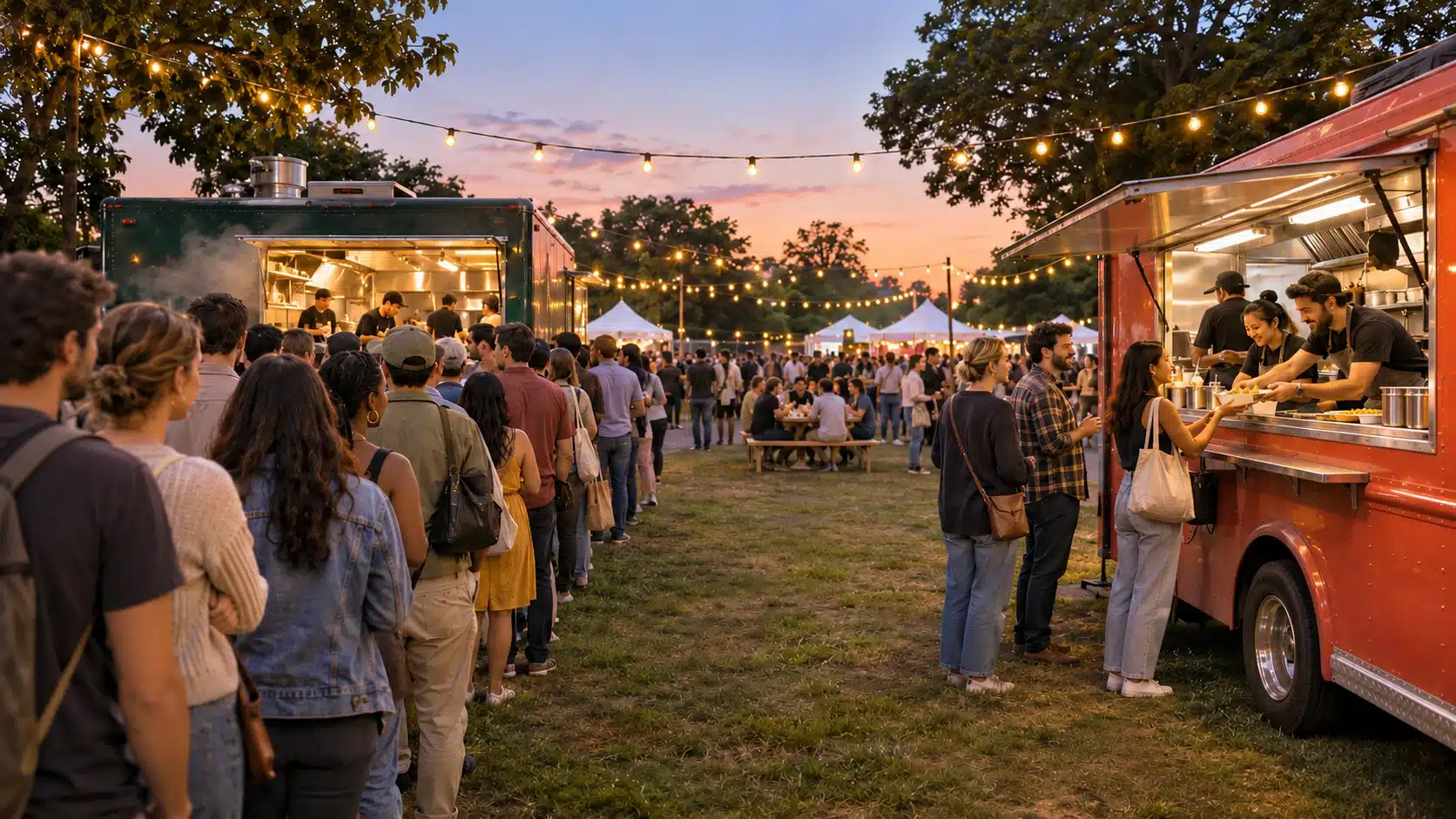
Vancouver’s Skookum festival drew up to 20,000 people at its peak. CBC reported complaints about food lines, including a guest who waited an hour and a half and asked for more food vendors.
Halifax’s Mac and Cheese Festival expected 7,500 people over three days. About 45,000 came, according to CBC, and vendors sold out several times. In Philadelphia, a cheesesteak festival drew more than 17,000 guests. PhillyVoice heard from attendees who waited 45 minutes to an hour for a single sample. This is panic time for organizers. Disappointed attendees don’t come back.
Notice what those complaints ask for. They ask for more food, faster. Organizers read that as a signal to add vendors.
Industry rules of thumb for the food truck to attendee ratio try to put numbers on this. Best Food Trucks suggests one truck for every 200 to 300 attendees when everyone is expected to eat. It also warns that past 300 guests per truck, lines tend to get long. Roaming Hunger says trucks need to average 40 to 60 customers an hour to call an event a success.
Both “rules” quietly assume a truck that serves 40 or more guests an hour. Truck A, at 30, falls below that pace. Truck B, at 200, blows past it. Here is what that does to the math. Each owner’s opinion of the exact same event will be different.
| Truck type | Guests served per hour | Trucks needed to feed 250 meals per hour |
| Truck A | 30 | 9 trucks |
| Truck B | 200 | 2 trucks |
Illustration, not a forecast: 2,000 guests, half of them buying food during a four-hour window, equals 1,000 meals or 250 per hour.
Same crowd. Same four hours. Nine trucks like A or two trucks like B. That assumes guests spread out evenly, and they never do. They hit the windows all at once. The organizer cannot see your capacity. The organizer sees lines. And so do the people you will be serving.
Organizers also have to make the money work. At some food festivals the organizer takes 15 or 20 percent of vendor sales, according to Ticket Fairy’s guide to revenue share and stall rental. Trucks generally hope total fees land nearer 5 to 10 percent of daily sales. A bigger lineup can raise revenue and cut wait times at once. That is not an evil plot. It is a business decision with a real upside for attendees.
What Should You Use Instead of a Food Truck to Attendee Ratio?
A ratio is the organizer’s tool. It helps them plan a site. It does not tell you whether your truck makes money there. That’s what you care about.
Your tool is your profitability number. I teach the decision is based on your breakeven and your capacity. Add your target profit to the breakeven, and you have the sales number the event has to support. Then the whole decision becomes a yes or no.
Notice what this removes. You stop guessing how many guests will show up. You stop guessing which of them will be hungry, and whether they will buy from you or from your neighbor. Those guesses belong to the organizer’s marketing. They do not belong in your decision. You hold numbers you control: your costs, your capacity, your prices, and the fee you were quoted.
That is also why no one forces you to accept an event. An invitation is not an obligation. If the numbers fit, say yes without apology. If they do not, say no without anger. Both answers are clean.
How Does Your Profitability Number Decide Yes or No?
Test the idea on a real offer. Take the example from my post on whether a food truck event is worth booking. Three days, a $1,500 fee, eighteen trucks, and twenty thousand expected guests. The breakeven came to $4,000. Capacity at 20 transactions an hour and a $12 ticket came to $4,320 across the weekend. That truck cleared breakeven by about $320.
Nobody forced that truck into the event, and the organizer did not create that thin margin. The truck’s own capacity did.
Now run Truck A and Truck B through six peak hours at a $12 average ticket. Truck A tops out at $2,160 a day. Truck B tops out at $14,400. Same event, same crowd, same organizer. Completely different answers to the same question.
No food truck to attendee ratio can capture that gap. Say your daily breakeven is $1,800. Truck A sits only 20 percent above it, short of the 25 to 30 percent buffer many experienced operators want. Truck B has a mountain of room. The right number of trucks for the event depends on which truck focuses on SOS and which just shows up with hope.
If your answer is no, you still hold levers. Tighten the menu to two to four core items. Add a second window or another cook. Reprice for the event. Then run the numbers again. Capacity limits sink trucks at exactly the events owners count on, a point I made in Food Truck Franchise Red Flags.
What Steps Do You Take Before You Say Yes?
- Build your profitability number. Add food cost (plan 25 to 28 percent of sales on mains, paper included), labor with payroll taxes, the event fee, any permits the event requires, fuel, travel, and owner pay as a planned cost. Add the profit you want. A solid food truck business plan already holds most of these figures, and NSFVA’s daily break-even guide walks you through the rest.
- Measure your real capacity. Pull transactions per hour from your last three similar events. Use service hours, not the hours the event is open. Do not use your best hour.
- Compare with a buffer. Look for capacity at least 25 to 30 percent above your number. A tie means one slow hour turns your weekend into a loss.
- Ask for terms, not predictions. Request the fee structure, service hours, vendor count, power, and placement in writing. Ask what the organizer plans to do about line times. Skip “how many people are coming,” because no one can promise that.
- Answer yes or no in writing. Decide on the numbers. If it is a no, send a short, polite decline: “Thank you for the invitation. The numbers do not support it for our truck.” You keep the relationship and lose nothing.
- Fix what you control, then retest. If capacity is the problem, trim the menu, add a window, or add a cook. Reprice for the event. Run the test again before you give up on the booking.
- Record what happened. Write down sales, hours, vendor count, weather, and placement. Your next test gets sharper, and you stop relying on memory or mood.
Frequently Asked Questions
What is the right food truck to attendee ratio for an event?
No single ratio is right. Common guidance suggests one truck per 200 to 300 attendees when everyone is expected to eat. Treat that as an organizer’s starting point. It assumes similar trucks. A truck serving 30 guests an hour and one serving 200 change the answer completely.
Are event organizers greedy for booking so many food trucks?
Usually not. Organizers hear loud complaints about long food lines, and adding vendors is their fix. They also have a right to earn money, like you. If the lineup breaks your numbers, the answer is a polite no, not an argument about their motives.
Should I turn down an event with a lot of trucks?
Turn it down only if your numbers fail. Compare your realistic capacity to your breakeven plus target profit. If capacity clears it with a 25 to 30 percent buffer, a crowded lineup may still work. If the cushion is thin, a crowded lineup makes it thinner.
Why do some organizers take a percentage of food sales?
A percentage gives the organizer a stake in your success. Some food festivals take 15 or 20 percent of vendor sales, while trucks generally hope total fees stay near 5 to 10 percent. Price the fee into your menu and your breakeven before you accept.
What is a profitability number for a food truck?
It is the sales your truck must hit at an event to cover food cost, labor, the fee, permits, travel, and your own pay, plus the profit you want. Once you know it, every booking becomes a yes or no comparison against your capacity.
The Bottom Line: Know Your Number and Answer Yes or No
Go back to the first line of this post. No one forces you to accept an event.
That is not permission to be bitter. It is the opposite. It frees you from the story where other people’s decisions decide your weekend.
The organizer has a job. They want guests fed, lines moving, and a fair return for the work. When guests complain about waiting, they add vendors, and from where they stand that is the right call. You have a job too. Yours is to run a truck that makes money. Those two jobs overlap often enough that events work for everyone. They do not overlap every time. That is fine.
So stop hunting for the perfect food truck to attendee ratio. It does not exist. Truck A and Truck B will never fit one number. Build your profitability number. Measure your capacity. Ask for the terms. Then answer yes or no.
The vendors who last share one habit. They decide before the excitement hits, not after the invoice arrives. They treat each booking as a business decision, not a hope.
You do not need a better ratio. You need your number, and the nerve to say no when an event cannot meet it.
| Keep Learning How Do You Know If a Food Truck Event Is Actually Worth Booking?: Run the Two-Number Test on your next festival offer before you sign.When Does Food Truck Experience Become Real Expertise?: See why one great or terrible event teaches less than owners think.Don’t Risk Going Broke Calculating Your Daily Break Even Point: Log in with a free NSFVA account to open the guide and calculate the sales you need each day. Not a member yet? The break-even guide above is one of the tools in the NSFVA resource library, and full library access comes with Vendor Membership. Membership also includes the Learning Center with videos, workbooks and templates, live mentorship calls with successful mobile food entrepreneurs, the online community, and exclusive vendor discounts. See what Vendor Membership includes. |
Bill Moore is the Founder and Executive Director of the National Street Food Vendors Association (NSFVA), a trade association dedicated to advocacy, education, and unifying street food vendors nationwide. He has worked in food service since 1977, and his first street food vending was in 1981. Bill hosts the “10-Minute Food Truck Training” podcast, leads NSFVA’s weekly Mini Class and group coaching sessions, and is the author of Food Truck 101: Beginner to Winner and, with Melisa Moore, Food Truck 201: Get Off the Truck!