Starting a food truck sounds exciting. For a lot of people, it feels like freedom. You get to serve food you love, be your own boss, move around, and build something that feels like yours. But let’s slow that thought down for just a minute.
One of the most common questions new owners ask is this:
Is a food truck profitable? Do I really need a business plan, or can I just learn as I go?
That question matters, because the answer can save you a lot of money, a lot of time, and a lot of frustration.
Can a Food Truck Be Profitable?
Yes, a food truck can absolutely be profitable. But a food truck is not profitable simply because it exists. It becomes profitable when it is run like a business. That is where a lot of new owners get misled.
They see a truck with a line and assume the owner is making great money. What they do not see is the food cost, labor, event fees, fuel, insurance, repairs, commissary fees, permits, card processing charges, spoilage, and slow days.
A truck can look busy and still be losing money. That is why the better question is not just, “Can a food truck make money?” The better question is:
Can your food truck make enough money, consistently, after expenses, with your concept, in your market, with your level of planning?
That is a business question. Not just a cooking question.
Why a Food Truck Business Plan Matters
A good food truck business plan is one of the best tools you can have before you spend money on a truck, trailer, equipment, wraps, permits, or inventory. Too many people start with emotion.
They love to cook. They have always wanted a truck. Their friends tell them their food is amazing. They think they will “figure it out” once they get rolling. That is an expensive way to learn.
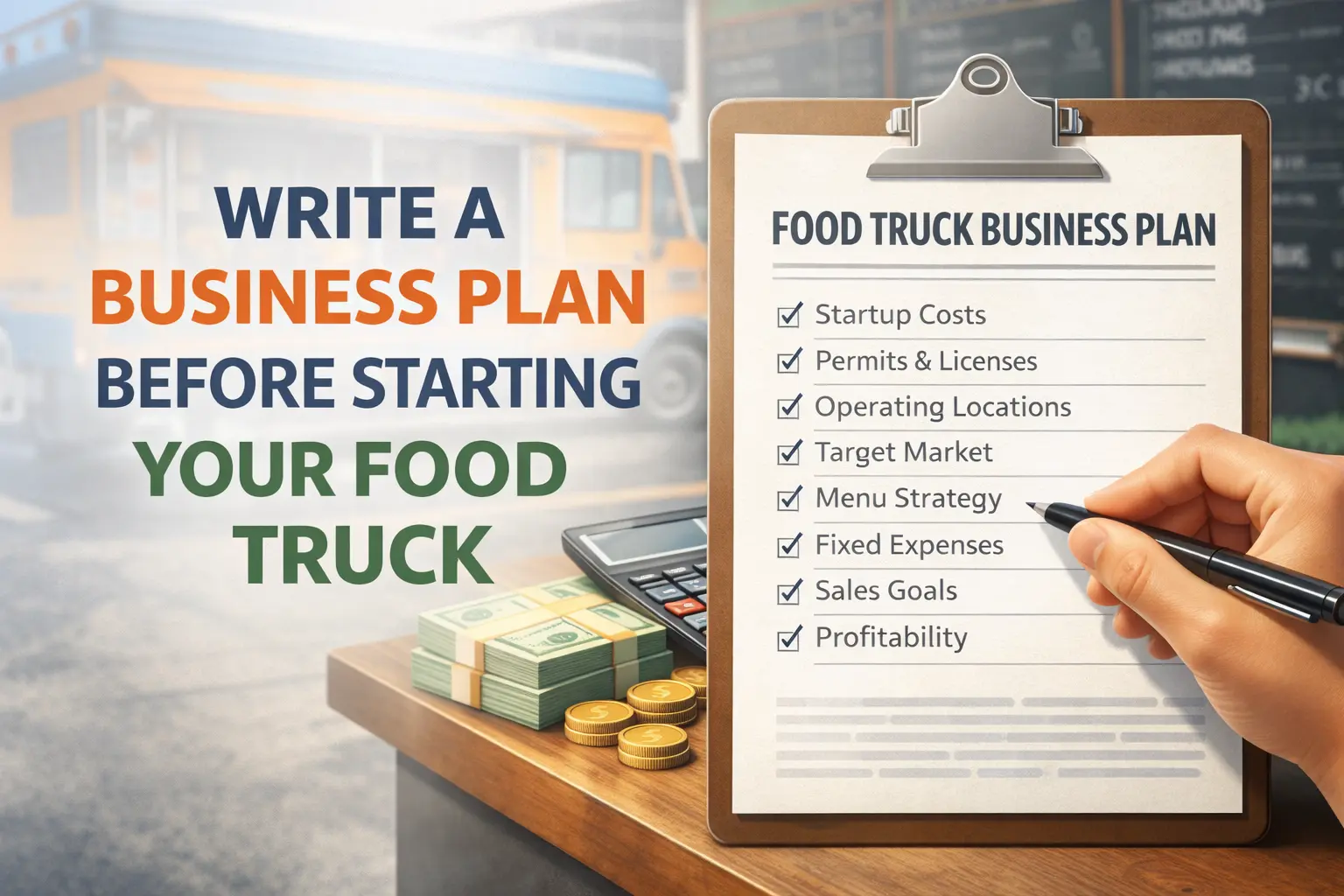
A business plan forces you to answer the questions that excitement usually ignores. It helps you think through:
- Who your target customer is
- What kind of menu fits your truck and your market
- Where you plan to operate
- What permits and licenses you need
- How much it will cost to open
- What your monthly fixed expenses will be
- How much you need to sell each day to break even
- What your marketing plan is
- What your backup plan is when weather, equipment, or events go wrong
That is not busywork. That is ownership.
Learning by Experience Is Real—But It Is Costly
Yes, you will learn a lot by doing. You will learn which menu items move fast. You will learn what takes too long to prep. You will learn which events are worth repeating and which ones are a waste of time.
But trial and error in the food truck business is not cheap. You are not testing ideas with pencil and paper. You are testing them with real dollars. Without a plan, you may discover too late that:
- Your menu is too large
- Your food cost is too high
- Your service time is too slow
- Your location strategy is weak
- Your staffing model does not work
- Your local market is already oversaturated
- Your truck setup does not match your concept
A solid food truck business plan helps you make better mistakes on paper before you make expensive mistakes in real life.
A Business Plan Helps You Build the Right Menu
A lot of new owners make the mistake of building a menu around what they personally love to cook. That is understandable, but that alone is not enough. A business plan helps you ask smarter questions.
- Can this menu be executed in a small mobile kitchen?
- Can it be produced consistently under pressure?
- Can it be served fast enough during a lunch rush or busy event?
- Can one or two people handle the volume?
- Does the pricing support a healthy profit margin?
- Will the ingredients store well in limited truck space?
- Will the local market actually buy it regularly?
These are the questions that separate a food idea from a food business.
A Business Plan Helps You Understand Food Truck Profitability
Profitability is not guesswork. It is math. That is one of the biggest benefits of having a food truck business plan. When you build a real plan, you begin to understand:
- Your startup costs
- Your fixed monthly costs
- Your variable costs
- Your average ticket goal
- Your daily sales target
- Your break-even point
That matters because a lot of owners think in terms of sales only. They say, “We did $1,200 today.”
Fine. But what did you keep?
How much went to food?
How much went to labor?
How much went to fuel?
How much went to event fees?
How much went to merchant processing?
How much is left after all of it?
A business plan helps you stop chasing gross sales and start focusing on actual profit.
Which Food Truck Days and Hours Are Best?
This is another common question, and the honest answer is this: It depends.
There is no universal best day or best hour for every food truck. Some trucks do well at weekday lunch near offices, warehouses, or job sites. Some do better in the evenings at breweries, neighborhoods, and community events. Some make strong money on weekends through festivals, private catering, and large public events.
But here is what many new owners miss:
Busy hours are not just about the time of day. They are about where real customer demand already exists. A truck in the wrong place at the right time is still in the wrong place.
That is why market research belongs in your business plan. You need to understand your local audience, traffic patterns, event quality, competition, and what type of service model fits your area.
The Real Benefit of a Business Plan
The real value of a business plan is not that it looks professional. The real value is that it helps you think clearly before you commit. It helps you decide:
- Whether your concept makes sense
- Whether your pricing is sustainable
- Whether your market has room for you
- Whether your operations can support your menu
- Whether your goals are realistic
- Whether you are building a business or buying yourself a very expensive job
That may sound blunt, but it is true. A lot of people want to own a food truck. Far fewer are prepared to operate a profitable food truck business. A business plan helps close that gap.
What Should Be in a Food Truck Business Plan?
Your plan does not need to be a giant document filled with fluff. It does need to answer the major questions. A strong food truck business plan should include:
1. Business Concept – What kind of food are you serving, and why does it fit your market?
2. Target Customer – Who are you trying to serve? Office workers? Families? Late-night crowds? Event guests? Catering clients?
3. Menu Strategy – What are you selling, how fast can you serve it, and what profit margin does each item produce?
4. Market Research – Who is already serving similar food in your area? Where are the gaps? What locations show promise?
5. Startup Costs – Truck or trailer, equipment, permits, inspections, branding, POS system, insurance, initial inventory, and working capital.
6. Monthly Operating Costs – Commissary, fuel, labor, food, insurance, phone, software, maintenance, event fees, and more.
7. Sales Goals – How much do you need to sell daily and weekly to survive and grow?
8. Marketing Plan -How will people find you? Social media? Local networking? Catering outreach? Google Business Profile? Email or text list?
9. Operating Plan – Who does what? Where will prep happen? How will service flow work? What are your opening and closing systems?
10. Risk Planning – What happens if an event cancels, equipment breaks, weather turns bad, or sales slow down?
That is a real plan. That is useful.
New to the Area? Start With Research, Not Purchases
For the person who asked this question and recently moved to a new area, this is actually the perfect time to pause and learn. Before you buy anything, spend time researching:
- Local permitting and health department rules
- Commissary requirements
- Existing food trucks and trailers in the area
- Local event quality
- Strong and weak selling locations
- What cuisines seem overdone
- What gaps may exist in the market
- The seasonality of local business patterns
Do not rush to buy a truck just because you are excited. Excitement without a plan is how people spend too much and learn too late.
Final Thoughts: Build the Plan Before the Truck
So, do you need a business plan for a food truck? Yes.
Not because it sounds formal.
Not because a lender might ask for it.
Not because somebody on the internet said so.
You need it because it helps you think like an owner before you start spending like one. A good food truck business plan can help you:
- Avoid costly mistakes
- Clarify your concept
- Understand profitability
- Set sales goals
- Build a menu that works
- Research the right locations
- Prepare for slow periods
- Make smarter decisions from day one
The food truck business can be profitable. But profit does not happen by accident.
It happens when a good concept is backed by a good plan, solid numbers, local research, and disciplined execution. That is the difference between chasing a dream and building a business.
Build the plan first.
Then build the truck around the plan.