Water expands when it freezes. One cold night can crack your pump, your heater, and the budget you were saving for spring.
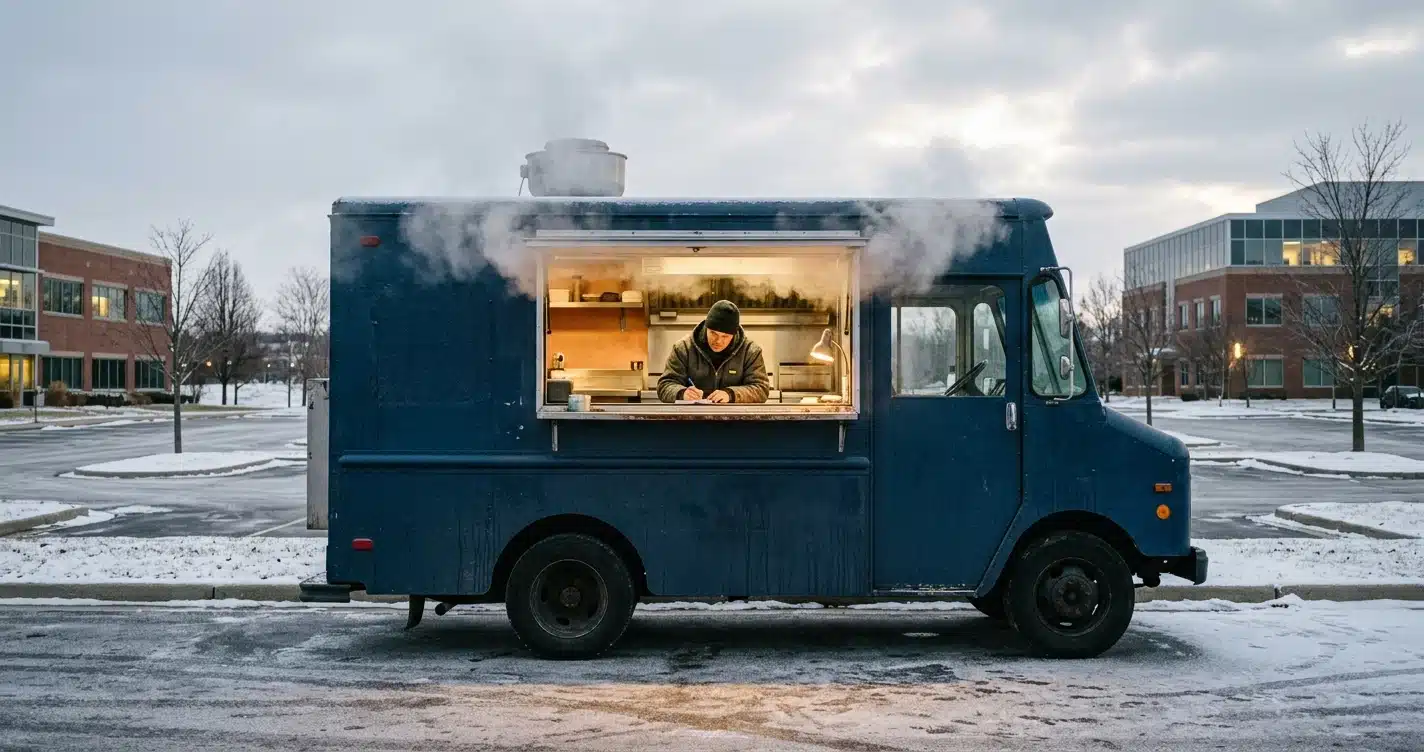
The forecast said 34 degrees, so you skipped the steps to winterize a food truck that night. The low hit 27. Now the hand sink faucet drips from a crack, the pump housing has split, and the water heater will not hold pressure.
Here is the short answer. To winterize a food truck or trailer, you empty every tank, line, pump, and heater until no water remains. Then you push compressed air or non-toxic RV antifreeze through whatever remains. After that, you protect everything else cold weather touches: propane, generator, battery, tires, and the gaps mice use to move in. Do all of it before the first night that might drop below 32 degrees.
If you plan to keep serving through winter, you run a freeze-night routine every time the forecast gets close. If you plan to park until spring, you run a full shutdown. This guide covers both, step by step.
My position is simple. Winterizing is not a chore you squeeze in on a slow weekend. It is business asset protection, and it belongs in your business plan next to food cost and labor.
Key Takeaways
- Any water left in a pump, line, or heater can freeze, expand, and crack the part.
- Drain the whole system, waste tank included, on any night the forecast might dip below 32 degrees.
- Use only non-toxic RV antifreeze in a drinking water system, never automotive antifreeze.
- Cold also steals capacity from propane, batteries, generators, and tires, so winterizing protects more than plumbing.
- A parked truck is free housing for mice, so seal the gaps and read your insurance policy before storage.
Why Does Winterizing Matter More Than Most Food Truck Owners Think?
Most owners treat winterizing as optional. They plan to get to it. Then a cold snap arrives a week early.
I see this most with owners in their first year. As I wrote in When Does Food Truck Experience Become Real Expertise?, an owner who has only run a busy summer has not met winter yet. Summer teaches you speed, lines, and heat. Winter teaches you what water, propane, and batteries do when the temperature drops.
A food truck is a small kitchen with a long list of places for water to hide. Count them. You have the fresh tank, the pump, the supply lines, and the faucets. You have a hand sink, a three-compartment sink, and a water heater. Add the filters, the P-traps, the waste tank, and any equipment with its own water line, like an ice machine, an espresso machine, or a beverage dispenser. Every one of those can freeze.
Trailers add a wrinkle. RV dealers point out that the low-point drain valves usually sit under the trailer, so you have to get down there and open them on purpose. Miss one, and a pocket of water stays behind to freeze.
Now the money. Your fixed costs do not care about a cracked pump. Loan payments, insurance, and permits keep coming whether the truck is working or sitting in a repair bay. A one-week fix in a slow January is annoying. A three-week parts delay that costs you a holiday catering booking hurts. That is why risk planning has a section in every food truck business plan. If you never wrote down what happens when the weather turns, start there.
What Does the Research Say About Freeze Damage, Cold Propane, and Stored Trucks?
Start with the water. Event Marketer’s winterizing guide, which draws on FoodRevolt, says to drain the whole system, waste tank included, if there is even a slight chance of dipping below 32 degrees that day or evening.
Homeowners learned this the expensive way. State Farm data reported by WVIR in Charlottesville showed more than 20,000 frozen-pipe claims in the 2024 to 2025 period, with an average payout above $30,000. Those are houses, not trucks. Your water system is smaller, and your repair bill will be too. The financial pain is still there. The pipe is the cheap part, and the damage and downtime around it are not.
Now propane. A Winnebago owner’s manual explains that propane vaporizes more slowly as the temperature falls, and that regulator freeze-ups come from moisture in the fuel. Mobile Cuisine gave a food truck owner a practical answer: a tank blanket or warmer will not raise your equipment temperatures, but keeping more propane in the tank holds better pressure.
Generators fight the same cold. Firman’s winter guide notes that slower propane vaporization cuts output. It recommends stabilized fuel, cold-weather oil, a warm-up before you add load, and a monthly test run under load for 15 to 20 minutes.
Tires lose air too. A manager in General Motors’ tire and wheel lab put the rule of thumb at about one pound per square inch for every 10-degree drop, as Grainews reported. Check your tires at 80 degrees in August and roll out at 20 degrees in January, and you are roughly six pounds low.
Then there are mice. In a reader poll by RVtravel.com, 28 percent said mice had chewed wiring on their RV or tow vehicle, and one RVer paid $24,000 to fix it. That poll is not a scientific study, but it shows how common the problem is. RV PRO magazine cites the CDC on the key detail: mice can enter through a hole the size of a dime. RV PRO also warns that some insurance policies limit coverage on vehicles parked for 30 days or require preventive measures. Now imagine a food truck build without any industry build standards or worse imported. Holes the size of a dime are caulked and forgotten at the shop.
Is Winterizing Really Maintenance, or Is It Capacity Protection?
Most advice files winterizing under maintenance. I file it under capacity. Your capacity is the number of orders your truck can produce in a service window, with the crew, equipment, and fuel you actually have. Cold weather trims that number in small cuts. Weak propane pressure slows your cook line. A low tire adds risk to every drive. A tired battery or a generator that will not start can cancel a day before it begins.
Nobody sees those cuts until they add up.
When the forecast shows 32 degrees or lower, you do not debate. You run the routine.
You make the plan before the first freeze, with a clear head. After that, the thermometer makes the decisions. The rule also settles a question I hear from newer owners: should I shut down or keep serving? You can do either. What you cannot do is sit in the middle, with water in the lines and hope in the forecast.
How Do You Winterize a Food Truck Water System?
Your water system takes the worst of winter, so start there. You have two proven methods, and the RV industry has used both for decades. A Winnebago manual lists them as blowing the lines out with compressed air or filling them with RV water system antifreeze. A Jayco manual calls antifreeze the preferred method. Take your pick I prefer compressed air.
With the air method, you drain everything, open every faucet, and push air through at low pressure. Jayco’s manual caps that pressure at 30 PSI, because higher pressure can rupture line couplings. With the antifreeze method, you use the pump to pull antifreeze through the lines until pink liquid runs from every tap, hot and cold. Some owners combine them. They blow the lines first, then add antifreeze to the P-traps.
One rule has no exceptions. Use only non-toxic RV antifreeze. A Fleetwood manual warns that automotive and windshield washer antifreeze can be harmful if swallowed. On a truck that serves food, that warning is not optional.
The water heater needs its own plan. If you use antifreeze, bypass the heater first. An RV dealer’s guide explains why: without the bypass, a tank heater swallows about six to ten gallons of antifreeze before it reaches the rest of your plumbing. Let the heater cool before you drain it, because Jayco warns against draining it hot or under pressure.
Commercial trucks add equipment that RV makers never planned for. Check the winterizing instructions for your ice machine, espresso machine, dishwasher, and beverage dispensers. If the manufacturer says to drain it, drain it. The same goes for a tankless or on-demand heater. Read the manual for its drain steps.
If you are still choosing a build, look at where the tanks, drains, and heater sit before you buy. Our guide on how to choose the right truck or trailer for your food business covers the water and power minimums that matter. And if you run solar panels, remember that cloud cover and short winter days cut output. Our solar power guide explains why the generator stays in the plan.
What Are the Steps to Winterize a Food Truck or Trailer for Storage?
Use this order if you are parking the truck until spring. If you keep serving, steps 1 and 4 are your freeze-night routine. Everything else belongs to the full shutdown.
- Drain every tank and open every low point. Empty the fresh tank and the waste tank. Open the low-point drain valves, then every faucet, hot and cold, and leave them open. Disconnect the supply hose, the sprayer, and any coiled hose, and store them somewhere warm. Vandoit’s winterizing guide gives the same advice for its van water systems.
- Bypass and drain the water heater. Wait until the heater is cool. Switch the bypass valve so antifreeze skips the tank, then open the heater drain and leave it open. Write down that you set the bypass, because you must switch it back before you fire the heater in spring.
- Push air or antifreeze through every line. Pick your method and finish it at every outlet, including the hand sink and any equipment water lines. With antifreeze, Escape Trailer’s guide says to pour a cup into each trap. Pull the water filter cartridges too, since a filter housing holds water just like a line does.
- Handle the propane before you walk away. If you keep serving, keep the tank as full as you can, because a fuller tank holds better pressure. If you park the truck, close every tank valve and keep the regulator dry, since moisture is what freezes it. Follow your fire marshal’s rules for where tanks may sit.
- Service the generator and charge the battery. Add fuel stabilizer and shut off the fuel valve so the engine burns the carburetor dry, as Firman recommends. Use the cold-weather oil your manual specifies, and charge the battery, because low temperatures slow the chemical reactions that make it work. If you are not sure the generator fits your load, work through our generator sizing guide first. Then schedule a monthly test run under load.
- Check tires and fluids. Use the one-pound-per-10-degrees rule to estimate how far your tires have dropped, then inflate to the pressure on the sidewall or load table. Check oil, coolant, brake, transmission, and power steering fluids before you park. Event Marketer lists the same fluid check as its last winterizing tip.
- Seal out mice and call your insurer. Remove every scrap of food, including dry goods, paper, and cooking oil. Clean the interior, and prop the refrigerator and freezer doors open. Seal any gap bigger than a dime. If the truck has an engine, Good Sam suggests starting it weekly to chase off squirrels and mice. Then read your policy for storage and rodent language.
Spring: Reverse the Order
Mobile Cuisine’s spring checklist starts with a walk-through for leaks, ceiling stains, and animal infestation. Then switch the heater bypass back to normal, flush the system with fresh water, and re-inflate the tires. Sanitize the fresh water system before you serve. Camping World lists about a quarter cup of bleach per 16 gallons of tank capacity as a starting point, but your owner’s manual and your health department set the method that counts.
Frequently Asked Questions
At what temperature should I winterize a food truck?
Act whenever the forecast shows even a slight chance of dropping below 32 degrees Fahrenheit that day or night. Water begins to freeze at that point and can crack your pump, lines, and heater. On those nights, drain the fresh tank, the waste tank, and the lines, and leave the faucets open.
Can I use regular car antifreeze in my food truck water system?
No. Use only non-toxic RV antifreeze made for drinking water systems. RV manufacturer manuals warn that automotive and windshield washer antifreeze can be harmful if swallowed. Your truck serves food, so one wrong jug creates a health risk and a compliance problem. Read the label before you pour.
Should I blow out the water lines or use antifreeze?
Both methods work. RV manuals list compressed air and non-toxic antifreeze as accepted options, and Jayco’s manual prefers antifreeze. If you use air, keep the pressure at or below 30 PSI to protect fittings. Some owners blow out the lines first, then add antifreeze to the traps as backup.
Do I need to sanitize my water system after winterizing?
Yes. Flush out the antifreeze and sanitize the fresh water system before you serve again. RV guidance uses about a quarter cup of bleach per 16 gallons of tank capacity, but your owner’s manual and your health department set the real method. Ask your inspector what they require before you reopen.
Does a food truck propane tank need a heater blanket?
Usually not. Mobile Cuisine notes that a tank blanket or warmer will not raise your equipment temperatures. A fuller tank holds better pressure, and a dry regulator avoids moisture freeze-ups. If your cook line still runs weak in deep cold, have a propane professional inspect the regulator and lines.
What Should You Do Before the First Freeze?
Go back to that January morning. The owner who lost the pump and the owner who did not had the same truck, the same forecast, and the same cold night. One of them had a written routine. The other had a plan to get to it.
This week, do three things. Write your freeze-night routine on a card and tape it inside the door. Buy the antifreeze, the heater bypass parts, and the air fitting before you need them. Then pull out your insurance policy and read the sections on storage and rodent damage. Put a shutdown date on your calendar, or decide in writing that you are serving through winter.
None of this is glamorous. It will not show up in a photo or a review. It shows up in the spring, when your truck starts, your water runs clear, and your first booking goes out on time. Decide in the fall, drain on the cold night, and spring will find your truck ready to work.
Keep Learning
- How Many Watts Does a Food Truck Generator Actually Need?. Size your power setup before cold weather makes the math harder.
- Is Solar Power Worth It for a Food Truck?. See why solar still needs a generator when winter clouds roll in.
- Do You Need a Business Plan for a Food Truck?. Build weather and equipment failure into your risk plan.
- When Does Food Truck Experience Become Real Expertise?. Why one busy summer does not prepare you for winter.
- How to Choose the Right Truck or Trailer for Your Food Business. Check tanks, drains, and power minimums before you buy.
Bill Moore is the Founder and Executive Director of the National Street Food Vendors Association (NSFVA), a trade association dedicated to advocacy, education, and unifying street food vendors nationwide. He has worked in food service since 1977, and his first street food vending was in 1981. Bill hosts the “10-Minute Food Truck Training” podcast, leads NSFVA’s weekly Mini Class and group coaching sessions, and is the author of Food Truck 101: Beginner to Winner and, with Melisa Moore, Food Truck 201: Get Off the Truck!