
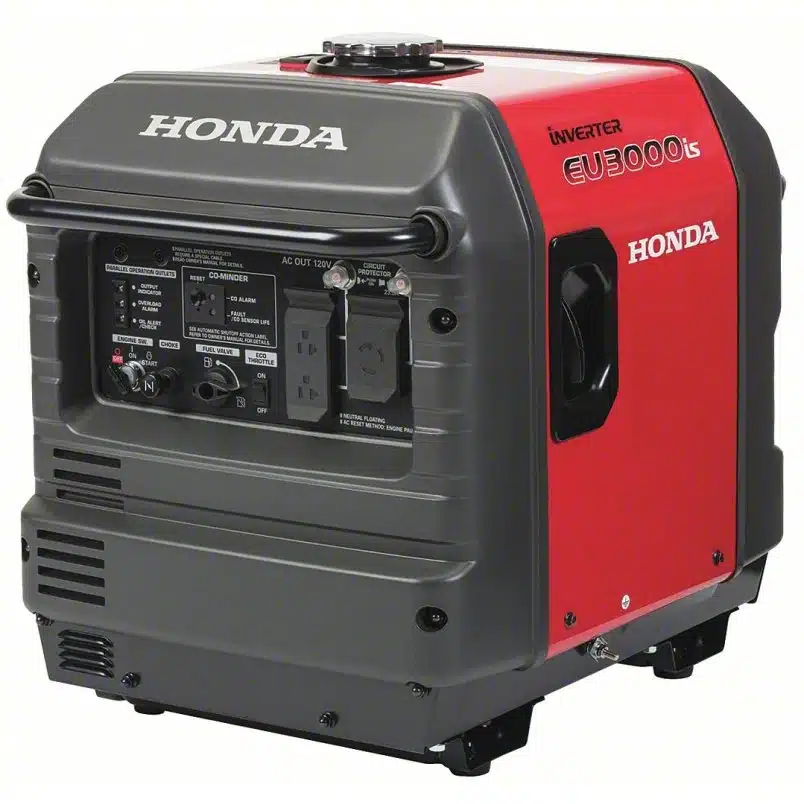
Most owners size their generator off running watts alone, and that guess is exactly what trips the breaker at your busiest moment.
Friday lunch rush, ten people deep in line. The fridge compressor kicks on, the rooftop AC fires up, somebody hits the blender at the same second, and the generator trips. Dead silence. POS is down and you’re standing in front of a full line losing money by the second.
That’s not a generator failure. That’s a sizing mistake made months earlier, when somebody looked at a spec sheet and guessed.
Here’s the direct answer. Your generator needs to cover your total running watts, plus the single largest startup surge from whichever compressor or motor kicks hardest. Then add 20 to 30 percent headroom on top. Most standard trucks with AC, hood, refrigeration, and lighting land somewhere in the 6,000 to 12,000 watt range once that math is done correctly. A small coffee or snack setup can often run on 3,000 to 5,000 watts. A full commercial kitchen with hood, freezer, refrigeration, expresso machine, and real HVAC can push past 12,000 watts. The number that matters isn’t what’s stamped on the box at the equipment dealer. It’s your specific truck, calculated from your specific nameplates.
I’ve watched this exact mistake sideline trucks on their busiest day more times than I can count. Let’s fix it properly.
KEY TAKEAWAYS
- Running watts alone will undersize your generator. Startup surge from compressors and motors is what actually trips the breaker.
- The real formula is total running watts, plus your single biggest startup surge, plus 20 to 30 percent headroom, not every surge stacked together.
- Standard food trucks typically need 6,000 to 10,000 watts, but your nameplate numbers are the only figures that matter for your truck.
- Running a generator flat out at 100 percent capacity all day accelerates wear and burns more fuel per hour than running it at a moderate load.
- A written startup sequence, compressors first, cooking equipment last, prevents trips for free, with no new equipment purchase required.
Why Does a Properly Sized Generator Still Trip?
If you’ve ever had a “big enough” generator trip during your lunch rush, you’re not imagining it. You’re not alone either. Almost every owner who undersizes a generator makes the same mistake. They add up the running watts on their equipment, land on a number, and buy a generator to match it. That number is real. It’s just only half the math, and it’s the easier half to get wrong.
I’ve sat on calls from owners who did the running-watts math correctly. They bought a generator that matched it on paper and still got tripped up on their first real service day. It wasn’t a bad generator. It was an incomplete calculation. Every piece of equipment with a compressor or a motor, your fridge, your freezer, your rooftop AC, a blender, draws far more than its normal running wattage for a few seconds just to start. Resistive equipment like a electric griddle (which you should avoid electric cooking if you can on a food truck) draws about the same at startup as it does running. There’s no motor fighting to get moving. Mix a fridge, an AC unit, and a electric fryer kicking on close together, and your surge demand spikes well past anything your running-watts total ever showed you.
Guess based on running watts alone, and you’ll buy a generator that works fine right up until your busiest moment. That’s exactly when everything tries to start or recover at once.
What Does the Research Say About Generator Surge and Load?
This isn’t a food truck quirk. It’s basic motor physics, and it shows up in every generator sizing guide worth reading.
An analysis of appliance startup behavior found that the average current a motor draws at startup runs three to five times higher than what it draws once it reaches full speed under load. That gap is the entire reason generators trip even when the “running watts” math checked out. The same principle applies inside your truck. A fridge compressor cruising at a steady wattage can spike to roughly double that number for a fraction of a second on startup. A full food truck buildout multiplies that risk across every compressor and motor you’re running.
Industry sizing guidance built specifically for food trucks backs up the exact math I teach on the podcast. One electrical planning guide for mobile kitchens walks through a real example: a truck with roughly 6,900 watts of running load and a 1,600 watt surge lands at 8,500 watts of true peak demand. Applying an 80 percent capacity rule pushes the recommended generator size up to nearly 11,000 watts. That’s not padding. That’s the difference between a generator that survives a lunch rush and one that doesn’t.
Equipment and Loads
On the equipment side, published wattage ranges for common food truck gear line up closely with what I’ve seen on real trucks. Commercial refrigerators and freezers typically run 700 to 1,500 watts. Griddles range from 1,200 to 3,000 watts depending on size. Electric fryers can push past 4,000 watts. Again avoid electric griddles and fryers as they are slow to recover, but we still need to talk about them. Startup surge for compressor-driven equipment routinely runs two to three times the running wattage, sometimes more. That’s why refrigeration and rooftop AC are almost always the piece that determines your true minimum generator size, not your cooking equipment.
On the load side, generator manufacturers and fleet operators agree on the same range. Standby generators perform best somewhere between 50 and 80 percent of rated capacity. Fuel efficiency and engine longevity both drop off if you run consistently below that band or push consistently above it. That’s not a marketing number. It’s why a generator sized exactly to your peak load, with zero headroom, ends up costing you more in fuel and wear than one sized with proper margin built in.
Here’s the Reframe Most Owners Miss
Most owners treat generator sizing like a one-time purchase decision: buy the biggest number you can afford, install it, forget about it. I teach it differently. A food truck generator is a capacity decision, not a shopping decision.
Capacity, not efficiency, is the lens. Your generator has a hard ceiling on how much surge it can absorb at once.
Your fryer works the same way: it only has so many baskets before ticket times fall apart. You don’t fix a capacity problem by working harder. You fix it by sequencing the load so you’re never asking for more than the system can deliver at one moment. A correctly sized generator, running a smart startup sequence, will outperform a bigger generator running everything at once every single time.
What Actually Changes When You Do the Math Right
Here’s what I walk owners through when we build out their electrical plan. It’s the exact same process whether the truck is brand new or you’re troubleshooting a generator that’s been tripping for a year.
- List every piece of electrical equipment and get real numbers, not guesses. Check the nameplate on each appliance for its running watts. Flag anything with a compressor or motor separately, because that’s where your surge comes from. Ballpark figures can get you in the neighborhood. Your actual equipment’s nameplate is the real number every time, not a chart from a podcast or a blog post, mine included.
- Do the math correctly. Add your total running watts across everything running at once. Then add the surge from whichever single piece of equipment has the biggest jump, usually your fridge or your AC compressor. You don’t stack every appliance’s surge on top of each other. That total is your real minimum. Add another 20 to 30 percent on top as headroom. That headroom protects your generator from running flat out all day, which accelerates wear and shortens its life.
Then
- Sequence your startup instead of firing everything at once. This step is free, and it’s the single easiest fix available to any owner reading this. Start the generator and let it stabilize for a couple of minutes with no load. Bring up the fridge and freezer first, since those compressors pull the hardest surge, and give them about a minute to settle. Bring the exhaust fan or AC up next. Then your griddle and fryer, since resistive heat adds running load but barely adds startup surge. Small electronics, your POS, lighting, microwave, go on last.
- Match the generator to your actual truck, not the biggest number on the lot. A small coffee or snack setup with basic refrigeration and a POS might run comfortably on 3,000 to 5,000 watts. A standard truck with a griddle, a fryer, refrigeration, and lighting typically lands in the 6,000 to 10,000 watt range. A full commercial kitchen with multiple fryers, an oven, and real HVAC can push past 12,000. Oversizing isn’t automatically the safe choice either. A generator that’s far bigger than your load burns more fuel even running light, costs more upfront, and adds weight you’re hauling for no benefit.
Your Generator Sizing Checklist
Walk your truck and record every nameplate. List running watts for every electrical piece of equipment: fridge, freezer, griddle, fryer, AC, exhaust fan, POS, lighting, everything. Skip nothing, including the small stuff.
Identify your single biggest startup surge. Almost always your fridge, freezer, or AC compressor. Add that surge number to your total running watts to get your true peak demand.
Add 20 to 30 percent headroom. Take that combined number and add the buffer. That final figure is your real minimum generator size, and it’s the number to compare against what you’re currently running or currently shopping for.
Build a written startup sequence. Compressors first, then fans and AC, then cooking equipment, then electronics. Write it down and post it where whoever opens the truck will see it every single time.
Train every opener on the sequence, not just yourself. A startup sequence that lives in your head only works when you’re the one opening. If someone else opens your truck, they need the same list you do.
Get your electrical panel reviewed before you buy. Generator sizing, wiring, and fuel setup is an electrical and fire safety decision, not just a shopping decision. Have your actual equipment specs and your truck’s electrical panel reviewed by a qualified electrician or your truck builder.
Verify any AI-generated wattage estimate against your actual nameplates. AI tools can help you organize a wattage worksheet or explain a concept. They should never be your final source on your equipment’s draw, your local electrical code, or a safety decision like generator sizing. Check every number against the nameplate yourself before you buy anything.
Frequently Asked Questions
What size generator do I need for a food truck?
Most standard food trucks with a griddle, fryer, refrigeration, and lighting need 6,000 to 10,000 watts. Small coffee or snack setups can often run on 3,000 to 5,000 watts. Full commercial kitchens with multiple fryers and HVAC may need 12,000 watts or more. Your actual nameplate wattage determines the real number.
Why does my generator trip even though it’s rated higher than my total running watts?
Startup surge is the cause. Compressors and motors, like your fridge, freezer, and AC, draw two to three times their running wattage for a few seconds at startup. If your generator’s peak capacity can’t absorb that combined running plus surge load, it trips even though the running watts alone fit fine.
Do I need to add up the startup surge from every appliance?
No. You add your total running watts across everything running simultaneously, then add only the single largest startup surge from whichever compressor or motor spikes hardest. Stacking every appliance’s surge together will lead you to oversize the generator far beyond what you actually need.
Is it better to oversize my generator just to be safe?
Not automatically. A generator far bigger than your actual load burns more fuel even running light, costs more upfront, and adds weight to your truck for no operational benefit. Size to your real math plus 20 to 30 percent headroom, not to the biggest unit available.
Can I trust an AI tool to calculate my food truck’s generator size?
Use it to organize your worksheet or explain a concept, but never as your final answer. AI tools don’t know your specific equipment’s actual nameplate draw or your local electrical code. Verify every number against your equipment and have your setup reviewed by a qualified electrician before you buy.
The Bottom Line
An undersized generator doesn’t fail on a slow Tuesday. It fails at your busiest moment, in front of your longest line, because that’s exactly when every piece of equipment wants power at once.
Capacity you planned for beats capacity you’re hoping for, every single time.
Keep Learning
- How to Handle Structural Equipment Failures in a New Food Truck
- Protecting Your Food Truck Investment: Propane Leak Detectors
- Lease, Buy, or Loan? Food Truck Equipment Financing Guide
- Bad Advice Is Holding Back the Mobile Food Industry
About the Author
Bill Moore is the Founder and Executive Director of the National Street Food Vendors Association (NSFVA), a trade association dedicated to advocacy, education, and unifying street food vendors nationwide. He has worked in food service since 1977, and his first street food vending was in 1981. Bill hosts the “10-Minute Food Truck Training” podcast, leads NSFVA’s weekly Mini Class and group coaching sessions, and is the author of Food Truck 101: Beginner to Winner and, with Melisa Moore, Food Truck 201: Get Off the Truck!