One busy trailer is a good business, not a proven system, and a buyer who can’t tell the difference can lose their savings learning it.
Scroll Facebook for five minutes and you will probably see a food truck franchise ad. A bright new trailer. A smiling owner. Loaded fries, tacos, or lemonade, and a headline promising you can own one in your town for about the price of a used pickup. “Proven concept.” “Turnkey.” “Low royalties.”
Those ads work because the dream is real. A lot of people want their own food business, and a franchise feels safer than starting from scratch.
A single food truck, or one young restaurant with a trailer version bolted onto it, is NOT a proven franchise. A franchise is supposed to sell you a system that has already worked for many owners, in several markets, over several years, without the founder standing at the window. One unit can’t show you that. It can only show you that one operator, in one market, had a good run. Like about 100,000 other food vendors.
I have owned franchise units, trained people inside corporate systems, and coached food truck owners in every corner of this country. I am not against franchising. What I am against selling a hope and calling it a system.
If you are shopping for a food truck franchise, or someone is pitching you on franchising your own truck, this article will show you what real proof looks like and how to check it before you sign anything.
Key Takeaways
- A franchise sells a proven system, and one truck or one location has not proven a system.
- In a well-known study of new franchisors, about three out of four were gone within twelve years.
- Any earnings or profit claim that isn’t in Item 19 of the Franchise Disclosure Document should set off alarms.
- Food cost is not profit, and a franchise pitch that blurs the two is teaching you the wrong math.
- If the numbers don’t work for the franchisee after royalties and owner pay, the brand ain’t gonna matter.
Why Are Single Food Trucks Suddenly Selling Franchises?
Franchising a mobile unit used to be something big brands did after they had hundreds of stores. Wetzel’s Pretzels had a proven store system long before its name went on a food truck. Today, franchising is a service a small owner can simply buy. Another “business in box” concept.
Look at The Franchise Maker, a franchise development company that markets directly to small business owners. Its website says it can take a business into franchising in as little as 90 days, for a price it describes as well under $50,000. The same site tells owners they can earn money from franchise fees, royalties, products franchisees are required to buy, and rebates from vendors. (Which is often a point of contention with franchisees. Ask me how I know.)
To be fair, that site also warns owners about something important. It says a business built around one star owner is harder to duplicate, and that there needs to be real demand outside the local area. That warning deserves more attention than the 90-day promise.
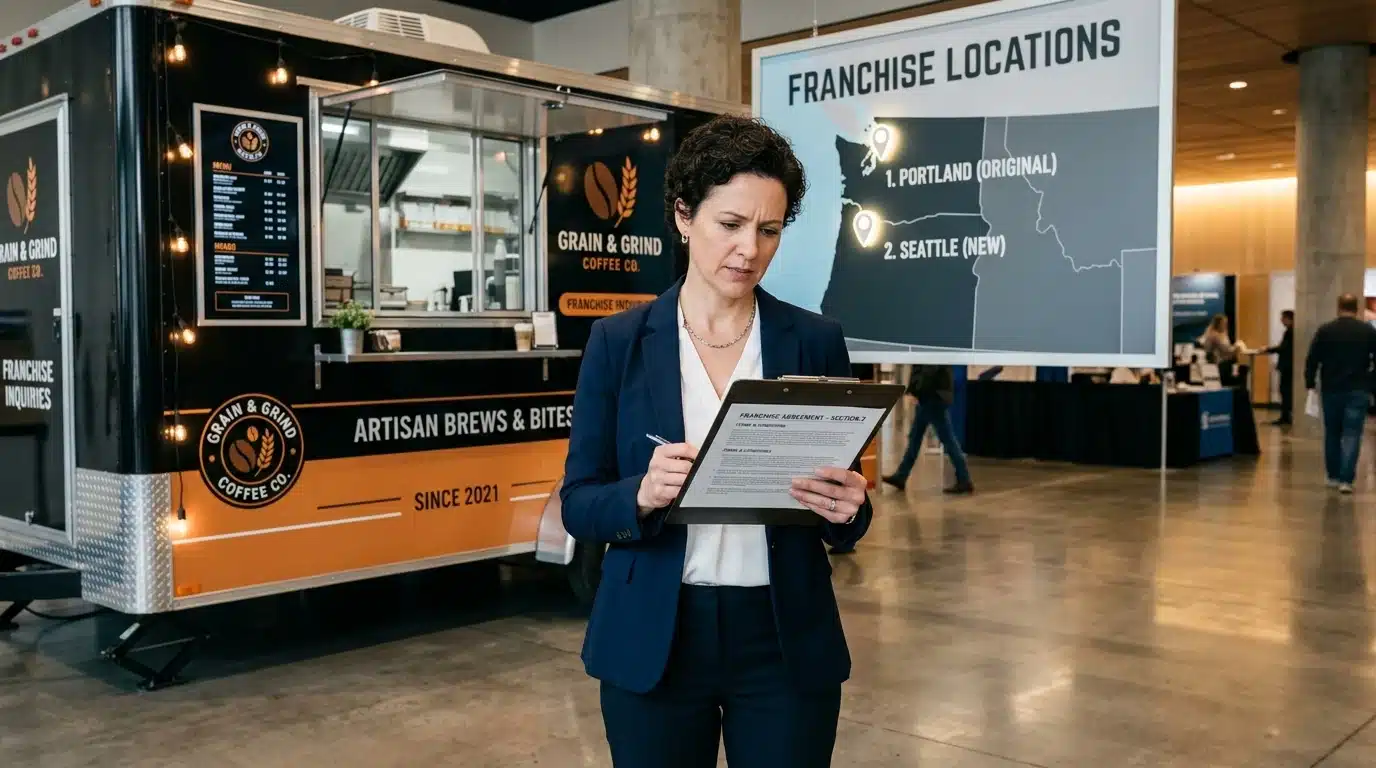
Now put the pieces together. A food truck owner has a good year and builds a nice social following. Somebody tells them their truck is a brand. For a flat fee and a few months, they can have a disclosure document and start selling territories. The system gets built on paper before it’s proven on the street.
An owner works one good summer, sells out twice, and starts giving advice. (ask me how I know that one, too!) Franchising takes that same instinct and then puts a huge price tag on it.
Running a truck is challenging. Selling franchises looks like an easy way off the truck. The owner wants out of daily operations, and the buyer wants in. Somebody has to carry the risk in that trade, and in these cases it’s the buyer.
What Does the Evidence Say About New Food Truck Franchise Systems?
Professor Scott Shane studied 157 companies that became franchisors between 1981 and 1983 and followed them for twelve years. His research, published in MIT Sloan Management Review, found that about three-quarters of those new franchise systems failed within that window. Those weren’t food trucks. They were new franchisors, and a one-truck franchisor is as new as it can possible get.
Growth doesn’t come easy either. A franchise developer writing in Entrepreneur reported that 67 percent of franchisors who launch don’t sell a single franchise in their first two years. The same writer put the average system at about ten units after ten years.
The Federal Trade Commission’s Franchise Rule controls what a franchisor can say about sales and earnings. Under the rule, any claim about sales, income, or profit belongs in Item 19 of the Franchise Disclosure Document, and the franchisor needs a reasonable basis for it. The FTC’s own franchise fundamentals guidance says a financial claim made outside Item 19 should set off your “baloney detector.” Its consumer guide to buying a franchise also says you must receive the disclosure document at least 14 days before you sign or pay.
A franchise attorney writing in Franchise Dictionary Magazine noted that franchisors who require a brand-new, custom truck can push the buyer’s investment into the $100,000 to $200,000 range. Given what one truck typically sells, he warned, breakeven can take a long time. What he really meant is it can take a long time to recover the initial investment. Breakeven is generating enough sales to pay all expenses not be debt free.
A Closer Look at One Heavily Advertised Offer
There is one offer I keep seeing on Facebook. According to the company’s published food trailer presentation, here is what the buyer gets:
- A new 8-by-7 foot trailer, with start-up listed at about $40,000 including initial franchise fees, plus $3,000 to $8,000 for inventory, smallwares, and licenses.
- A 3 percent monthly royalty and a 1 percent marketing fee.
- Marketing that calls it a “proven concept,” backed by 10,000 Instagram followers and a 4.5-star rating.
- The floor plan has a SINGLE fryer. You already know that makes zero sense for a business with a signature items of French Fries.
Read the rest of the presentation and the picture gets clearer. The company describes itself as a young start-up offering discounts to early adopters. (like it is software) The trailer is a condensed version of its brick-and-mortar restaurant, and the materials say the trailer will be just as profitable because it avoids rent, utilities, and labor. Every review and improvement it describes comes from its first year in business.
So the proof being offered is one restaurant’s early guest reviews. What’s being sold is a trailer model in a different format, run by a stranger, in a different market. Nothing in the presentation I reviewed shows sales or profit history from a company-run trailer anywhere.
I’m not saying the food is bad. The reviews sound like happy guests. I’m saying the proof doesn’t match the promise. Good reviews prove people like the fries. They don’t prove a buyer in another state can earn a living from that trailer after royalties, permits, event fees, and their own paycheck. That is key.
Why Food Cost Is Not Profit
The same presentation says fries cost about $0.90 a serving, a regular cone sells for $5.50, and it calls the $4.60 difference profit. It also claims profit margins of 75 to 90 percent on fries.
That $0.90 against $5.50 is roughly a 16 percent food cost on that item. That’s a nice number. It’s not profit.
Profit shows up after packaging, fryer oil, propane, labor, permits, commissary fees, event fees, insurance, fuel, repairs, royalties, marketing fees, and the owner’s pay. Skip those lines and you’ve skipped every cost that actually closes food trucks. I teach owners to plan food cost on mains around 25 to 28 percent and then build a breakeven with owner pay as a planned cost. That’s the math a franchise pitch should survive. One-unit pitches never show it.
What Makes a Food Truck Concept Actually Franchise-Worthy?
A concept earns the right to be franchised when it passes a simple test. The test is based on my book Food Truck 201: Get Off the Truck!, because a franchise is the ultimate version of the owner not being on the truck.
The test asks for three proofs.
Proof of Replacement. The unit runs profitably for a full season without the founder cooking, taking orders, or booking events. If the magic walks out the door when the owner does, there is nothing to sell.
Proof of Repetition. More than one unit, in more than one market, with more than one year of real books. Two company-owned trucks in two cities tell you far more than 10,000 followers of one location.
Proof of Profit After Royalties. A franchisee’s unit has to cover food, labor, permits, fees, and a real owner paycheck, and still show profit after the franchisor takes its cut. A royalty is a percentage of sales, not profit. It comes off the top whether the franchisee made money that month or not.
A single truck fails all three proofs by definition. That’s not a knock on the owner. One unit simply can’t answer those questions yet and is not franchise worthy.
What Should a Food Truck Owner Do Instead of Franchising Too Early?
If you own a successful truck and someone is pitching you on franchising, just stop. Selling franchises means you are no longer in the food business. You are in the business of training, supporting, and protecting other owners’ investments. That is an entirely different business model.
Build the second unit first. Then the third. Run them with managers, not family members covering for you. You’ll find out quickly whether your recipes, your prep system, and your service standards survive without you. Most don’t on the first try, and that’s normal. You fix them on your own dime instead of a franchisee’s.
Write your operations manual while you do it. Every recipe, every prep list, every opening and closing checklist. Then hand it to a new hire and watch what happens. If you need to stand beside them to make it work, the manual isn’t finished. Training is where most systems break, which is why training food truck employees who actually stick around matters long before anyone signs a franchise agreement.
Pay attention to capacity, too. An 8-by-7 trailer with two people inside has hard limits on fryer space, cold storage, and how many orders you can push in an hour. A big menu with multiple proteins, multiple fry types, and a wall of sauces eats that capacity fast. That’s why I push new owners toward two to four core items. A franchise that can’t serve a festival line at speed will lose money at the exact events buyers are counting on. If you want to see how event math really works, read how to tell if a food truck event is worth booking.
And be honest about licensing. Mobile vending permits are a normal cost of doing business in much of the country, and they change county by county. A franchisor in one state can offer to “assist” with licensing, but your local health department and fire marshal make the call. Price those permits into your numbers before you decide anything.
If you’re on the buying side, remember what you’re paying for. With a real franchise, you’re buying years of mistakes someone else already made and fixed. With a one-unit franchise, you are paying to make those mistakes for them.
How Do You Vet a Food Truck Franchise Before You Sign?
- Get the Franchise Disclosure Document before talking money. Ask for the FDD on the first call. Federal rules require you to have it at least 14 days before you sign or pay anything, and a seller who dodges that request just told you what you need to know.
- Read Item 19 before anything else. This is the only place earnings claims belong. If the ads, the brochure, or the salesperson quoted numbers that don’t appear there, treat those numbers as marketing, not facts.
- Count the units in Item 20. Item 20 shows how many outlets exist, how many opened, and how many closed. Ask specifically how many are mobile units and how many the franchisor operates itself.
- Call the owners on the list. Item 20 also lists current and former franchisees. Call them, not just the ones the franchisor recommends, and ask what they actually net after royalties and their own pay.
- Rebuild the numbers yourself. Use your local permit costs, commissary fees, event fees, and a real paycheck for yourself. If the unit only works when you pay yourself nothing, it doesn’t work. Our look at the state of the food truck industry in 2026 is a good starting point for realistic sales expectations.
- Price the trailer on its own. Get quotes from two or three independent builders for the same size and equipment package. If the franchise price is far above that, you’re paying for the name, so make sure the name is worth something in your town.
- Hire a franchise attorney before you sign. Not your cousin who handled your house closing. A lawyer who reads FDDs for a living can spot termination clauses, territory gaps, and supply requirements you’ll miss.
Frequently Asked Questions
Can you franchise a single food truck?
Legally, yes. Once a business has a trademark, a disclosure document, and follows the FTC Franchise Rule and any state registration rules, it can sell franchises. Being legal to sell is not the same as being proven. One truck can show that a concept works for one owner in one market, not that it works as a system.
Is a food truck franchise cheaper than starting my own truck?
Sometimes the upfront price looks lower, but franchises add royalties, marketing fees, and required purchases that never go away. A 4 percent total fee on $150,000 in sales is $6,000 a year, every year. Compare the full five-year cost, not just the opening check.
What is Item 19 in a Franchise Disclosure Document?
Item 19 is the section where a franchisor may disclose sales, income, or profit figures for its outlets. It is optional, but it is the only place those claims are allowed. If a seller gives you earnings numbers that are not in Item 19, the FTC advises treating that as a warning sign.
Are all food truck franchises bad investments?
No. Established brands with many operating units, years of disclosed results, and a record of franchisees making money can be solid choices. The risk is highest with brand-new systems selling their first units, where the buyer is effectively funding the franchisor’s experiment instead of buying a tested system.
How many units should a business have before it franchises?
There is no legal minimum, but a responsible benchmark is multiple company-owned units in more than one market, profitable for at least a couple of years without the founder on site. That track record is what gives Item 19 real numbers and gives buyers something more than a promise.
So, Should You Buy the Trailer in the Ad?
Go back to that Facebook ad. The bright trailer. That smiling owner. The word “proven” in big letters.
Before you fall for it, ask one question. Proven by whom? One restaurant’s early reviews? One owner’s good summer? Or a stack of franchisees in different towns who can show you their books and tell you they paid themselves?
If you’re a buyer, you deserve the second kind of proof. If you’re an owner being told your truck is ready to franchise, you owe your future buyers that same proof before you take their money. Build the second truck. Then the third. Get off the truck and see if it still makes money. If it does, you’ll have something real to sell.
The most expensive mistakes I’ve seen came from people who confused excitement with evidence.
A great truck proves you can run a truck. A franchise has to prove a stranger can.
Keep Learning
- The State of the Food Truck Industry in 2026: Opportunity Is Real, but So Are the Numbers: What the industry really looks like, including realistic sales expectations.
- How Do You Know If a Food Truck Event Is Actually Worth Booking?: The event math every owner and every franchise buyer should run.
- How Do You Train Food Truck Employees Who Actually Stick Around?: Why training is the backbone of any system that runs without the owner.
- How Do Food Truck Drinks Actually Make You Money?: A practical look at margin and what really reaches your bottom line.
Bill Moore is the Founder and Executive Director of the National Street Food Vendors Association (NSFVA), a trade association dedicated to advocacy, education, and unifying street food vendors nationwide. He has worked in food service since 1977, and his first street food vending was in 1981. Bill hosts the “10-Minute Food Truck Training” podcast, leads NSFVA’s weekly Mini Class and group coaching sessions, and is the author of Food Truck 101: Beginner to Winner and, with Melisa Moore, Food Truck 201: Get Off the Truck!