The honest math on what solar can, what it can’t do. Plus, why the real answer is not as simple as “yes” nor “no.”
Three folks asked me some version of “should I go solar and get rid of my generator”. A salesperson’s pitch or a slick video showed a food truck running silent, sun powered, generator gone for good.
For most food trucks, solar power could be useful tool for part of the load. Then it could be a bad fit for the rest of it. Knowing which part is which before you spend a dollar is worth thousands of dollars to you.
Solar for food trucks gets marketed the way a lot of equipment gets marketed in this industry. As a total solution, a generator killer, a “we haven’t bought fuel in two years” success story. Some of that is real. Most of it skips something important. What actually decides whether solar makes sense for you. What does your truck draw? Can solar physically deliver that draw? Does the math work for your roof square footage, your method of setting up, and your weather.
That’s what we’re working through today.
| Key Takeaways Solar handles lighting, POS systems, small refrigeration, and device charging well. That is a proven, provable investment most trucks can make right now. Full commercial cooking loads (griddles, fryers, ovens) commonly need 6,000 to 12,000-plus watts, a load that panels and batteries alone rarely cover without a five-figure system. Cloudy days cut solar output. In one commonly cited study, heavy cloud cover reduced panel output by well over half compared to full sun, so any all-solar plan needs a real weather answer, not a hopeful one. A hybrid setup (solar for baseline loads, propane for cooking, a generator sized for backup) is the version of “going solar” that actually survives contact with a real service day. Get independent numbers before you sign anything. A sales rep’s wattage promises, or an AI-generated cost estimate, are not the same as a licensed electrician looking at your specific truck. |
Why “Ditch the Generator” Sounds Better Than It Works
I get it, I really do. Generators are loud. They smell. Every gallon of fuel is a cost you eat before you sell a single item. A cook watching a video of a silent, sun-powered truck gets excited about the story. An operator asks the boring question first: what’s my actual power draw, and does solar cover it.
That gap between the story and the math is where owners get burned. I know folks who got a quote built around their lighting and POS system. Only to find out the hard way that the same quote was quietly assumed to cover a fryer too. Nobody lied to them directly. It’s just no one walked them through the difference either.
A griddle, a fryer, or a convection oven pulls thousands of watts continuously. Most run on 220 to 240-volt hardwired circuits drawing 20 to 50 amps under normal operation. Recovery for electric is painfully slow. That is why you see propane used so much.
Standard food trucks typically need a 6,000 to 12,000-watt generator PLUS propane to run that kind of cook line. Then add in refrigeration, lighting, and ventilation, not the mention hot water heating, water pump, and air conditioning. That is not a load a couple of rooftop panels and a battery bank could absorb. It is a load requiring planning, the same way you’d plan for how many watts your generator actually needs.
What Solar Actually Costs, and What It Actually Runs
Let’s separate what’s real from what’s oversold, using real numbers instead of a sales pitch.
The baseline win is real and affordable. A basic hybrid setup includes, panels, a battery bank, and an inverter. It typically runs from a few thousand dollars up to around $10,000 depending on system size. That kind of system covers LED lighting, your POS and card reader, exhaust fans, phone and tablet charging, and refrigeration. It takes real strain off your generator for your daily baseline load.
The full replacement is where the physics push back. DIY solar forums discussing systems for a food truck report needing battery banks in the 13 to 15 kilowatt-hour range. That is roughly the size of a home battery unit, just to get through a service day without a generator. One forum thread on sizing a 15 kilowatt-hours battery bank puts the cost at $15,000 to $20,000. Just for the battery bank alone. Then the battery pack weight (around 3,000 pounds) and needing replacement every three to four years. Adds to a costs sales people conveniently skip. That same builder needed 6,000 watts of rooftop panels just to keep those batteries charged. That’s a lot of square footage on a roof. Remember it has to hold your up hood system and exhaust fan, too. Do you feel the gas mileage on your tow vehicle dropping as you read this?
Weather is the variable that breaks a lot of “solar only” plans. Cloud cover measurably cuts panel output. There is a known reduction (around 10 to 25 percent) with light cloud cover. The University of Port Harcourt found light cloud cover cuts a monocrystalline panel’s output by roughly 24 percent. Heavy cloud cover cut it by close to 67 percent compared to full sun. If you work under a gray sky, that is the difference between running your fridge and not.
To be fair, full solar builds are not fantasy. One owner describes converting an entire food truck to 15 kilowatt-hours of battery and rooftop panels. They reported it is working well for their operation. But even that owner’s real-world fix for cloudy days was an on board generator and propane.
The Baseline-Versus-Burner Test
One question that cuts through most of the confusion: does your load run continuously at low, steady wattage?
Baseline loads don’t care exactly when they get their power. Your lighting, your POS system, your exhaust fan, your small under-counter fridge, these draw steadily and forgive a little variance. That’s a baseline load, and it’s exactly what solar and a modest battery bank are built to carry.
Burner loads are different. Your griddle, your fryer, your oven, these need full power the moment the lunch rush hits. They’re hardwired, high-voltage, and unforgiving. Treat a burner load like a baseline load and you’ll find out quickly how fast it fails.
Every solar conversation you have from here forward should start by sorting your equipment list into those two buckets. Everything after that gets a lot easier.
The Hybrid Setup That Actually Holds Up on the Line
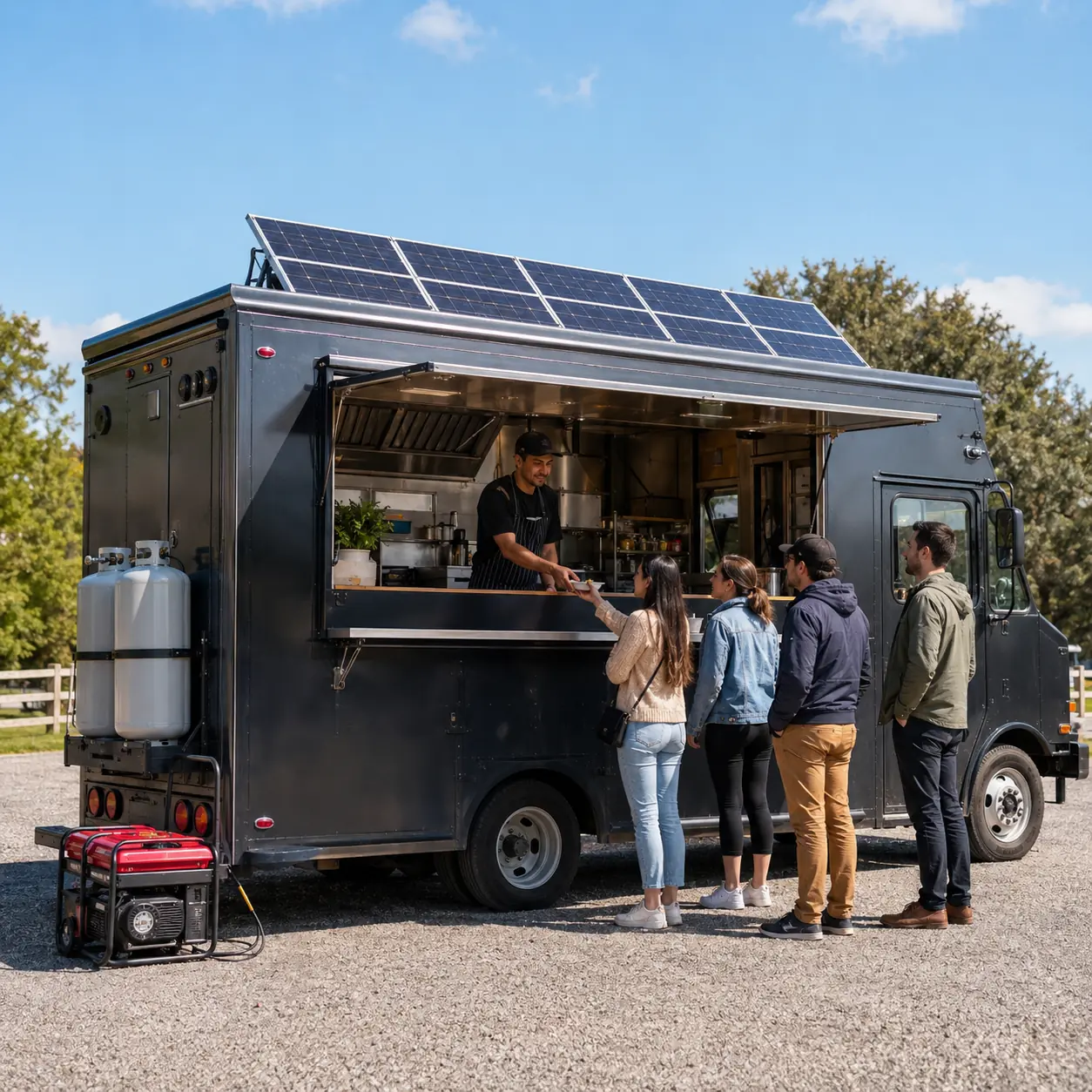
The realistic, proven setup for most food trucks isn’t “all solar” or “no solar.” It’s solar carrying your baseline electrical load. Your cooking equipment stays on propane, which most trucks already run anyway. Your generator stays in reserve for air conditioning, refrigeration startup surges, or a stretch of cloudy days.
This is the version that actually matches your equipment’s real power draw and your weather. A sales rep’s best-case slide deck doesn’t keep you cooking. This keeps your fuel costs down from the loads solar genuinely handles. It takes wear off your generator. Plus, it gives your guests a quieter, less smoky truck to stand in line at.
If someone claims to run your cook’s line off the sun with no generator backup at all. Ask them to walk you through their math for cloudy days and winter sun hours specifically for your town. Then send that math to me. A legitimate commercial installer will have a real answer. A sales pitch will have a warm and fuzzy reassurance instead. I asked one supplier, a well known supplier, for the math. They refused claiming it proprietary. Really? Math isn’t proprietary. They didn’t want pretend math exposed.
Six Steps to Take Before You Buy a Solar System
- List your baseline loads separately from your cooking loads. Lighting, POS, small refrigeration go in one column. Griddle, fryer, oven go in another. These are two completely different power conversations, and mixing them is how owners end up underpowered.
- Get quotes from installers who specifically work on commercial vehicles. Residential home solar companies size systems for a house on a foundation. You have a moving vehicle with weight limits, vibrations, and a completely different duty cycle. The engineering isn’t the same, and neither is the sales pitch.
- Ask any full-replacement pitch for their peak-sun-hour math for your actual location. Not a national average. Your parking spots, your typical event season, and your area’s average cloudy days per year. If they can’t answer that specifically, they’re selling a story, not a system.
- Have your roof and electrical panel reviewed by a qualified electrician or your truck builder before you sign anything. Panels carry real weight. A rooftop mount needs to be checked against what your specific truck can actually support, not assumed. It is NOT what the axles can carry. It is the load the walls and ceiling carry.
- Size your backup generator to your true startup surge, not just your running watts. Equipment like refrigeration and AC spike three to five times their running wattage for a few seconds at startup. An undersized generator trips right when you need it most. If you haven’t run this math yet, check our food truck generator sizing guide before you finalize anything.
- Get independent numbers before you commit capital. This is a real investment, often a five-figure one for a full system, so treat it like one. Don’t take a sales rep’s wattage promises, or an AI tool’s cost estimate, as verified fact. If you’re financing the purchase rather than paying cash, work through your options in our equipment financing guide first.
Frequently Asked Questions
Can solar power run a food truck’s fryer and griddle?
Not as a full, standalone replacement for most trucks. Griddles and fryers can pull 1,200 to over 4,000 watts continuously on hardwired 220 to 240-volt circuits. That’s a load that typically requires a battery bank in the five-figure cost range. Just to cover it without a generator, plus more rooftop panel space than most trucks have available.
How much does a basic solar setup cost for a food truck?
A basic system covering lighting, POS, and small refrigeration generally runs up to around $10,000, depending on battery size and installation. A full off-grid system covering cooking can run into the $20,000-plus range once you include a battery bank large enough to keep up.
Do solar panels still work on cloudy days?
Yes, but output drops meaningfully. Light cloud cover commonly cuts output by roughly 10 to 25 percent, and heavy cloud cover can cut it by half or more depending on the study and cloud type. Any solar plan for a food truck needs a real backup answer for those days, not an assumption that the sun will cooperate.
Is a hybrid solar and generator setup worth it for a food truck?
For most operators, yes. Solar covers your steady baseline loads and reduces fuel use and generator wear, while propane stays on cooking duty and your generator remains in reserve for air conditioning, refrigeration surges, or bad weather. It is the setup most likely to actually hold up through a full season of real service.
What’s the biggest mistake owners make when shopping for food truck solar?
Treating solar as an all-or-nothing generator replacement instead of a tool for a specific part of the electrical load. Owners who separate their baseline loads from their cooking loads before shopping make far better buying decisions than owners chasing a “no more generator” story.
Solar Is a Tool, Not a Miracle
Solar isn’t hype, and it isn’t a miracle either. It’s a tool that does one job very well and another job very badly, and the owners who get burned are the ones who bought the story instead of the specs.
“The owners who get burned are the ones who bought the story instead of the specs.”
Cover your baseline load with solar if the math works for your truck. Keep propane for cooking. Keep a generator in your back pocket for the days the sun doesn’t show up. That’s not settling for less than “real” solar. That’s what actually running a food truck looks like.
Keep Learning
How Many Watts Does a Food Truck Generator Actually Need? Work through the same starting-watts-versus-running-watts math your generator backup needs to be sized correctly.
Propane Safety Isn’t Optional. If propane is staying on your cook line, here’s what every operator needs to know about running it safely.
Should You Trust an AI Tool You Didn’t Build? Why an AI-generated wattage or cost estimate should never be the final word on a capital decision like this one.
Lease, Buy, or Loan? Food Truck Equipment Financing Guide. If you’re financing a solar system instead of paying cash, compare your options before you sign.
Bill Moore is the Founder and Executive Director of the National Street Food Vendors Association (NSFVA). A trade association dedicated to advocacy, education, and unifying street food vendors nationwide. He has worked in food service since 1977, and his first street food vending was in 1981. Bill hosts the “10-Minute Food Truck Training” podcast, leads NSFVA’s weekly Mini Class and group coaching sessions, and is the author of Food Truck 101: Beginner to Winner and, with Melisa Moore, Food Truck 201: Get Off the Truck!