The chains are spending millions to turn drinks into a destination. On a truck, food truck drinks do something more valuable than that, and most owners never notice.
I sat with a taco truck owner going through a Saturday at a park event. He ran 140 tickets in four hours. Good day by his standard. Then we pulled the drink count off the report. Twenty-two.
Twenty-two drinks on 140 tickets. His add on rate was under 16 percent, and he had a cooler full of product that went home with him. He was not out of drinks. He was not out of ice. Nobody had refused a drink. His crew simply never asked, and his menu board listed beverages in six point type at the very bottom as an after thought.
Food truck drinks make you money because a drink is an item you sell that likely never creates a bottleneck. Your grill, your fryer, your flattop, that is your capacity ceiling, and every food item on your board as a limit. A drink comes out of a cooler in three seconds. It adds revenue per hour without adding a single second to your cook time. That is not an accessory. That is the only lever you have that raises sales without creating a corresponding choke point.
The chains figured this out and are now spending serious money on it. What they are chasing is traffic, because they need it and have room for it. What you should be chasing is margin on tickets you are already ringing up, that is where you have room today to grow sales without more marketing.
KEY TAKEAWAYS
- Food truck drinks are the only items that add revenue without consuming cook line capacity.
- Attachment rate, not drink variety, is where most trucks are leaving money behind.
- Run every candidate drink through the Three Line Test: cook line, water line, power line.
- Event contracts often restrict or forbid vendor beverage sales, so read before you plan on the revenue.
- Menu discipline applies to drinks too, and two to four options plus water beats a chalkboard full of them.
Why Do Food Trucks Treat Drinks as an Afterthought?
Because drinks feel like they do not count.
Food truck drinks get ignored for a simple reason. Owners get into this business because they cook. That is the passion, that is the identity, and that is where all the attention goes. Your Signature Item isn’t a can of soda. The drink cooler becomes a utility, something you restock when it looks empty. Nobody builds a recipe card for a canned soda. Nobody times the build. So the category sits there generating a little cash.
I have seen this same blind spot on trucks doing $100,000 and trucks doing $700,000. Owners will spend six weeks perfecting a sauce and zero minutes looking at their beverage sales mix. Most of them cannot tell me what that number is when I ask.
There is a second reason, and it is more understandable. Space. A truck has a finite number of cold cubic feet, and every one of them is already spoken for. Cold storage is usually the tightest constraint on the whole vehicle, tighter than counter space and tighter than cook surface. So adding drinks feels like it costs you prep room you cannot spare, and for some trucks that is true. But most it is not, and it is not even close when we actually look at the operation.
That tension is real and I am not going to pretend it is not. The owner who carries eleven kinds of canned soda because a distributor talked him into a variety pack has the same problem as the owner who carries nothing. Neither one made a business decision. They let a feeling win.
Feelings are what every industry, every business will punish. Somebody who cannot explain why each item is on the truck, food or drink, is carrying inventory on hope.
What Is the Restaurant Industry Actually Seeing in Beverages?
The data on this is strong right now, and it is worth knowing what the chains know.
The National Restaurant Association’s 2026 Restaurant Beverage Trends report found that 80 percent of limited-service operators say beverages can be an important driver of restaurant traffic, and that majorities in both service segments now consider beverage variety more important than it used to be.
Consumer behavior is where it gets interesting for us. That same report found that 37 percent of consumers make beverage-only purchases at least weekly, rising to 50 percent of Gen Z adults and 47 percent of millennials. Afternoon is the most popular time for those purchases. In the industry this is called the “snack” daypart. If you have ever wondered why your two o’clock to four o’clock window feels dead, that is a real daypart you may be ignoring. Sonic for example has drink specials during this time frame. They spend billions to understand consumers.
The report also found that 71 percent of Gen Z and millennial consumers say their favorite restaurant beverages deliver flavor experiences they cannot easily replicate at home, and 72 percent of all consumers say restaurants are a good place to discover a beverage they have never tried. So is a food truck.
Look at what the big operators are doing with that information. QSR Web reported in September 2026 that Taco Bell is targeting $5 billion in beverage sales by 2030 and is expanding a beverage-focused café concept that carries more than 30 specialty drinks made by a dedicated drink barista. McDonald’s launched a nationwide Refreshers and crafted soda lineup as permanent menu items rather than a limited time offer, then entered the energy category through a Red Bull partnership. Dirty Soda owners need to take notice. These are plans on the corporation’s growth plans. They are not “reacting” to the local tent vendor selling dirty soda on the weekend.
Read that Taco Bell detail one more time. A dedicated drink barista. That is an entire labor position assigned to beverages, which tells you exactly how much revenue they expect the category to carry. You are not going to staff a barista. What you should take from it is the priority, not the model.
On profit, the picture is just as clear. Restaurant365 puts a healthy pour cost between 18 and 24 percent, with the average landing near 20 percent, meaning roughly 80 cents of every beverage dollar stays as gross profit. Packaged non-alcoholic drinks on a truck often run better than that. Flavor trends are moving fast too. Datassential reported that matcha latte menu mentions grew 218 percent over four years and oat milk grew 112 percent.
A Drink Is the Only Item That Skips Your Bottleneck
Now here is the part the chain coverage can’t tell you, because a chain does not have your problem.
Every truck has one constraint that sets the ceiling on a service. Usually it is cook surface. Sometimes it is a single fryer, sometimes it is the one person who can assemble. Whatever it is, it determines how many tickets per hour you can physically produce, and no amount of hustle changes that number. This is why I teach capacity rather than efficiency. Efficiency asks you to move faster inside the ceiling. Capacity tells what the ceiling actually is. You can’t break that ceiling without changing equipment.
Food if bound by that ceiling. Drinks are not.
A canned drink pulled from a cooler consumes three seconds and zero cook surface. Sell 60 more of them in a service and your line does not slow by one second. There is no other category on your truck where that is true. Not sides, not desserts, not add-ons, because most of those touch a fryer or a prep hand at some point.
So stop thinking of drinks as something you offer and start thinking of them as the only revenue you can add to a maxed-out service. When your window is slammed and you physically cannot cook another taco, the suggestion of a drink is the last dollar available to your business.
That leads to one practical rule for food truck drinks. Before any drink goes on your truck, run it through what the Three Line Test.
How Does the Three Line Test Work?
Three lines. Cook line, water line, power line. Every drink you consider either touches one of them or it does not, and each one it touches has a real cost you must price.
Cook line. Does making this drink occupy a hand that should be building food? A canned or bottled drink does not. A drink that needs to be poured, blended, shaken, or topped with anything does. During a rush, that hand is the most expensive thing on your truck. If a drink pulls someone off the cook line during peak, it has to earn more than the food the employee was cooking.
Water line. Does it require ice, potable water, dispensing, or open-cup handling? This is the one owners underestimate, because it is not just a convenience question. It is a permit question. Open-cup beverages, ice handling, and dispensing equipment can carry different requirements than sealed packaged drinks, and in some jurisdictions adding them means amending your plan review or upgrading tank capacity. Do not take my word for it and do not take an AI chatbot’s word for it either. Call your health department and ask before you buy equipment. Ice handling in particular is a food safety issue that inspectors look at closely, which is one more reason to keep your food safety certification current and your crew trained on it.
Power line. Does it draw amps? Blenders, frozen drink machines, espresso equipment, and additional refrigeration all pull load, and a truck that is already near the edge of its generator will find out at the worst possible moment. Size it on paper before you buy. I walked through that calculation in our piece on how many watts a food truck generator actually needs.
A drink that touches zero lines is close to pure margin. A drink that touches all three had better be a signature item you can charge real money for, not a novelty you added because you saw it at a chain or it’s your kids favorite.
What Should Actually Be on a Food Truck Drink Menu?
Think of food truck drinks in three tiers.
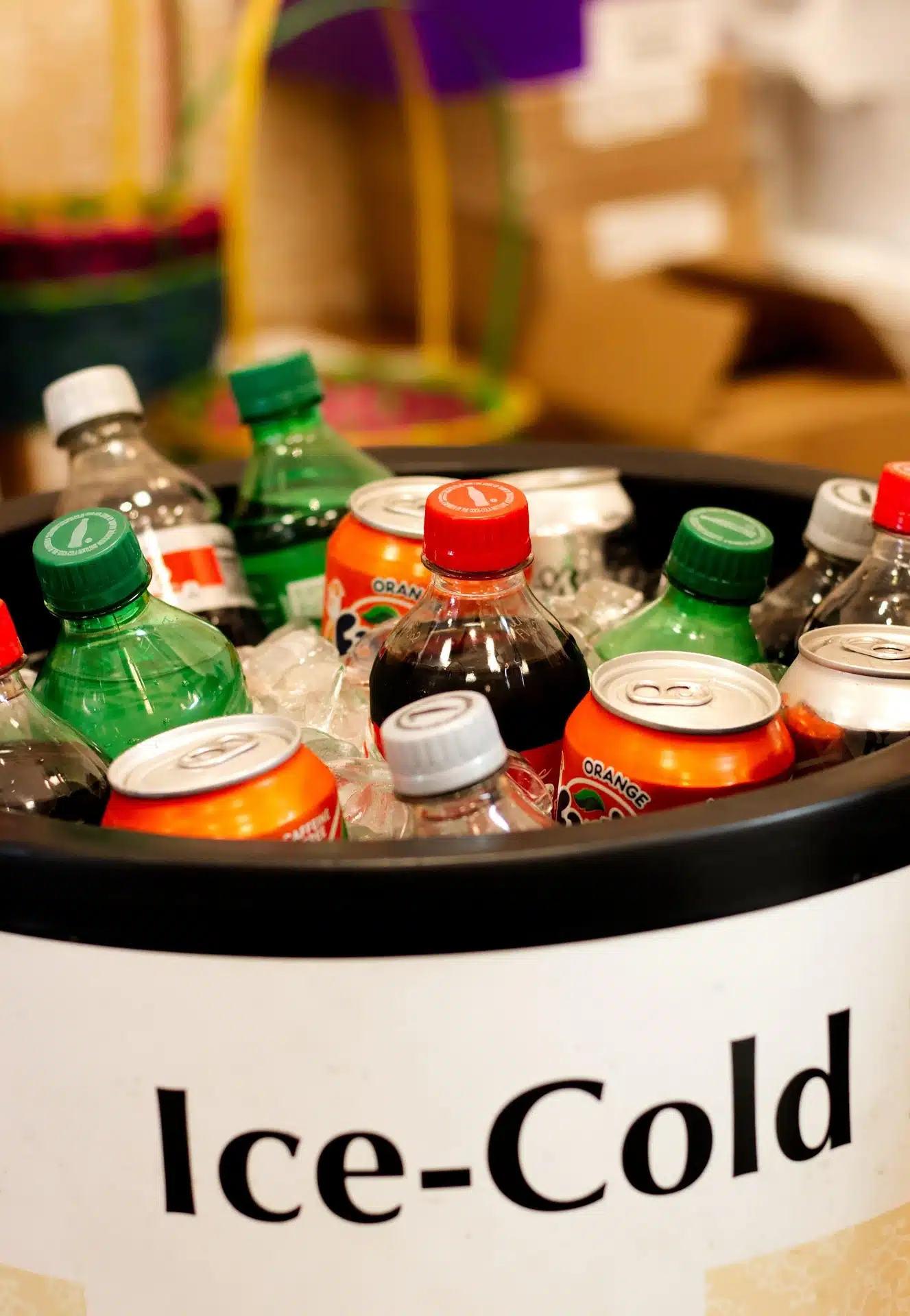
Tier one is packaged. Bottled water, canned soda, canned tea, sealed specialty sodas. Zero lines touched. Every truck should run this tier well before considering anything else, and plenty of profitable trucks never go further. The move here is not variety. It is placement, pricing, and asking.
Tier two is batch and pour. House lemonade, sweet tea, agua fresca, horchata, cold brew. You touch the water line and sometimes the cook line. The payoff is real, because a batched drink costs you very little per serving and carries a higher price than a can. It also gives you something a convenience store cannot sell. A signature drink that ties to your food concept is a reason to choose your truck over the one parked next to it.
Tier three is made to order. Blended, frozen, espresso based, anything built per ticket. All three lines. This tier can absolutely work, but it usually needs a dedicated person and a dedicated station, and on most trucks that means it is either your whole concept or a mistake.
Menu discipline applies here exactly the way it applies to food. I teach a two to four item core menu because that is what a truck can execute at volume, and drinks are not exempt from that math. Water, one soda option, and one signature batched drink will outperform a cooler holding eleven varieties nobody chose on purpose.
One more warning that costs owners real money. Many event contracts restrict or forbid vendor beverage sales, because the organizer is selling drinks themselves or has a pouring rights sponsor. I have watched vendors load a cooler for a festival and find out at load-in that they cannot sell a single bottle. Read the contract before you build a revenue plan around drinks, the same way you should be evaluating every other term in an event offer.
Practical Steps to Build Beverage Revenue This Month
1. Pull 30 days of POS data and calculate your attachment rate. Divide drinks sold by total tickets. Under 30 percent means the category is being ignored. Above 60 percent means it is working. You cannot fix a number you have never measured.
2. Put the ask in the order script. Train every crew member to say the same line on every ticket, something like “cold drink with that?” This single change costs nothing, adds no equipment, and moves attachment rate further than any new product will. It only sticks if you train it and reinforce it rather than mentioning it once.
3. Move drinks off the bottom of your board. If beverages live in small type under everything else, customers read past them. Give the category its own block at eye level with a price. People buy what they see while they wait.
4. Count your cold cubic feet before you add anything. Measure what you actually have and what is already committed. If adding a drink means displacing prep you need, that drink costs more than its invoice says.
5. Price on contribution dollars, not percentage. A canned drink at roughly $0.45 landed cost sold for $3 contributes $2.55. Compare that against what a side or a dessert contributes and against the seconds each one consumes. Dollars per second of labor is the honest comparison on your truck.
6. Add one signature batched drink as a two week special. Pick something that fits your food and can be made in advance. Track whether it lifts your overall attachment rate or simply replaces can sales. If it only replaces, it has not earned a permanent spot.
7. Check your next three event contracts for beverage language. Look specifically for exclusivity, pouring rights, and any clause requiring you to buy drinks from the organizer. Find out now, not at load-in.
Frequently Asked Questions
What is a good beverage attachment rate for a food truck?
Aim for 50 to 60 percent of tickets including a drink. Many trucks sit below 30 percent simply because nobody asks and the menu board buries the category. Track it monthly from your POS. Attachment rate improves faster through crew scripting and menu placement than through adding new products.
Are canned drinks or fountain drinks better for a food truck?
Canned and bottled drinks win for most trucks. They require no water line, no dispensing equipment, no plan review changes, and almost no labor per sale. Fountain systems add syrup, carbonation, water capacity, and cleaning requirements that rarely pay off at food truck volume.
Do I need a separate permit to sell drinks from a food truck?
Requirements vary by jurisdiction. Sealed packaged beverages are usually simple, while ice, open cups, and dispensing equipment can trigger additional water capacity, sink, or plan review requirements. Contact your health department directly before purchasing equipment, and never rely on social media or AI answers for permit questions.
How much should a food truck charge for a bottled water?
Most trucks land between $2 and $3, with $1 to $1.50 common at low-price community events. Price for contribution dollars rather than matching a convenience store. You are selling cold, convenient, and right now, and that carries value at an event.
Can food truck drinks really increase profit that much?
Yes, because drinks add revenue without consuming cook capacity. Moving from 20 percent to 60 percent attachment on 140 tickets adds roughly 56 drinks. At about $2.55 contribution each, that is near $140 per service with no added cook time and no new equipment.
The Cooler Is Not Storage, It Is Inventory
That taco truck owner changed three things. He moved drinks to the middle of his board with a price, he trained his crew on one sentence, and he added a hibiscus agua fresca that matched his food and could be batched the night before.
Next event, same park, similar traffic. His attachment rate came in at 61 percent. He did not cook one additional taco. He did not add a person. His gross went up by almost $200 in the same four hours, out of a cooler he was already hauling anyway.
The chains are spending millions right now to make drinks a destination, and the coverage makes it sound like a flavor race. It is not, at least not for you. For a truck, this is the simplest math in the business. You already have the customer standing at your window. You already have the cooler on board. The ticket is open in front of you.
Keep Learning
- How Do You Know If a Food Truck Event Is Actually Worth Booking? What to check in an event offer before you say yes, including beverage terms.
- How Many Watts Does a Food Truck Generator Actually Need? Size your power load before you add blenders or extra refrigeration.
- How Do You Train Food Truck Employees Who Actually Stick Around? Building a crew that executes your scripts and standards consistently.
- Food Safety Certification: What Food Truck Operators Need to Know The certification basics behind ice handling, water, and inspection readiness.
- The State of the Food Truck Industry in 2026 Where the real numbers stand on revenue, cost structure, and risk.
Bill Moore is the Founder and Executive Director of the National Street Food Vendors Association (NSFVA), a trade association dedicated to advocacy, education, and unifying street food vendors nationwide. He has worked in food service since 1977, and his first street food vending was in 1981. Bill hosts the “10-Minute Food Truck Training” podcast, leads NSFVA’s weekly Mini Class and group coaching sessions, and is the author of Food Truck 101: Beginner to Winner and, with Melisa Moore, Food Truck 201: Get Off the Truck!