Home-printed parts might look like a clever fix for your setup, but the FDA Food Code and the filament makers themselves say otherwise.
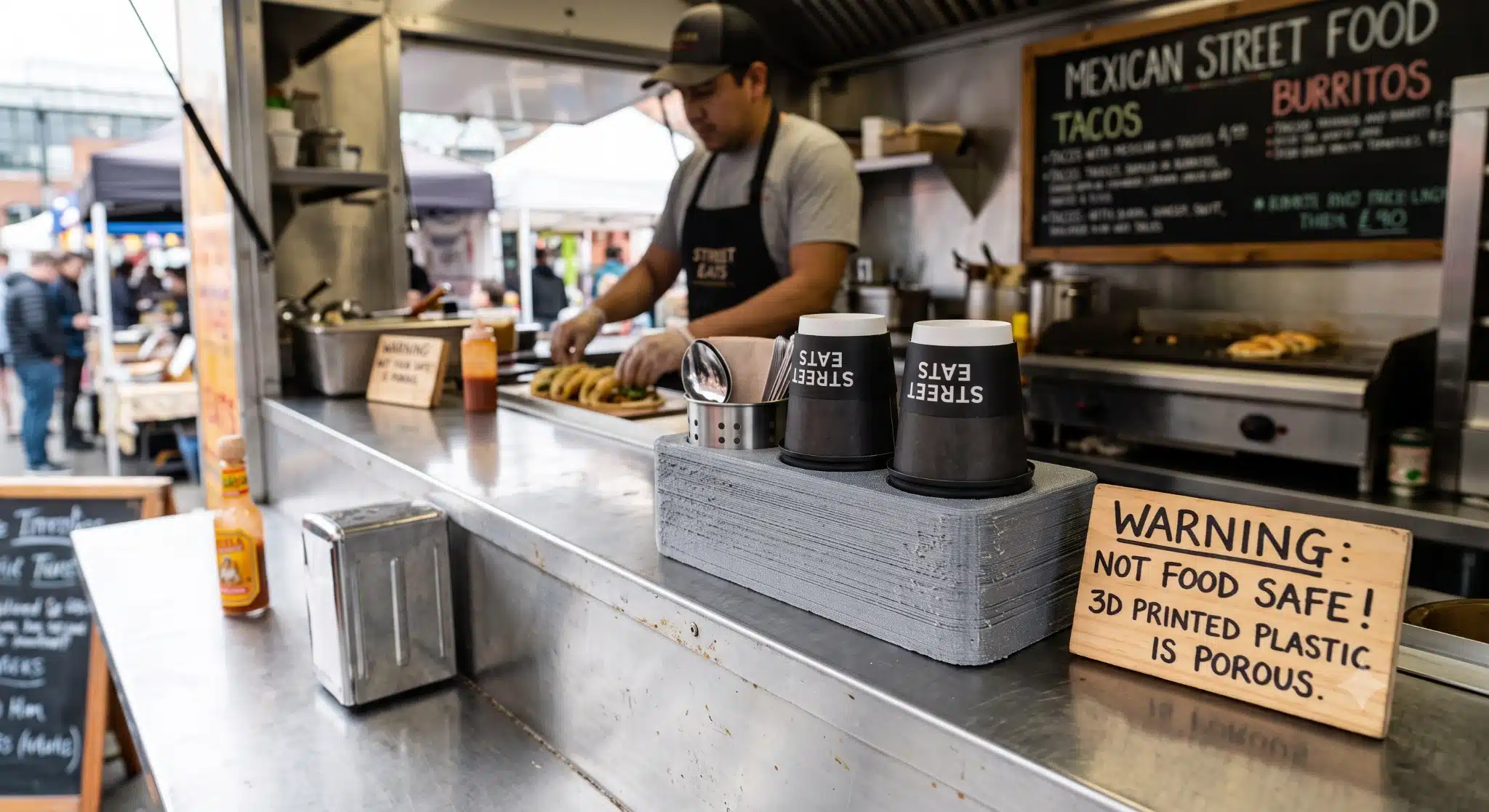
A custom lid adapter. A cup holder that finally fits your window. Maybe a napkin caddy that snaps right onto your prep table. Home 3D printing looks like a gift to a food truck owner. Should any of it touch a customer’s cup, lid, or lips? No. Home-printed FDM parts, PLA, PETG, ABS run through a typical desktop printer, should never serve as food or drink contact surfaces. That includes anything a customer’s mouth touches. The FDA Food Code requires food contact surfaces to be smooth, non-absorbent, and easily cleanable. A printed part cannot honestly meet that standard.
Even the printer makers themselves say so. That is not me being cautious for the sake of it. Prusa, Formlabs, and Stratasys tell their own customers, in writing, to keep printed parts away from food and drink.
Key Takeaways
- Layer lines in FDM printing create microscopic grooves that trap bacteria and cannot be cleaned to the FDA Food Code standard for multiuse food contact surfaces.
- “Food safe filament” is not the same claim as “food safe finished part.” Regulations test raw plastic pellets, not what comes out of a heated nozzle.
- Standard brass nozzles used in most desktop printers can carry trace lead that transfers into the plastic at printing temperature.
- Filament colorants and additives are frequently unverified for food contact, and filament makers themselves say their products are for personal use only, with no certification behind them.
- Anything a customer’s mouth touches, cups, lids, straws, needs commercial food-grade equipment or approved single-service disposables, not a part off your home printer.
Why Food Truck Owners Keep Reaching for the 3D Printer
I understand the appeal. You are standing at the window. A lid does not seat right on this week’s cup order. The supplier cannot get you the right size until Thursday. Somebody on your crew has a printer at home, or a buddy who runs one. Twenty minutes later, you have a part that snaps right into place. It looks clean. It holds its shape. Problem solved, or so it seems.
I have coached enough owners through equipment gaps to know that mindset well. When you are running lean, a $20 spool of filament beats a $200 custom order. A few hours of print time beats a two-week lead time. That logic works fine for a truck bracket, a POS mount, or a sign holder. It falls apart the moment the part touches a customer’s food or drink. The standard you are held to at the window is not “does it look clean.” It is whether that surface meets the same cleanability and material requirements as the stainless equipment next to it. A health inspector who knows layer lines will not treat a printed pan lid the same as an injection-molded one.
The gap here is not laziness. It is marketing. The phrase “food safe filament” makes the leap from raw material to finished part sound smaller than it actually is.
What the Food Code and the Printer Makers Actually Say
Start with the regulation food safety inspectors work from. The FDA Food Code, Section 4-101.11, requires that materials used for multiuse food contact surfaces be safe, durable, corrosion-resistant, and nonabsorbent. They must also be finished to a smooth, easily cleanable surface. That surface must resist pitting, chipping, crazing, scratching, scoring, distortion, and decomposition. Section 4-202.11 goes further. Multiuse food contact surfaces must be smooth, free of breaks, open seams, cracks, chips, and pits. They must also be free of sharp internal angles and crevices where soil can collect. Read that list next to a part fresh off an FDM printer. The mismatch is obvious. Every layer boundary is a seam. Every seam is a place residue and moisture can sit.
Prusa, one of the biggest names in desktop 3D printing, addresses this directly in its own knowledge base. A print itself will never be food grade, the company states plainly. FFF printing produces objects with gaps between layers, and those gaps become a breeding ground for bacteria and fungi that can cause illness. Prusa goes on to say it does not recommend using 3D prints as food containers at all. Even its filaments carrying food-safe pigments have not been put through actual certification testing.
Formlabs, another major player in the space, publishes similar cautions. Its guidance points to particle migration and bacteria buildup as the core risks. It notes that even dip-coating a print in food-grade epoxy or a sealed resin does not guarantee long-term safety. Coatings can degrade with repeated washing, exposing the unsafe surface underneath again.
Stratasys builds industrial 3D printing systems used across manufacturing, and it frames the underlying regulatory issue clearly. Food-grade status applies to a finished part made within a validated, documented workflow, not to a spool of plastic sitting on a shelf. A desktop print run in your back office has no validation and no documentation. It does not meet that bar, no matter what the filament label claims.
Then there is the hardware itself. Most desktop FDM printers use brass nozzles. Brass commonly contains a small percentage of lead to make it easier to machine. At typical printing temperatures, trace amounts of that lead can transfer into the plastic as it passes through the nozzle. Manufacturers who sell genuinely food-contact-rated filament often specify a stainless steel nozzle for exactly this reason. Most owners printing at home are not swapping hardware before they run off a quick part.
The Reframe: Stop Asking If the Plastic Is Approved. Ask If the Part Would Pass the Window Test.
Here is where I think most owners get the question backwards. They search “is PLA food safe” or “is PETG food safe,” find an answer that sounds like yes, and stop there. That is the wrong question. The right question is whether this specific finished part, printed on this specific machine with this specific nozzle and filament, would pass the same scrutiny you apply to any other piece of equipment at your service window.
I call it the Window Test, and it is simple. Would a stainless steel version of this part, or an approved single-service disposable, be the item sitting there instead? If yes, and your printed part is standing in for it temporarily, treat that as a stopgap you fix fast, not a permanent solution. If a health inspector picked up this part and ran a finger across the surface, would they find layer lines they could feel? A “yes” fails the same smoothness standard as a scratched cutting board or a cracked serving spoon. You already know how those conversations go.
Filament companies are not lying when they call a product food safe. They are describing the raw pellet, tested under a specific regulatory framework, before it ever touches your nozzle, your print settings, or your printer’s own history of what else has run through it. What comes out the other end is a different object entirely. It is the object, not the pellet, that has to pass inspection.
What to Actually Do With Your 3D Printer
None of this means put the printer away. It means drawing a hard line around what it is allowed to touch.
Your printer is genuinely useful for brackets, mounts, jigs, drawer organizers, cable clips, and sign holders, and for any part that never contacts food, drink, or a customer’s mouth. Keep using it there. Owners get into trouble when convenience quietly expands that line, one small exception at a time, until a printed lid adapter or a printed scoop ends up sitting on the service counter next to the stainless equipment.
If you have a genuine custom-fit problem, a cup that will not seat with your current lid stock, a scoop shape nothing on the market quite matches, that is a sourcing problem, not a printing problem. Commercial suppliers who manufacture food-contact plastics can produce custom or semi-custom parts backed by a real Certificate of Analysis referencing FDA 21 CFR compliance or NSF/ANSI 51, the standard covering food equipment materials and design. That documentation is what your health inspector wants to see if they ever ask. It is also what protects you if something goes wrong and someone asks how that part was validated.
Before you print or purchase anything for your truck, run it through one more filter. Would you be comfortable explaining this part, in plain language, to your local health inspector, standing at your window? If the honest answer is you would rather they did not notice it, that is your answer already.
Practical Steps
1. Walk your truck this week and list every 3D printed part currently in service. Do not rely on memory. Physically check your prep area, your window, and your storage.
2. Pull anything printed that touches a customer’s mouth, an open beverage, or unpackaged food immediately. Cups, lids, scoops, funnels, straws and wedger holders top that list. Replace with commercial stock today, even if it costs more than the printed version.
3. Reserve your printer for non-food-contact parts only going forward. Brackets, mounts, signage, and organizational pieces are fair game. Write that boundary down so your crew follows it too, not just you.
4. Source custom food-contact parts from a real supplier, not a home printer. Ask specifically for a Certificate of Analysis referencing FDA 21 CFR or NSF/ANSI 51 before you buy.
5. Ask your local health inspector directly, before an inspection, if you are unsure about a specific part. A five-minute phone call beats a citation, admin hearing or shutdown.
6. Add a written rule to your operations checklist: no home-printed parts at the service window. Make it as automatic as your temperature logs.
7. Treat every “food safe” filament claim as a starting point for your own research, not a stopping point. Read the actual datasheet, not just the marketing copy on the spool or ad copy.
Frequently Asked Questions
Is PLA filament food safe?
Pure, uncolored PLA pellets can pass food-contact testing as a raw material, but that says nothing about a finished 3D printed part. Layer lines create grooves bacteria can grow in, and most home printers use nozzles and colorants that were never tested for food contact use.
Can I coat a 3D printed cup or lid to make it food safe?
Food-grade epoxy or resin coatings reduce some risk, but manufacturers like Formlabs note these coatings are often not dishwasher safe and can degrade with washing, eventually exposing the unsafe surface underneath. A coating is not a substitute for approved commercial equipment.
Will a health inspector actually fail me for using a 3D printed part?
A printed part with visible layer lines at a food or drink contact point does not meet the FDA Food Code’s smooth, easily cleanable standard for multiuse equipment. An inspector who recognizes what they are looking at has grounds to cite it, and many now do.
What can I safely 3D print for my food truck?
Anything that never touches food, drink, or a customer’s mouth is fair game: equipment brackets, POS or tablet mounts, cable organizers, drawer dividers, and signage holders. Keep a clear, written boundary so convenience never quietly expands into food contact use.
Do I need NSF/ANSI 51 certification for a custom food-contact part?
If you are sourcing a custom part meant for repeated food or drink contact, look for a supplier who can document compliance with NSF/ANSI 51 or FDA 21 CFR. That paperwork is what protects you with your health department, not a filament spool’s marketing claim.
Print the Bracket, Not the Cup
That vendor with the lid adapter was not careless. He was resourceful, the same way most of us are when a supplier lets us down on a Saturday morning. The fix is not to stop printing. The fix is to know exactly where the line sits, and to keep it there even when convenience is standing right in front of you asking you to move it. Your printer earns its keep holding your tablet steady and your cables tidy. Keep it away from anything your customer puts to their lips. Let the equipment built and certified for that job do what it was actually designed to do.
Keep Learning
- What the FDA’s 2024 Outbreak Report Means for Food Truck Owners: A breakdown of what last year’s federal outbreak data actually means for daily operations at the window.
- Do Pan Liners Solve a Problem or Cover Up Poor Practice?: Another look at a popular shortcut that trades real cleaning practice for something that just looks clean.
- When Cheap Food Trailers Become Expensive Mistakes: Why cutting corners on build quality and materials tends to cost more than it saves.
- Should You Trust an AI Tool You Didn’t Build?: The same verify-before-you-trust principle applied to another tool owners are told will just work.
About the Author
Bill Moore is the Founder and Executive Director of the National Street Food Vendors Association (NSFVA), a trade association dedicated to advocacy, education, and unifying street food vendors nationwide. He has worked in food service since 1977, and his first street food vending was in 1981. Bill hosts the “10-Minute Food Truck Training” podcast, leads NSFVA’s weekly Mini Class and group coaching sessions, and is the author of Food Truck 101: Beginner to Winner and, with Melisa Moore, Food Truck 201: Get Off the Truck!