A separate business account, a chart of accounts built for food service, weekly reconciliation, and owner pay recorded the right way. That’s the whole list.
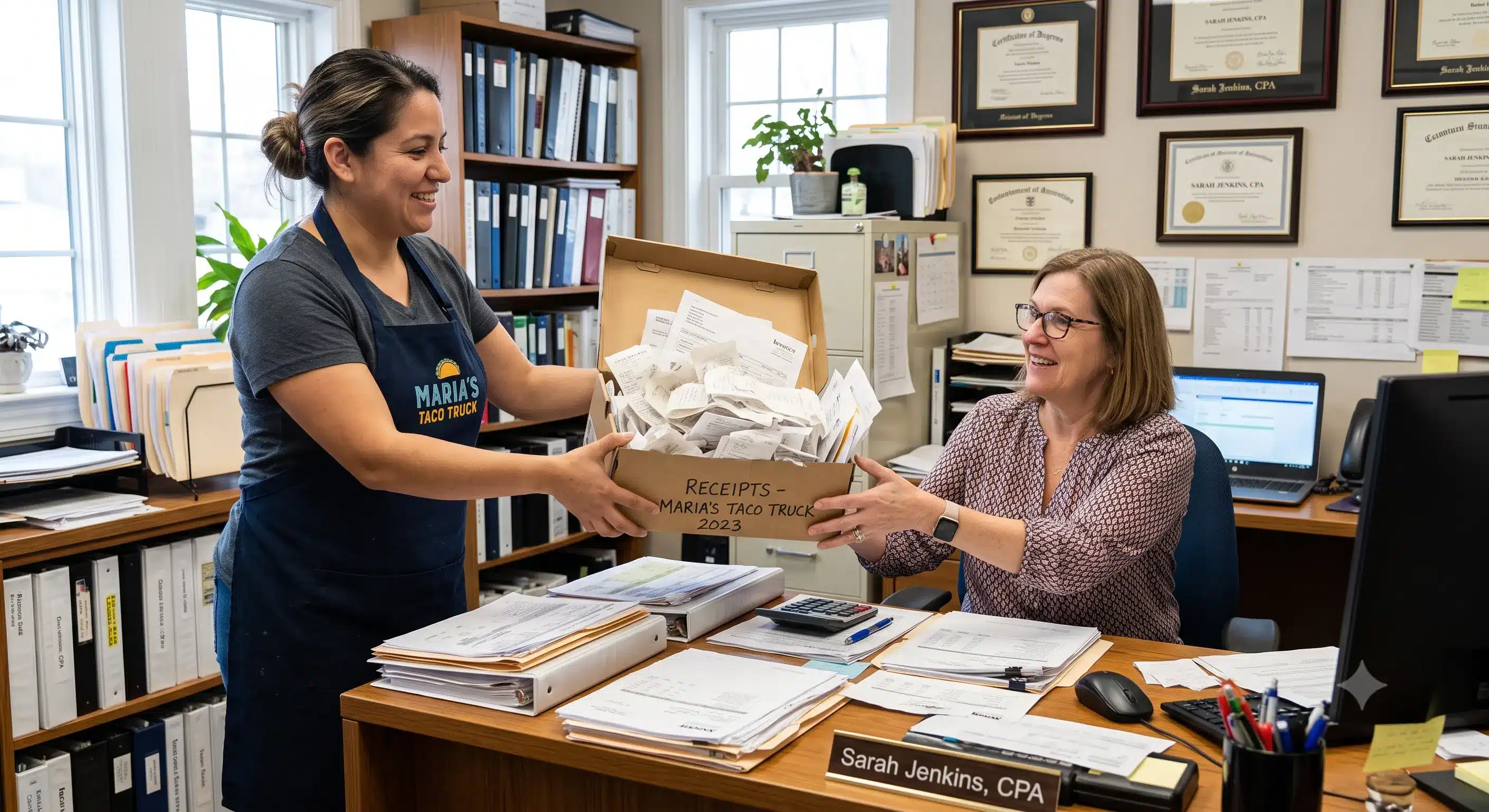
A member sent me her books last month. It was a shoebox of receipts, a Venmo history, and one bank account carrying her grocery runs, her daughter’s soccer fees, and her Sysco orders all in the same feed. She had no idea if she made money last quarter. Not a rough guess. No idea at all.
That is not a bookkeeping problem. That is a business flying blind, and eventually it hits something.
If you’re searching for food truck bookkeeping basics, here is the direct answer before we go any further: separate your business money from your personal money completely, build a chart of accounts that actually matches how a food truck makes and spends money, reconcile your bank feed every single week instead of once a year, and record your own pay as an owner’s draw, not an expense. Do those four things and you’ll know, at any point in the year, whether the truck is actually working. Skip them and you’re guessing, no matter how good the food is.
I’ve watched more trucks go under from bad numbers than from bad cooking. This is the part of the business nobody dreams about when they buy the truck, and it’s the part that decides whether you’re still open in three years.
| Key Takeaways Commingling business and personal money is the single most damaging bookkeeping mistake a food truck owner can make, and if you’re an LLC, it can undo the liability protection you formed the LLC to get. Your chart of accounts needs food cost, food expense, paper and disposables, owner’s draw, and labor as separate lines. A generic retail template will not tell you what you need to know. Reconciling weekly, not annually, is what catches a miscategorized charge while it’s one transaction instead of forty. Owner pay is a planned cost in your breakeven math, but it belongs in equity as a draw, never buried in a wage line that distorts your real food cost and labor percentages. Software is a tool, not the fix. The fix is the habit of sitting down every week and looking at the numbers. |
Why Do Food Truck Owners Put Off Bookkeeping Until It’s a Crisis?
Here’s what happens to almost every new food truck owner: you start out doing everything yourself because you have to, and bookkeeping gets pushed to the bottom of the list every single week. Cooking is urgent. Bookkeeping never feels urgent, right up until tax season, or until you need a loan and your accountant asks for numbers you don’t have.
A cook thinks about tonight’s shift. An operator thinks about knowing, at any moment, whether the business is actually making money. Those are two different jobs, and bookkeeping is squarely the operator’s job. I’ve said this on the podcast more times than I can count: working on the business means you can answer the money question without opening a shoebox.
The single most common mistake I see, and the one that causes the most damage down the road, is commingling. That’s running the truck’s money and your personal money through the same account. It feels harmless when you’re small. It’s how you end up not knowing whether that four hundred dollars on your card was propane or a birthday present. And if you’ve set up as an LLC, mixing funds will actually undo the liability protection that LLC was supposed to give you in the first place.
The fix isn’t complicated. It does require discipline you have to build on purpose, because it will not happen by accident.
What Do the Numbers Say About Owners Who Skip This?
You don’t have to take my word for the stakes here. A widely cited study by banking researcher Jessie Hagen, commissioned through U.S. Bank, found that poor cash flow management contributes to the failure of roughly 82 percent of small businesses that close. Notice what that stat is really saying: it’s rarely a lack of sales that kills the business. It’s not knowing where the money went.
Source: U.S. Chamber of Commerce, “Top Reasons Small Businesses Fail”
Food trucks aren’t exempt from that pattern, and the data specific to our industry backs it up. Estimates on food truck failure vary because the industry doesn’t track it as tightly as brick-and-mortar restaurants do, but multiple industry sources put the first-year failure rate for food trucks in the neighborhood of 60 percent, and poor financial planning shows up again and again as a lead cause. That number should sting a little. It’s not the food that’s failing. It’s the operators who never built the habit of knowing their numbers.
Here’s the part that surprises a lot of members when I bring it up in coaching calls: commingling isn’t just sloppy, it’s a legal liability. Business law firms that specialize in LLC protection are blunt about this. Mixing personal and business finances can cause an LLC to lose its limited liability protection entirely, through a legal doctrine courts call piercing the corporate veil. When that happens, a court can treat your LLC as if it never existed, and your personal home, your personal savings, and your personal retirement accounts become fair game for a business debt or lawsuit. That single-member LLC you formed to protect your family isn’t protecting anyone if your books can’t tell the difference between your business and yourself.
Source: NCH, “The Risks of Mixing Business & Personal Finances”
Put those three data points together and the picture is clear. Cash flow blindness sinks small businesses generally. Food trucks fail at a rate that tracks right along with it. And commingled books don’t just hide the problem, they can strip away the legal protection you thought you had. That’s not a spreadsheet issue. That’s a survival issue.
Why “Food Cost” and “Food Expense” Are Not the Same Line
Here’s where I part ways with a lot of generic small business advice, and it’s the piece nobody else in this space says out loud the same way I do. Most bookkeeping guidance treats “food cost” like a vague catch-all category. I don’t teach it that way, and neither should your books.
First thing to understand is when I say “food cost” I am including paper products that are given to the guest. Not foil wrap around your brisket, that is a supply. Sandwich wraps, napkins, utensils, carry out bags, clamshells, boats, if the guest gets it you count it in with food.
Food cost is percentage math. It’s what your ingredients cost against what you charged for the item, and on your core menu it should be running in the 25 to 28 percent range on mains, not the 35 percent number that gets thrown around in generic restaurant content that was never built for a truck’s margins. Food expense is the dollar total of everything you spent on food and paper in a given month. Those two numbers (food expense and food cost) answer two different questions, and if your chart of accounts blends them into one line, you cannot see either one clearly.
Supplies (soap, bleach, paper towels for cleaning) and disposables (foil to wrap the brisket) get their own line too, separate from food cost entirely. A truck that folds paper towels, soap and foil into “food cost” will always look like it’s running a worse ingredient margin than it actually is, and that leads owners to cut corners on the wrong thing. Get the categories right and the numbers stop lying to you.
How Do You Actually Fix Food Truck Bookkeeping?
This is where the four basics from the top of this article turn into a real system.
Separate accounts, no exceptions.
One business checking account, one business card. Every dollar the truck earns or spends goes through those and nothing else. If you accidentally use the truck’s card for something personal, and it happens, don’t panic. Just record it correctly as an owner’s draw, not a business expense. If you ever pay a business expense out of your personal account, record it as a contribution, not a wash. Never let a transaction sit unrecorded because you’re not sure which bucket it belongs in.
A chart of accounts that matches how a food truck actually makes money.
Most accounting software ships with a one-size-fits-all category list built for a retail shop. That’s not you. You need food cost separated from food expense, supplies and disposables on their own line, and owner’s draw kept separate from wages and from a real payroll line if you have employees. If your chart of accounts can’t answer “what’s my actual food cost percentage on mains this month,” it isn’t built for a food business. It’s just a generic ledger with your logo on it.
Weekly reconciliation, not annual.
This is where owners lose the thread. You don’t need the most expensive software. You need consistency. A true one-person operation with no employees can often get by on a basic tier built for sole proprietors filing a Schedule C, which handles income and expense tracking and mileage at a low monthly cost. Once you’ve got even one employee, or you need real profit-and-loss statements a lender or accountant can actually read, step up to a small-business tier with double-entry accounting and bank reconciliation. Pricing on these shifts, so check current numbers before you commit rather than trusting a figure you heard on a podcast, mine included. Whatever you pick, the software is the tool, not the fix. The fix is sitting down every week, reconciling your bank feed against what’s actually in your account, and catching a miscategorized charge while it’s still one transaction instead of forty.
Owner pay recorded correctly.
If you’re an LLC or sole proprietor, your own pay is an owner’s draw from equity. It is not a business expense, and it should never be categorized as one. Categorizing your own pay as an expense can create real problems at tax time. Owner pay is still a planned cost in your breakeven math. It’s just recorded correctly, not buried in a wage line where it distorts your real profitability.
Your Next Steps This Week
- Open dedicated accounts. If you don’t already have a business checking account and card, open them before your next event. Most banks can get you set up the same day.
- Rebuild your chart of accounts. Pull up your software’s default category list and rebuild it so food cost, food expense, supplies and disposables, owner’s draw, and labor are each their own separate line. Stop running your business through a generic retail template.
- Block a standing weekly appointment. Same thirty minutes, same day every week, and reconcile. Not “when I get to it.” Treat it like a standing supplier order. Best bet is join our weekly coaching that is what they are there for.
- Get professional help for a real cleanup. If your books are already tangled going back months, don’t try to fix a year of commingled transactions alone on a Sunday night. Talk to a bookkeeper or your accountant about a formal cleanup.
- Verify anything an AI tool tells you about your books. Bookkeeping software can categorize transactions automatically, and it gets things wrong more often than owners realize. Always have a real accountant review your setup and your tax treatment.
- Price events with your real food expense in mind, not just food cost percentage. Once your categories are clean, use the real numbers when deciding whether an event fee and expected sales actually make sense.
- Review your chart of accounts every quarter. As you add equipment, staff, or a second truck, your categories need to grow with you.
Frequently Asked Questions
Do I really need a separate business bank account if I’m a small, one-person food truck?
Yes, without exception. Even a true solo operation needs one dedicated business checking account and card. Commingling funds is the single fastest way to lose track of your real numbers, and if you’re an LLC, it puts your personal liability protection at direct risk.
What’s the difference between food cost and food expense?
Food cost is a percentage: what your ingredients actually cost divided by what you charged for the item. This requires a physical count each week. Food expense is the dollar total of everything spent on food in a period. They answer different questions, and blending them into one line hides your real margins. Food cost shows if you waste food or over portion. Food Expense shows the money that left your bank.
How often should I reconcile my food truck’s books?
Weekly, not monthly and definitely not annually. A weekly reconciliation catches a miscategorized charge while it’s one transaction. Waiting until tax season means untangling months of transactions you may not remember clearly.
Should I record my own pay as a business expense?
No. If you’re an LLC or sole proprietor, your pay is an owner’s draw from equity, not an expense. .
Can I trust an AI chatbot to handle my food truck’s bookkeeping categories?
Use AI tools for organization and speed, never for final decisions. AI can miscategorize transactions more often than owners expect. Always have a licensed accountant review your setup, especially anything touching owner pay, LLC structure, or sales tax.
The Bottom Line
Your books aren’t paperwork you deal with in April. They’re the only honest answer to the question “is this thing actually working.” Separate the accounts. Get the categories right. Reconcile every week. None of that is glamorous. All of it is the difference between running a business and guessing at one.
That member with the shoebox? She’s not unusual, and she’s not a bad operator. She’s just been treating bookkeeping like a chore instead of a tool. Fix the four basics above and you’ll never hand anyone a shoebox again.
Bill Moore is the Founder and Executive Director of the National Street Food Vendors Association (NSFVA), a trade association dedicated to advocacy, education, and unifying street food vendors nationwide. He has worked in food service since 1977, and his first street food vending was in 1981. Bill hosts the “10-Minute Food Truck Training” podcast, leads NSFVA’s weekly Mini Class and group coaching sessions, and is the author of Food Truck 101: Beginner to Winner and, with Melisa Moore, Food Truck 201: Get Off the Truck!