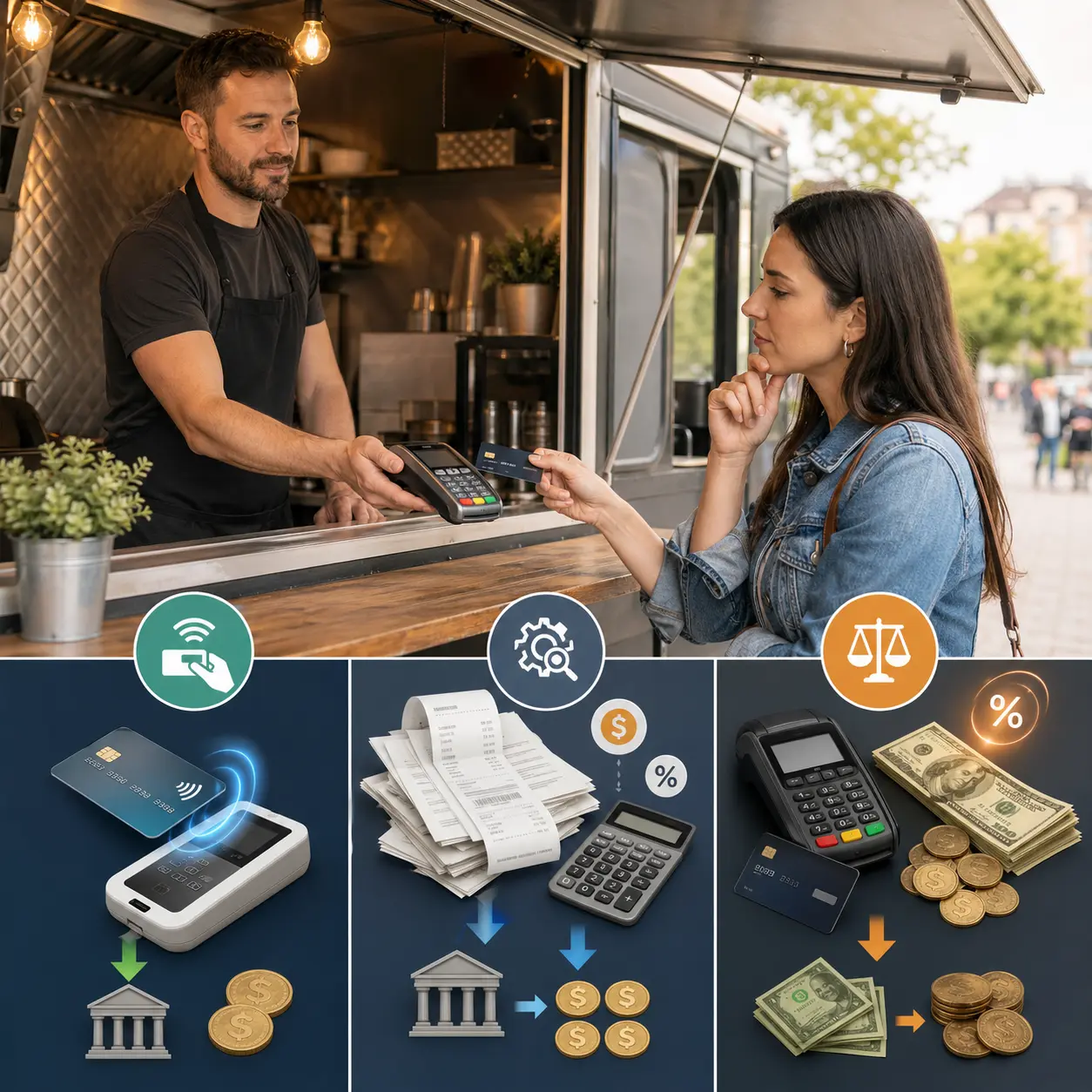
A food truck owner signs up for card processing and thinks the decision is simple.
One company says, “We charge a flat rate.” Another says, “We can save you money with interchange-plus.” A third says, “Stop paying processing fees. Pass them to the customer.”
On paper, all three sound reasonable.
But at the service window, where a guest is deciding whether your prices feel fair, the issue is bigger than the processing rate. It affects your real cost, your checkout experience, your pricing strategy, and the level of trust your guests have in your business.
Food truck owners should not choose a processor based only on the headline rate. You need to understand the full cost, the contract terms, and the way your payment model feels to the person standing at the window.
The Three Common Processing Models
Most food truck owners will run into three common approaches:
- Flat-rate processing, such as Square-style pricing.
- Interchange-plus processing, usually offered by traditional merchant processors.
- Cash discount or surcharge programs, where the guest pays more for using a card or receives a lower price for paying cash.
Each model can work. Each model can also hurt you if you do not understand what is really happening.
Flat-Rate Processing: Simple, Predictable, and Easy to Understand
Flat-rate processing is popular with food trucks for one major reason: it is simple. You usually pay one clear rate for in-person card transactions. You do not need to study interchange categories, card types, network fees, processor markups, or complicated monthly statements. For a new food truck owner, that simplicity has real value.
You are already dealing with permits, commissary rules, menu costing, event booking, equipment problems, labor issues, prep lists, and weather. Having a processor that is easy to understand can keep one more headache off your plate.
With flat-rate processing, the guest sees one clean menu price. They tap, dip, swipe, or insert their card, and the transaction is done. There is no extra conversation at the window about cash discounts, service fees, or card penalties.
That is good for speed. It is good for clarity. It is good for guest experience.
The downside is cost. Flat-rate processing may not always be the cheapest option, especially once your truck starts doing consistent volume. You will be paying the same general rate whether the guest uses a lower-cost debit card or a higher-cost rewards credit card.
That means a flat-rate processor may be convenient, but not the least expensive.
For many beginners, simplicity may be worth it. For a higher-volume truck, it is worth comparing the numbers.
Interchange-Plus Processing: Potential Savings, but Not Automatically a Better Deal
Interchange-plus processing is often presented as the more transparent or professional option. In basic terms, you pay the underlying interchange cost set by the card networks and issuing banks, plus a processor markup.
That markup might look something like:
Interchange + 0.20% + 8¢ per transaction
At first glance, that may look much better than a flat-rate processor. And sometimes it is.
A clean interchange-plus agreement with a fair markup, no long-term contract, no equipment lease, no monthly minimum, and limited extra fees can be a solid option for a food truck doing strong card volume.
But interchange-plus is not automatically a good deal. The danger is that the headline markup does not tell the whole story. You also need to look for fees such as:
- Monthly account fees
- PCI compliance fees
- PCI non-compliance fees
- Statement fees
- Batch fees
- Gateway fees
- Annual fees
- Chargeback fees
- Monthly minimums
- Equipment rental fees
- Long-term terminal leases
- Early termination fees
- Next-day deposit fees
- “Regulatory” or “service” fees
This is where some food truck owners get burned. These are the “hidden” fees buried in your statement. These can be more than the processing fees, effectively doubling your processing expense.
A processor may quote a lower rate than a flat-rate company, but then make the money back through fees around the edges. That can be especially painful for food trucks because sales are often seasonal.
A brick-and-mortar restaurant may process a fairly steady amount every month. A food truck may have a great June, a decent September, and a slow January. Monthly fees, minimums, and equipment leases do not care whether your truck is parked for the winter or rained out for the week.
Before choosing interchange-plus, ask what it costs during a busy month, a slow month, and if you decide to leave how much are you penalized.
Cash Discount and Surcharge Programs: The Guest Experience Problem
The third model is becoming more common among new businesses and cash flow strapped operations: cash discounting or charging the guest a fee for using a card.
From the owner’s side, it sounds attractive. Why should the business absorb the processing fee? Why not pass it to the customer? If margins are tight, why not protect that 3% or 4%?
That logic makes sense on a spreadsheet. But now look at it from the guest’s side.
They walk up to your truck. They read your menu. They decide to buy. They place their order. Then, at the end of the transaction, the screen shows a higher total because they used a card.
To the guest, that feels like they are being charged money to give you money.
That may not be how the processor describes it. It may not be how the owner intends it. But perception matters. And in food trucks, the buying experience already has friction.
Guests may be standing outside. They may be waiting in heat, wind, or rain. There may be a line behind them. They may already be paying inflated event pricing. They may not have seating. They may be juggling kids, drinks, bags, or a short lunch break.
Adding a surprise card fee at checkout makes the transaction feel worse at the exact moment the guest is deciding whether your business feels fair.
That is not just a payment issue. It is a brand issue.
“Cash Discount” vs. “Card Surcharge”: The Wording Matters, but the Feeling Matters More
Some programs are sold as “cash discount” programs. Others are described as “surcharge” programs. The technical difference can matter legally and contractually. Different states, card brands, and processors may have different requirements for how these programs must be structured and disclosed.
But from the guest’s perspective, the wording does not matter much. If the menu says one price and the card screen shows a higher price, guests will simply feel like the price changed at checkout. Commonly called “bait and switch”. That is the problem.
A true cash discount should be clear before the guest orders. The guest should understand the cash price and the card price without having to feel tricked or being corrected at the register like a child fumbling for lunch money with a hole in their pocket.
If the guest finds out only after they pull out their card, you have created friction. A sign might cover the legality but vendors complain about folks not reading the menu so expecting them to read a disclaimer is just folly.
More importantly friction at checkout can cost you more than the fee you tried to recover.
The Debit Card Problem
One of the biggest concerns with cash discount and surcharge models is how they treat debit cards. Many guests are not using premium rewards credit cards. They are using debit cards tied directly to their checking account. A benefit of direct deposit is NOT having to go the bank or ATM, just use the card for direct access to their money at most any merchant.
What matters is debit card processing costs are different from credit card processing costs.
If a program adds the same 3.5% or 4% fee to every non-cash transaction, a debit card user is charged far more than the actual cost associated with that payment type. That is pure profit to the processor based on the sweat of YOUR brow. That is where the practice can start to feel like price gouging to the guest.
The owner says, “I’m just recovering my processing cost.”
The guest thinks, “You are charging me an inflated fee for using my own debit card.”
Those are very different perceptions.
And the guest’s perception is the one that shows up in reviews, repeat visits, word of mouth, and complaints at the window.
Food truck owners need to ask whether their system distinguishes between debit, prepaid, basic credit, and rewards credit cards. They also need to ask whether the program complies with applicable card network rules and state laws. Oh and there is the issue of additional sales taxes. Added fees are subject to sales tax in many states. Are you paying it or is the processor? This is not something to guess at.
If your processor is pushing a one-size-fits-all fee, ask very direct questions before you put that system in front of your guests.
The Price Gouging Perception
Price gouging is a strong phrase, and it should not be thrown around carelessly. But perception matters.
If a guest sees a 4% fee added to a debit card transaction, they will not view that as a legitimate recovery of cost. They view it as an inflated checkout penalty. That becomes especially risky when the fee is not clearly disclosed before ordering.
Food truck owners need to understand the difference between covering costs and creating a negative guest experience.
Guests usually do not know or care about your merchant statement. They do not care about interchange, PCI compliance, batch fees, or gateway fees. They do care about whether the price felt honest.
If the menu says $15 and the screen says something higher because of the payment method, the guest feels misled. Even if the fee is technically allowed and disclaimed, it still feels bad.
That is the part many processors do not talk about. They may sell the program, but your food truck owns the guest relationship. For good or for bad.
Your name is on the menu. Your employee is at the window. Your review page takes the hit.
Why Building Fees Into Menu Pricing Is Cleaner
Sometimes simplest answer is to treat processing as a cost of doing business. You know like propane, gasoline, insurance, permits, and food ingredients.
That does not mean you ignore it. It means you build it into your menu pricing, just like food cost, paper cost, propane, insurance, commissary rent, labor, repairs, event fees, and waste. That is what smart businesses do.
If your burger needs to be $12.50 instead of $12 to protect margin, then price it with confidence.
If your lemonade needs to be $8 because lemons, cups, ice, labor, event fees, insurance, and card processing all have to be covered, then make it $8 and own the price.
Clean pricing builds trust. Surprise fees create doubt.
The guest may not love a higher menu price, but at least they understand the deal before they order.
That is better than letting them make a buying decision and then switching the total when they present a card at checkout.
Questions to Ask Before Choosing a Processing Model
Before you choose between flat-rate processing, interchange-plus, or a cash discount/surcharge program, ask these questions:
For Flat-Rate Processing
- What is the rate for in-person transactions?
- What is the rate for keyed-in transactions?
- What is the rate for online orders or invoices?
- Are there monthly fees?
- Are there chargeback fees?
- How fast are deposits?
- Does the POS system fit how my truck actually operates?
For Interchange-Plus Processing
- What is the exact processor markup?
- Are there monthly fees?
- Are there PCI fees?
- Are there PCI non-compliance fees?
- Are there batch fees?
- Are there statement fees?
- Are there gateway fees?
- Is there a monthly minimum?
- Is equipment purchased, rented, or leased?
- Is there a long-term contract?
- Is there an early termination fee?
- What happens during slow months?
For Cash Discount or Surcharge Programs
- Is this a true cash discount or a surcharge?
- Is the pricing clearly disclosed before the guest orders?
- Does the program apply to debit cards?
- Does the program apply to prepaid cards?
- Does it distinguish debit from credit?
- Does it comply with card network rules?
- Does it comply with state law?
- Who keeps the difference if the collected fee exceeds the actual processing cost?
- Will it slow down the line?
- Will it create complaints at the window?
- Will guests feel nickel-and-dimed?
The Best Choice Depends on Your Truck
There is no single answer for every food truck.
A brand-new food truck may be better off with a simple flat-rate processor because it is easy to understand, easy to set up, and clean for guests.
A higher-volume truck may be able to save money with interchange-plus, but only if the agreement is clean and the owner understands the full fee structure.
A cash discount or surcharge model may reduce direct processing expense, but it can create guest friction, especially if debit cards are treated the same as higher-cost credit cards or if the fee is not clearly disclosed. Hopefully you are not giving this real consideration.
The wrong choice can cost you money. But it can also cost you trust.
Final Thought: Processing Is Not Just a Fee Decision
Credit card processing is not only about the rate.
It is about your menu pricing.
It is about your checkout speed.
It is about guest trust.
It is about slow-season costs.
It is about whether your pricing feels honest.
Food truck owners should stop asking only:
“What is my processing rate?”
The better question is:
“What does this payment model cost me financially, operationally, and reputationally?”
Because saving a few cents on a transaction does not help much if the guest walks away feeling like they were tricked.
Price your food correctly.
Understand your processing costs.
Read the full agreement.
Ask hard questions.
And protect the guest experience at the window.
The goal is not just to process payments cheaper. The goal is to build a food truck business guests trust enough to come back to.