Let’s start with the truth about the food truck industry.
The food truck industry is still one of the best entry points into food service, but that does not make it easy. It makes it accessible. Those are not the same thing.
A lot of people see a truck and think freedom. They see lower startup costs and think “lower risk.” They see a line at a festival and assume profit. That kind of thinking is exactly what gets people in trouble before they ever start.
The opportunity is real. The numbers say so. The U.S. food truck market in 2026 is estimated between roughly $14 billion and $20 billion, with about over 100,000 trucks operating nationwide. Independent operators still dominate the market, but larger brands are also using mobile units for testing and expansion. First thing to understand is our number exceed anything you will research online for two reasons. There are no state wide reports showing legal vending licenses (except Florida) and all sales research never matches the projected totals. Take the oft cited 58,000 trucks times the frequently cited $250K sales average and you get – 14 BILLION in sales not the usual 2 or 4 billion.
We extrapolated the truck potential based on Florida’s population, vendor to restaurant ratio and sheer number of legal license projecting that against the entire US. Which landed us between 130,000 and 149,000 operators. We feel very safe saying “over 100,000”. Our internal research of members of the NSFVA and our Facebook group’s self-proclaimed sales exceeds $400,000 on average so we feel confident being conservative at $250K national annual average.
That should tell you something important.
This is not a fad. But it is also not easy money.
Lower Startup Cost Does Not Mean Lower Standards
One of the biggest reasons people enter this business is simple. A food truck costs far less to launch than a brick-and-mortar restaurant. Food truck startup costs at roughly $75,000 to $250,000, compared with $300,000 to $1.27 million for a traditional location.
That is a big advantage. But too many owners hear “lower cost” and act like that means they can be casual with the math, loose with planning, or sloppy with operations.
No. Lower startup cost is an advantage. It is not permission to wing it.
A truck still needs proper equipment, solid systems, strong branding, correct permitting, and somebody in charge who understands that frantic movement is not the same as progress.
Revenue Looks Good on Paper. Paper Does Not Run a Truck.
Many websites show average annual revenue per truck around $346,000. Monthly revenue often falls between $20,000 and $42,000. Top performers can exceed $492,000 per year. We have trucks doing one and two million annually. Being conservative with a $250,000 average seems prudent without cheerleading.
All that sounds great until you remember one thing. Sales do not automatically equal profit.
How many times have you heard someone say, “We stay busy”? Busy is not a financial statement.
Busy can still be broke. Busy can still be underpriced. Busy can still be bleeding cash through waste, labor, repairs, event fees, and poor menu design. Simple mismanagement by the inexperienced.
The truck can feel profitable because cash is flowing. That does not mean the business is healthy. Often one rainy season can lead to closure.
The Owners Who Win Know Their Cost Structure
This is where the real game is played.
Monthly operating expenses often run between $5,000 and $10,000. Food and paper supplies should land at 25% to 28% of revenue. Fuel averages around $500 to $1,000 per month. Labor for one to two full-time employees can add over $62,000 to $80,000 annually once wages and insurance are included. Vehicle maintenance is also a major expense for many owners.
Sadly many food trucks we examine the books show the food cost 6% to 8% higher than the menu recipes. That means a truck does not need a real disaster to get into trouble it already is.
It has a few weak habits that when repeated long enough spell financial ruin. Such as:
A little over portioning here. A bloated menu there. A few poorly chosen events. A repair that was ignored too long. Too much labor for the sales volume. (this one is huge)
Pricing built on hope instead of math. That is how profit disappears.
This is why owners need to know their numbers first. Not eventually. Not after they get “more established.”
First.
Technology Is Raising the Standard
The industry is getting more digital whether some owners like it or not.
About 74% of customers discover food trucks through social media. Facebook is used heavily to promote daily locations and events. Instagram is still strong for visual selling and menu photos. TikTok continues to grow with younger audiences. To say nothing of a website strong in SEO, GEO and AEO.
That means invisibility is a choice.
If people cannot find you, do not know where you are, and do not get reminded that you exist, your menu quality alone will not save you.
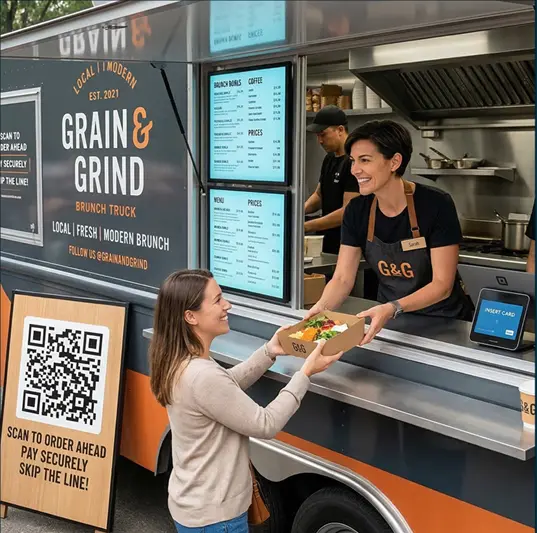
65% of trucks partner with at least one delivery platform, and those platforms can add about 22% or more to total sales. We know of trucks exceeding 50% of sales coming via some online platform or service. QR ordering and mobile apps are becoming normal customer expectations. AI-driven ordering and inventory tools are also being talked about as ways to reduce labor needs and improve margins.
That does not mean every owner needs to chase every shiny tech tool.
It does mean the old excuse of “I’m not good with that stuff” is getting weaker by the day. Essentially one food in the financial grave.
Catering and Events Still Matter, but Not Every Event Is Good
Expect the continued value of events and catering for 2026 with more competition from new folks. Catering for weddings and corporate events can provide ~ 20% revenue boost, and many operators are participating in multiple festivals each year.
That said, owners still need to evaluate events instead of blindly chasing volume. An event is not good because it has a flyer. It is not good because the organizer sounds excited. It is not good because other trucks said yes.
It is good if the crowd is right, the buying power is there, the logistics make sense, the fee is fair, and your truck can execute profitably in that environment. It comes down to your desired profitability goals and will the event attract enough guests to eat your food.
Too many owners still buy into hope instead of evidence.
The Risks Have Not Gone Away
This industry is still full of avoidable mistakes.
The familiar problems such as poor location selection, overcomplicated menus, ignoring customer feedback, underestimating inflation, and getting blindsided by permitting delays are still there. As well as theft, weather damage, and liability claims as ongoing risks. Permitting alone can take on average 30 to 37 business days, which is long enough to stall somebody who thought they were almost ready to launch.
None of this should scare a serious owner. But it should wake them up.
A food truck is not a shortcut around business fundamentals. It is a smaller platform that demands stronger discipline.
A Tax Break Is Helpful, but It Is Not a Business Plan
We do see the return of 100% bonus depreciation for qualifying vehicles over 6,000 pounds placed in service after January 20, 2025. The report also notes Section 179 expensing opportunities for eligible equipment and vehicles. That may help owners who are planning to buy equipment or a vehicle.
But let’s keep this straight.
A tax advantage can improve a buying decision. It does not rescue a bad one.
Buying a truck you cannot operate profitably is still a bad deal even if the write-off looks attractive. That where planning becomes so important.
What 2026 Really Means for Food Truck Owners
So what is the takeaway?
The food truck industry is still growing. The opportunity is still real. There is still room for smart operators to build something meaningful.
But 2026 is rewarding discipline more than enthusiasm.
The owners who will do well are the ones who know their food cost, control labor, simplify the menu, use social media consistently, choose events carefully, and plan for maintenance and setbacks.
That is the real state of the industry.
Not hype. Not fantasy. Not “just get started and figure it out later.”
The truck business still works. But it works best for owners who respect the numbers, respect the process, and stop pretending that motion alone equals progress.
Final Thought
If you are serious about building a profitable food truck business, stop chasing hype and start paying attention to your numbers, your systems, and your guest experience.
The trucks that last are the ones that treat this like a real business from day one.