A lot of food truck owners still think food safety is mostly about passing inspection.
That is not the real issue.
The real issue is whether your systems are strong enough to protect your guests, protect your reputation, and protect your business when a contaminated ingredient enters your truck through no fault of your own.
That is why the FDA’s CORE 2024 Annual Report matters. It is not just a government document. It is a warning label for anyone serving food to the public. FDA says that in calendar year 2024, it evaluated 72 incidents, initiated 26 responses, and issued 10 public health advisories tied to FDA-regulated foods.
The biggest lesson: trouble often starts with the ingredient, not the truck
One of the strongest patterns in the report is where the linked foods came from. Among 2024 responses with identified products linked to illnesses, 55% were vegetables, followed by 20% multi-ingredient foods, with dairy, fruit, eggs, and nuts also represented. The report specifically names foods such as imported and domestic cucumbers, onions, organic carrots, sprouts, basil, raw cheddar cheese, queso fresco, cotija cheese, eggs, walnuts, frozen shakes, shrimp salad, and bagged salad mix.
That ought to get every food truck owner’s attention.
Why? Because many of you use those categories every single week. Lettuce, onions, tomatoes, herbs, cheese, eggs, sauces, cut produce, ready-to-eat toppings, cooled prep items. The danger is not always the finished taco, burger, wrap, or bowl. Sometimes the danger is the ingredient you trusted.
Fresh does not automatically mean safe
A lot of operators market themselves on freshness. Good. You should.
But fresh produce and ready-to-eat ingredients also show up over and over in outbreak investigations. The FDA report highlights a major E. coli outbreak linked to organic carrots, a Listeria outbreak tied to queso fresco and cotija cheese, a Salmonella outbreak tied to basil, and multiple cucumber-related investigations.
That does not mean food truck owners should panic. It means you should stop assuming that “fresh” and “healthy” are the same thing as “low risk.”
They are not.
Traceability is no longer optional thinking
One of the most important parts of the report has nothing to do with gloves, sanitizer buckets, or cooler thermometers. It has to do with traceability.
FDA says CORE+EP played a central role in 2024 in preparing for the Food Traceability Rule, including industry and regulator training, deploying FDA’s internal product tracing system, and conducting outreach. FDA says these efforts are intended to help trace contaminated food through the supply chain faster, identify the source, and remove it from the market before more people get sick.
Food truck owners need to hear this clearly:
If you do not know what you bought, when you bought it, who you bought it from, and where it went, you are behind.
Paperwork is not the enemy. Sloppy records are.
Why this matters to a food truck owner
Some owners still talk about foodborne illness as if it only comes from “dirty kitchens” or careless employees.
That is too simplistic.
FDA explains that its teams evaluate outbreak signals using data that includes inspection history, sampling results, product distribution, and sourcing information, and that coordinated response efforts often identify a specific ingredient or product tied to illnesses.
In other words, your crew can wash hands, wear gloves, and still get blindsided by a contaminated ingredient upstream.
That is why food safety has to be a full operating system, not a collection of good intentions.
The cheese case is a reminder that problems can go on for years
One of the report’s most eye-opening sections covers the Listeria investigation involving queso fresco and cotija cheese. FDA says the case was tied to a historical investigation dating back years, with epidemiologic evidence reaching as far back as 2014. In 2024, inspectors collected environmental samples during an on-site inspection, whole genome sequencing linked those samples to the outbreak strain, and the resulting recall impacted 19 brands. Later, a federal court entered a consent decree of permanent injunction requiring corrective action and FDA approval before operations could resume.
What should a food truck owner take from that?
Simple. Food safety failures can have a very long tail. This stuff does not just “blow over.”
The carrot outbreak proves even simple ingredients can become major problems
The report also highlights the 2024 E. coli outbreak linked to organic carrots. FDA says traceback efforts identified a common supplier, and the investigation led to recalls across 20 different brands. FDA also noted international distribution to places including Canada, Colombia, Hong Kong, and the United Arab Emirates.
Think about what that means.
A basic ingredient. A common ingredient. A healthy ingredient. Still a major problem.
That is exactly why food truck owners cannot afford to get casual about produce sourcing, receiving checks, storage discipline, and recall awareness.
What food truck owners should do right now
This is where the report becomes practical.
Here is the plain-English version of what operators should take from it:
1. Start checking outbreak and recall information regularly
FDA says its Investigation Table is updated weekly and is intended to give early awareness of developing multistate foodborne illness outbreaks.
If you serve the public, this should not be news you hear about three weeks later on Facebook.
2. Tighten up receiving procedures
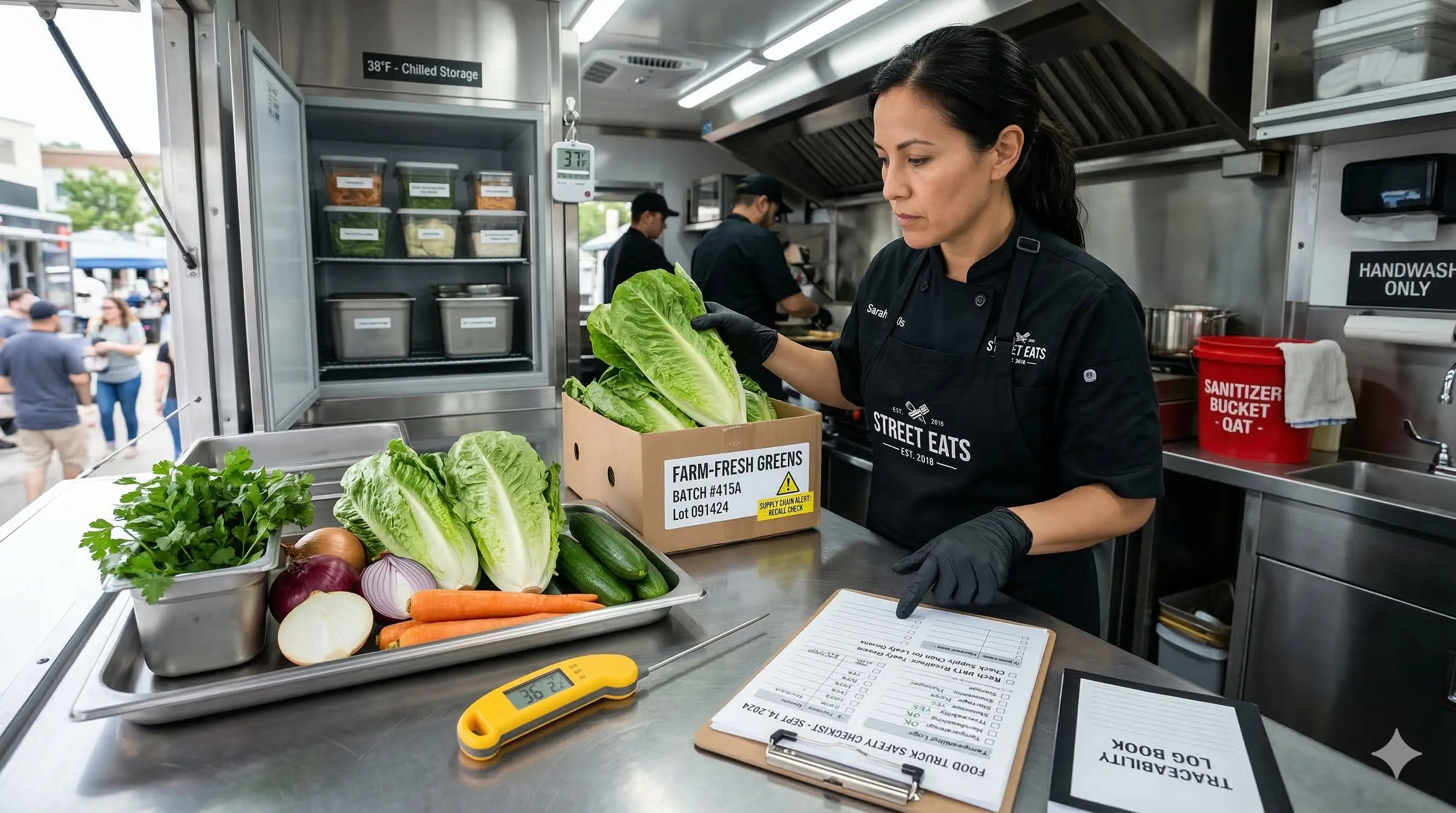
Who is checking produce quality, packaging condition, date coding, supplier information, and temperatures when applicable?
“We got the order” is not a receiving system.
3. Identify your high-risk ingredients
For many trucks, the watch list will include:
- leafy greens
- onions
- tomatoes
- herbs
- cucumbers
- sprouts
- cheeses
- eggs
- sauces
- cooled ready-to-eat prep
That is not paranoia. That is pattern recognition based on what kept showing up in the 2024 report.
4. Improve lot tracking and invoice retention
You may not be a giant chain, but you still need to be able to answer basic questions fast:
- What brand was it?
- Which supplier sold it to us?
- When did it arrive?
- Did we already use it?
- Do we still have any on hand?
5. Train your crew on what happens when an advisory hits
FDA notes that public health advisories are issued when there are specific, actionable steps to protect the public.
That means your team needs to know how to:
- stop using the product
- isolate it
- verify labels and source
- contact the supplier
- document what was pulled and when
6. Stop treating recipes as one unit
The report lists multi-ingredient foods as 20% of identified linked products in 2024.
That matters because owners often think of a menu item as one thing. Food safety does not. Every ingredient has its own risk.
The real business lesson
Food safety is not just compliance.
It is operations.
It is brand protection.
It is guest trust.
It is crisis prevention.
It is profit protection.
Every owner says they want repeat business. Fine. Then build systems that make guests feel safe coming back.
Because one contaminated ingredient, one missed advisory, one sloppy receiving habit, or one undocumented batch can do more damage than a slow week ever will.
Final thought
Read the FDA report like an owner, not like a spectator.
Ask yourself:
Would I know today if one of my core ingredients was under advisory?
Could I trace where my produce came from?
Could I prove what brand I used last week?
Would my staff know what to pull immediately?
Do I have a real system, or just good intentions?
Good intentions do not stop outbreaks.
Systems do.